Magazine
Trading the Spotlight for Spiritual Light: The Journey of Rabbi Rafael Kleinman
A promise and a Shabbat that transformed his life
- Hidabroot
- |Updated
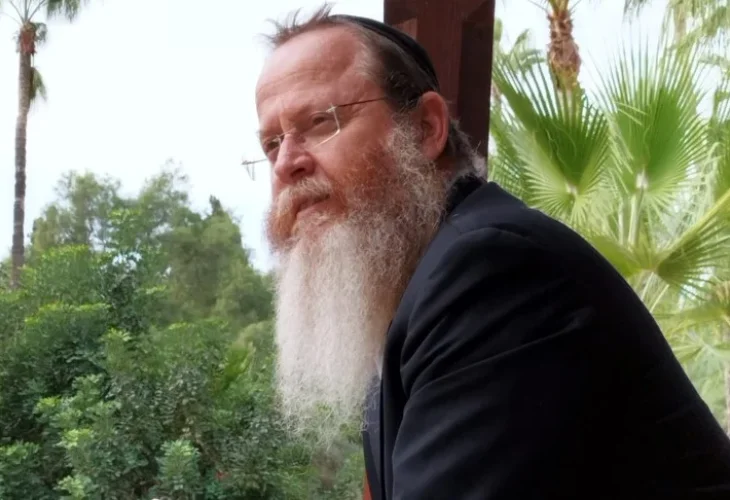 Rabbi Raphael Kleinman
On stage, he looks like someone born into the world of yeshivot: a long, reddish beard and a distinctly rabbinic appearance. But those who know Rabbi Rafael Kleinman today, find it hard to imagine that in his past he was a secular actor, standing on the brink of a major breakthrough in his career in the United States. One promise, and one Shabbat, changed his life from end to end, transforming him into an educator who has been guiding generations of students for 35 years.
Choosing Between Studies and a Tour
Among Rabbi Kleinman’s roles today are serving as head of a Talmud Torah, providing educational counseling and supervision. But his background was entirely different. He grew up in south Tel Aviv, in a family that did not observe Torah and mitzvot.
“We had the simple Israeli tradition: we celebrated the Seder night, fasted on Yom Kippur, and didn’t mix meat and milk. But there was no problem having coffee after schnitzel, for example,” he recalls.
Abu Kabir, the neighborhood where he grew up, was then a transit camp of wooden shacks, “with dirt paths, sour clover, young chickens, and daisies,” he says, and the family lived with the simplicity typical of the city’s south.
The turning point came in middle school. The Tel Aviv municipality decided to integrate children from different parts of the city. “My friends and I moved to study in north Tel Aviv, and there we were exposed to ‘The Big Apple.’ Suddenly we realized there was another world we hadn’t known at all.
“I remember the school taking us to a theater performance — it was a real culture shock for us. Over time, we went through a kind of cultural shift, though we remained conservative and there were things we still didn’t do.
“My own world was developing too. From kindergarten onward I was often cast in leading roles in plays. At the end of middle school, the school counselor told me, ‘I think there’s a school that can nurture your talents.’ She sent me to an arts high school, where I chose the theater track.”
Rabbi Kleinman did not finish high school as a regular student. “The theater attracted me more than my studies. By then I had already joined a troupe that was about to go on a European tour. The school principal summoned me and told me I had to choose: either go on the tour or stay in school. Of course, I chose the performances.” He completed his studies externally.
During his army service, he performed in a military band, and during the Lebanon War he served as the band’s manager. After completing his service, he continued pursuing his career.
“I joined the Chassidic Festival,” he recalls.
A Chassidic festival?
“Yes. There used to be a Chassidic festival in Israel. It wasn’t a religious festival — men and women performed together. I did the choreography and was part of the troupe’s staff. As part of the festival, every year a delegation would go on an intensive tour in Europe and the United States that lasted about two and a half months. After the festival everyone returned to Israel, but it was clear to me that I was staying in the U.S. I stayed in Philadelphia and was accepted into a musical there.”
“Making a Deal with God”
According to Rabbi Kleinman, throughout his journey — and despite not observing Torah and mitzvot, he maintained a unique connection with God.
“I always spoke with the Creator. Already at age nine I went to synagogue, and every Friday night I would make Kiddush by myself. After my bar mitzvah, there were a few months when I prayed the entire service from a siddur at home, and even in the army there was a period when I kept Shabbat.
“It never lasted very long, but I always had a dialogue with God. Once I even made a deal with Him, that if I got accepted for a certain performance, I would start putting on tefillin. I was accepted, and from then on I was careful to put them on.”
At a certain point, he felt he had exhausted Philadelphia. “I told myself I could move on. I went to New York, and there I met someone who had become religious and knew that I put on tefillin. One day he invited me to spend Shabbat in a yeshiva.
“Of course I refused. I was in rehearsals and on the verge of signing a contract. He wouldn’t let go and kept coming back, but I persisted in refusing. I explained to him and to others around me: ‘I know that if I go, I won’t come back — and I don’t want that. I’m standing on the brink of something very big in my career, and I’m not interested in giving it up.’”
That’s a surprising statement. How did you know that one Shabbat would lead you to return to religion?
“I don’t know, but everyone remembers that sentence of mine. It was like a prophecy that slipped out of my mouth. Apparently something inside me already knew the truth. I think God simply gathered my soul and literally redeemed me from the claws of the evil inclination. If I had grown and become famous there, who knows where I would have ended up — and it’s very doubtful I would have returned.”
“Don’t Deal with Me at All”
Despite his refusals, there was one Shabbat when the invitation came at a different time.
“That person who had returned to Judaism called me on Wednesday and said they had saved me a place for Shabbat. I turned to God and said, ‘You know what, Master of the World, I’ll make a deal with You. Two things are scheduled for Shabbat: rehearsals, and a meeting with the director to plan next year’s show. If, for some reason not dependent on me, both of those things are canceled, I’ll come for Shabbat.’
“On Friday at 8:30 in the morning, the phone rang and the director asked if we could postpone our meeting to Monday. At ten o’clock, the choreographer told me, ‘From my perspective, you’re doing your role perfectly — you don’t need to be at rehearsals.’ That’s extremely unusual; you don’t just get released from rehearsals before performances.”
“After those two calls, I told God I wouldn’t break my word and I went for Shabbat. I arrived in a town called Monsey in New York State and met Rabbi Tauber of blessed memory. He seemed to me like a very interesting and wise person, but when he wanted to speak with me, I refused. I said to him, ‘Leave it — I didn’t come for anything. Don’t deal with me at all.’
“But in the end, on Saturday night I asked to meet him. No one understood why, and neither did I. We met at eleven at night, and I left after an hour-long conversation.
“When I returned to my apartment, I called New York and asked to cancel the show, telling them I wasn’t coming back. I also called Philadelphia and informed the director of the same. On Sunday morning, instead of returning to Manhattan, I entered the Ohr Sameach Yeshiva in Monsey and stayed there for several months. Later I returned to Israel, straight to Ohr Sameach in Jerusalem.”
“A Tremendous Fall”
Today, Rabbi Kleinman has many years of experience in education and is also active in the organization “Beyachad,” which supports people who return to Judaism. He says his personal experience — and many cases he encountered along the way, led him to deep insights about the world of baalei teshuvah.
“At the beginning of our path, we really immersed ourselves in the ultra-Orthodox world,” he says. “The goal was full integration into Charedi society. Over the years, you realize it doesn’t work that way. The dilemmas, conflicts, and challenges of someone who became religious are not the same as those of someone raised in that world.”
What were the main challenges in your own return to Judaism?
“One of the hardest things for me was moving from learning in kollel all day to learning only half a day. On one hand, you desperately want to learn and you’re surrounded by Torah constantly. On the other hand, you need to make a living. At the beginning, the dream is to be Rabbi Akiva — and then you realize you won’t be Rabbi Akiva. That’s a tremendous fall.”
Another challenge he mentions is the drop in material standard of living. “For someone who didn’t grow up in poverty, that drop is very difficult. Take the concept of a gemach (interest-free loan fund). I remember the first time I needed a loan from a gemach — I cried so much, even though I knew I would repay it. The feeling was: what do you mean? You can’t manage on your own?
“And on top of that comes the issue of educating children. You arrive in educational frameworks, you say ‘amen’ to everything and are afraid to speak up, worried that if you do, you’ll be thrown out or something will be said about your children. Even when you see things that aren’t right, you don’t dare say anything, because you don’t have family backing in the system.”
Unlike other arenas you mentioned, in education you’re deeply involved. Did you try to change things?
“I tried to create changes in many behavioral patterns within the systems — of course, only with Heavenly assistance. Many years ago I was called to Rabbi Steinman and asked to open a cheder. I was also close to Rabbi Shmuel Auerbach, who guided me and supported my ideas and views. He gave me a lot of strength.
“Later, I ran a cheder and a girls’ seminary in Brazil for 11 years, and afterward I served as the principal of a seminary here in Israel. Everything I did was with the encouragement, strength, and initiative of great Torah leaders who knew exactly who I was. I never hid my life story or pretended to be someone else.”
In what ways did your different background contribute to your educational work?
“The search for truth in everything, without calculations. It requires investment, admitting mistakes, growing from them, knowing there’s always more to do — and above all, constantly asking: is this God’s will or not?
“You know what I was most afraid of as an educator? That I might make a mistake. I work with the children of the Jewish people — for life, for generations, even future generations.”
Did your background in acting find expression in education?
“Absolutely. When I entered education, I realized I could finally use the artistic tools I’d had all my life. I told myself: now I understand why I returned to Judaism — to bring renewal to the world in this way.
“As a teacher, every class was like a play or a performance, with songs and dancing together with the children. It worked wonders. We started learning this way from the very beginning — letters and vowels.”
He notes that awareness of the positive impact of the arts on children and youth is growing. In the past two years, he has been asked, among other things, to produce a performance in a small yeshiva for boys who need a learning style different from the standard yeshiva track. “The boys did everything — built the set, acted, sang, and danced. It was truly a combination of all the senses.”
Alongside all these activities, in recent years you’ve also been engaging with the secular public. Do you have contact with non-religious Israelis?
“First of all, absolutely. My connections with friends from the army, from theater, and from everything I did in the past were never severed. They come to our sukkah, to the Chanukah candle lighting, and to the Purim meal.
“Beyond that natural connection, I recently joined a series of ten meetings called ‘Jerusalem: Many Faces.’ People from different segments of Israeli society — religious and secular, meet and talk. The goal is to have conversations that allow people to get to know each other’s worlds and make concepts accessible.
“In these discussions, you first of all manage to give people a different perspective. I hear participants say, ‘You know what? We didn’t think there were ultra-Orthodox people like you,’ or ‘If only everyone were like you.’ These sentences come up again and again, because people don’t encounter such figures in daily life. Secular Israelis meet the Charedi world through the media, which portrays us in a very unflattering way.”
Isn’t there some risk in this kind of exposure? You’ve already built your identity, but the younger generation that looks up to you hasn’t yet formed a solid worldview. Doesn’t that worry you?
“Many non-religious people say to me: ‘Why are you afraid to send your children to these meetings? If your religion is so fragile, maybe you should examine it.’ There’s an element of ‘know what to answer.’
“Of course, you don’t introduce everyone to everyone at every stage. It’s clear to me that meeting secular people is only for those who already have enough life experience and a solid religious worldview.
“People leave the religious world for many reasons, unfortunately. But in the end, I don’t tell everyone to attend these meetings. Whoever comes needs to have strong tools and armor, and a clear understanding that they are coming on a mission — and emissaries of a mitzvah are not harmed.”
Recently, Rabbi Kleinman staged a play dealing with the dilemmas faced by baalei teshuvah in relation to the second generation — their children.
“The idea is to speak about the conflicts a person deals with and dilemmas that arise when systems don’t quite match his true inner will.
“The question is how you truly manage to direct your life and fulfill your mission in the world. My message is that a person should dare to ask himself the questions that may be hidden inside him, questions he never dared to ask.
“Through the play, I want to give people strength to deal with their difficulties, to dare to speak about things that are hard for them, and above all to search for the path to the best and truest solution. Many times the solution is already inside you — you just need to discover it.”