
Magazine
Turning Tragedy into a Mission: Rabbi Shalom Hammer on Loss, Depression, and Saving Lives
A father’s journey from unbearable grief to purpose, transforming his daughter’s legacy into education, awareness, and real-life rescue for teens in emotional crisis
- Moriah Luz
- |Updated
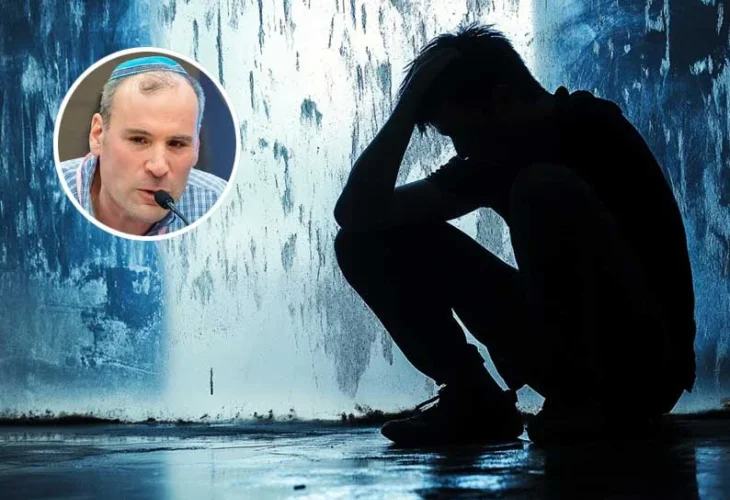 Inset: Rabbi Shalom Hammer
When Rabbi Shalom Hammer’s daughter passed away tragically five and a half years ago, he decided to step away from his previous pursuits — which included teaching classes in the IDF and in yeshivot, as well as running a nonprofit organization. Today, he devotes his time and energy to commemorating his daughter’s good deeds and, above all, to preventing similar tragedies from happening again.
“Why Are You Sitting Alone?”
The Hammer family immigrated to Israel from the United States 35 years ago, and their six children were born here. Gila, of blessed memory, was the fifth. When Rabbi Hammer speaks about her, it’s impossible not to hear the smile in his voice. “Gila was a girl full of joy,” he recalls wistfully. “When she walked into a room, it immediately became brighter. She was warm, social, and very well liked.”
Rabbi Hammer shares that once, during an event, a young woman approached him and asked, “Are you Gila Hammer’s father?” When he answered yes, she told him she knew Gila from high school. When he asked if they had studied together, she explained that she attended a nearby school — but she would never forget the time she was sitting alone in the shared courtyard between the two institutions. Gila came over to her, asked how she was doing, and why she was sitting there alone.
After Gila’s passing, her father published a series of books in her memory, describing the compassion and joy for life that so deeply characterized her.
Alongside her sensitivity to others, Rabbi Hammer adds that his daughter was also energetic and adventurous. With a smile, he recalls that once, during a special Shabbat at her high school, she organized a lively pillow fight — which ended up triggering the fire system and spraying water everywhere.
“Tremendous Pain and a Terrible Sense of Loss”
When Gila was 16, there was a sudden change in her behavior. The transformation was obvious, but despite their efforts, her parents couldn’t understand what had caused it. Only about six months later did Gila gather the courage to share with them a traumatic event she had experienced during the Purim holiday.
“In hindsight, we discovered that about two weeks after the traumatic event, Gila told her counselor — an 18-year-old girl. She asked her not to betray the trust she had placed in her and not to tell anyone. The counselor promised — and kept that promise. She didn’t report it to anyone, not even to us, her parents.
“Today, one of the things I always emphasize in my lectures is that, first of all, there is a legal obligation to report. But beyond the legal requirement, it’s crucial that teenagers understand the consequences of not reporting to responsible authorities, out of a desire not to break a friend’s trust. ‘You’re choosing between breaking trust — or, God forbid, losing your friend,’ I tell them as directly as possible.
“When someone goes through trauma and doesn’t share it or process what they experienced, it can eventually explode,” he says. “Often it shows up as depression and anxiety, and it can deteriorate into something far worse.”
Rabbi Hammer explains that in Gila’s case, the lack of proper treatment for the trauma quickly led to depression, which manifested in various ways — from apathy and avoidance of responsibility to behaviors that had never existed before and were completely uncharacteristic of her. She began isolating herself in a dark room, stopped doing things she loved, became less social, and also connected with peers who were not a healthy influence. She even began using dangerous substances.
“It took Gila time to open up to her sisters, and later to us, about the trauma she had experienced. But even before she told us, we understood that something was wrong and started looking for treatment for her. We sent her to various forms of therapy, but they weren’t what she truly needed. It took time until we found the right treatment for her.”
Tragically, Gila’s condition continued to deteriorate, and at the age of 18 she passed away. “I have no doubt that Gila did not want to die, and I have no doubt that in her final moments she said to herself, ‘Oh no, what have I done?’” he says.
Rabbi Hammer describes the shiva as filled with “tremendous pain and a terrible sense of loss. The thoughts gnaw at you nonstop, like a playback running in your head. It’s impossible to describe the pain. When people say to me, ‘I can only imagine the pain you’re going through,’ I answer them, ‘Thank God — you can’t imagine it.’”
“A Glimmer of Hope”
Despite the immense pain, Rabbi Hammer realized that his life’s journey was now leading him toward a new mission. He founded an organization called “Gila’s Path”, through which he works to raise awareness about proper treatment for depression — both through lectures and through a consultation hotline for family members of those struggling. “We help the patient’s environment make sense of the situation and guide them to the first step they need, because this is a very complex issue.”
What are the most important principles the surrounding family and friends should know?
“First and foremost, it’s critical to understand that most people who pass away tragically do not want to die — they want to live. That’s a crucial point, because it helps those around them realize that there is a way to help.
“A person in deep distress feels like they’re stuck in a dark, deep pit. In those moments, they don’t always remember that it’s possible to cope, to climb out, and that there are other paths,” Rabbi Hammer explains. Unfortunately, he notes, this is more common during adolescence and young adulthood, between ages 16 to 24.
“At younger ages, there’s sometimes an inability to think clearly about ‘tomorrow.’ These young people don’t always realize they’re doing something irreversible. They didn’t want to die — they just didn’t know how to deal with life. If we recognize the signs of distress early enough, give them a glimmer of hope, and show them there’s another option — there’s no doubt we can save lives.”
Through his work, Rabbi Hammer also encounters real, life-saving situations. He describes an emergency call he once received on a Friday evening. A woman who had attended one of his talks called him urgently and told him that her husband was in a critical mental state. Rabbi Hammer didn’t hesitate for a moment and rushed from Beit Shemesh to Jerusalem, to the couple’s home. “Half a year later I met him by chance. He hugged me and said, ‘You saved my life.’”
Recently, Rabbi Hammer received a letter in English from someone who had previously contacted him for guidance. The man’s daughter had been in severe emotional distress, and Rabbi Hammer supported the parents, guided them through the complex situation, and directed them to qualified professionals. “Thank God, the daughter did go to therapy,” he says. “The father wrote that he doesn’t know if I remember him, but he wanted to share that their daughter is on the path to a new life. She’s doing well, received treatment, and is now rebuilding her life.”
Isn’t it difficult for you to deal with this subject again and again?
“Of course it’s challenging. But I have to tell you — don’t we, as Jews, do difficult things? It’s very hard, but we’re talking about saving lives. There are some organizations working in this field, but we need many more people to help fight this battle. It really is a battle, and there is no value more important or stronger than the value of life and the will to live.
“I always tell people not to think I’m some kind of saint,” he concludes. “I’m not doing this only to help others. It’s also therapeutic for me — and it keeps me connected to our Gila.”

