
Jewish Law
The Science of Kosher Fish: How the Torah Predicted a Biological Truth Thousands of Years Ago
Explore how ancient Torah wisdom anticipated a fact no scientist has ever disproven, revealing the timeless harmony between faith, biology, and the Creator’s design
 (Photo: shutterstock)
The Torah provides not only spiritual guidance but also practical direction for living a balanced and elevated life — including what we eat. Since food nourishes both body and soul, the Torah outlines which foods are suitable for the unique spiritual nature of the Jewish people.
When it comes to sea creatures, the Torah defines which are permitted for consumption: “These you may eat of all that are in the waters: whatever has fins and scales in the waters, in the seas and in the rivers — them you may eat.” (Vayikra 11:9)
The Torah establishes two identifying signs for kosher fish: fins and scales.
The Statistical Expectation — and the Torah’s Astonishing Declaration
From a scientific or statistical standpoint, all marine creatures could theoretically be divided into four categories:
Fish with both fins and scales.
Fish with neither fins nor scales.
Fish with fins but no scales.
Fish with scales but no fins.
Logically, each category should account for roughly 25% of all aquatic species. However, the Oral Torah — in the Talmud, Tractate Chullin (66b) — makes a breathtaking statement: “Any fish that has scales also has fins, but some have fins and no scales. If it has both — it is kosher. If it has fins and no scales — it is not kosher.”
The Talmud categorically rules out the existence of any fish that has scales but no fins. This is an extraordinary claim — one that seems to defy statistical logic and could, in theory, be tested by science.
Even more remarkably, the Torah reverses the logical order in the verse, mentioning fins before scales. The Sages explain that if the verse had listed “scales” first, there would have been no need to mention “fins” at all — since, by Divine definition, any fish with scales must necessarily have fins.
How Could the Torah Make Such a Scientific Statement?
The Torah was given in the wilderness over 3,300 years ago — long before the age of microscopes, submarines, or global oceanography. How could the Torah assert a biological statement so absolute, one that could be empirically tested — and potentially disproven?
Even if the author had somehow examined every body of water known at the time — rivers, seas, and oceans, how could He guarantee that no mutation or new species would ever emerge in the future that contradicted this rule?
The answer lies in the identity of the Author: The One who gave the Torah is the Creator of the world Himself. Only the Creator, who formed every living thing and governs nature from beginning to end, could make such an unbreakable statement — and ensure that it remains true for all time.
The Halachic Implication: Trusting Divine Knowledge
Because of this Divine assurance, the Jewish people have relied on this biological principle for millennia — and it is recorded as law in the Shulchan Aruch (Yoreh De’ah 83:3): “Any fish that has scales also has fins. Some have fins but no scales. Therefore, if one finds a piece of fish that has scales, there is no need to check for fins.
But if it has fins and no scales, it may not be eaten.”
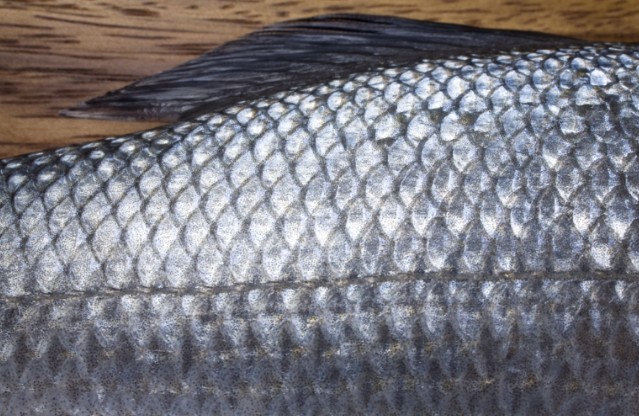
In practical terms, this means that the presence of scales alone is sufficient to determine a fish’s kashrut — because the Torah guarantees that no scaled fish exists without fins.
 (Photo: shutterstock)
Modern Science Confirms the Torah’s Words
Marine biologists have explored the world’s oceans for centuries, investing billions in research. Despite the discovery of thousands of new species — from the shallow coral reefs to the deepest ocean trenches, not one single species has ever been found that has scales but lacks fins.
And according to the Torah, none ever will.
Why Mention Both Signs in the Torah?
If scales alone guarantee the presence of fins, why did the Torah mention both? The Talmud (Chullin 66b) raises this very question and answers succinctly: “To magnify the Torah and make it glorious.”
By stating both signs in the Written Torah and revealing through the Oral Torah that only one is necessary, the Torah demonstrates the depth of its Divine wisdom and the harmony between its two dimensions — written and oral.
Faith, Science, and the Infinite Wisdom of Creation
This is yet another example of the Torah’s superhuman precision — knowledge that transcends time, culture, and scientific discovery. The Creator of the universe embedded eternal truths within His Torah, that continue to astonish even the most advanced scientific minds.
Through these revelations, God reminds His people — the descendants of Avraham, Yitzchak and Yaakov, that there is none beside Him.
May we continue to strengthen our faith, deepen our understanding, and merit the day of ultimate redemption: the rebuilding of the Holy Temple, the coming of the righteous Mashiach, and the return of Divine Presence to the world — speedily and forever. Amen.

