
Faith
“Bring Them Home”: The Heartbreaking Journey of Ditza Or, Mother of Hostage Avinatan
A powerful story of resilience, trust, and inner warfare
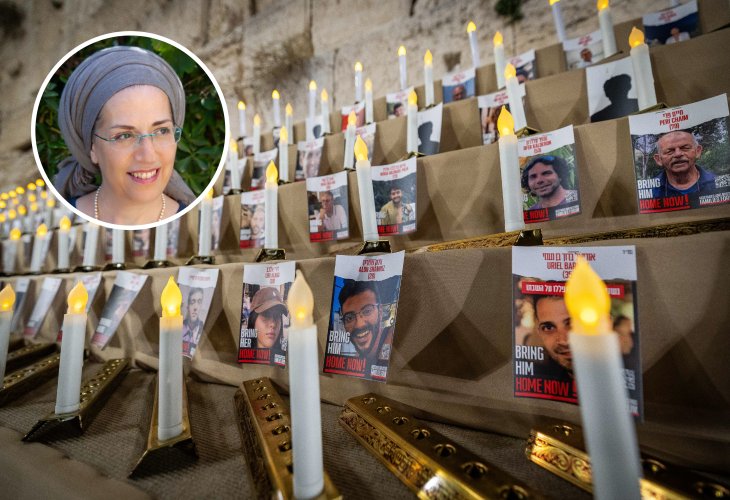 (Photo: Yonatan Sindel/Flash90)
At the entrance to Ditza Or’s home, a row of blooming flowerpots welcomes visitors. In the green yard, a large swing faces the pastoral landscape of the Shiloh Valley. Everything looks serene — except for one jarring detail: a large sign peeking out from the trunk of the car parked in the driveway. On it is the photo of her kidnapped son, Avinatan, alongside the heartbreaking and familiar message: “Bring them home.”
“Avinatan is a wonderful and brilliant young man — generous, kind-hearted, funny, and loved by everyone,” Ditza begins. “He’s not someone who makes a lot of noise, but at the right moment he knows how to deliver one sharp sentence that leaves everyone laughing. He’s an electronics engineer, and in his spare time he volunteered with oncology patients — children. He loved telling them stories, laughing with them, playing with them. A person full of life, surrounded by friends. And he knows how to cook and bake — not just simple things, but truly impressive dishes.”
On the morning of Simchat Torah, a video was released showing Avinatan being led on foot into Gaza, held captive by a group of terrorists. His girlfriend, Noa Argamani, appears in the same clip — crying out for help as she is forced onto a motorcycle and kidnapped beside him. From that moment on, life turned upside down.
For Ditza — a mother of seven, a grandmother, and a professional specializing in emotional counseling and the study of Jewish psychology, ordinary days became a distant concept. A new, unbearable routine took over.
What are you going through these days?
“The emotions change from day to day, depending on what happens and what arises within me. Every morning until about 11 a.m., I give space to the hard emotions. During those hours, my psychological ‘muscles’ and defense mechanisms are still soft. I allow the pain and fear to bubble up. This has been my reality for a long time now. It became the routine.”
She recites Psalm 31 daily — the chapter associated with her son according to Chabad custom. “It’s so precise it shakes me. It begins and ends with verses of faith and trust, but the middle describes captivity: ‘They conspired together against me to take my life’, ‘You have not handed me over to the enemy.’
“Whenever I say Tehillim for someone, I imagine entering their inner world and speaking from their voice. It hurts to say this chapter as if I’m speaking from inside Avinatan. And yet, I feel these words strengthen him.”
Setting Emotional Boundaries to Survive
After 11 a.m., Ditza “closes the gate.” “For the rest of the day, I work on emotional fortitude — keeping out ‘terrorist intrusions’ into my consciousness. Pain must have space; otherwise, repression will explode destructively. But not all day. Only at ‘designated times,’ as taught in Tanya. I choose when to meet the weakness. When it ambushes me suddenly, I push it away and guard the borders of my mind.
“It’s not easy — nothing is easy now, but this is what keeps me from drowning.”
Faith vs. Trust: Two Opposites Within the Soul
“In my worldview, this touches on the difference between emunah (faith) and bitachon (trust). They seem similar, but in Jewish psychology they are opposites.
Faith is saying — as Rabbi Akiva said: ‘Everything God does is for the good’, even when it looks terrible. It’s saying ‘No evil descends from above’ even when we cannot see the good.
Rabbi Levi Yitzchak of Berditchev said, ‘If it’s good, it’s You; if it’s bad, it’s still You — and if it’s You, then it’s good.’ That is faith — transcendent, beyond logic.”
Trust, she explains, is different. “Trust belongs to the lower realms — where we live in this world. It’s wanting to feel goodness here, in visible, tangible ways. Sweet goodness, like we say in the blessing for a ‘good and sweet year.’ Chabad teaches that trust is a commandment — and if we are commanded, it means we can do it.
“So I work on it. I choose to imagine a victory picture that is vivid, strong, and joyful. I picture Avinatan returning healthy, happy, victorious. And I imagine that this, too, becomes a great sanctification of God’s name.”
Acting from Strength Instead of Fear
“When you approach reality from below — from fear and defeatism, everything looks huge and frightening. But when you come from a deep inner place, aligned with the idea that we are here to bring divine presence into the world, and we have infinite support from above, then you can act far more effectively.”
She uses a simple metaphor: “When you’re hiking and unsure of the path, the best thing to do is climb to a high point and look from above. You can’t navigate from inside a pit of despair. Acting from hysteria often leads to the opposite of what’s good for you.
“Climbing the mountain means rising into trust that God is with us, that we will win, that it will be good — and then choosing the next step with clarity.”
Balancing Human Action and Spiritual Perspective
“My whole worldview relies on distinguishing between two layers:
Our natural human efforts, in the visible world.
The divine layer, where God runs the world with precise providence.
“These two layers coexist. Within me, they meet as what the Baal Shem Tov called ‘energetic urgency with inner calm.’
“I act with strength, doing whatever I can with the tools I have. But I also hold a place inside that knows: the one determining the fate of the hostages and the people of Israel is not the prime minister, not the cabinet, not Biden. It is God.
“That inner calm comes from knowing we are in good hands.”
The Hope Forum and Its Vision for Israel
“The Hope Forum works from deep concern for Israel’s security — now and for generations. Our premise is that the good of the hostages and the good of the nation are intertwined.
“A correct and principled stance toward Hamas, in our view, is what will ultimately promote the release of the hostages. When Hamas is crushed, they will beg us to take our captives back and leave them alone.”
Is there something you want people to do for the hostages, especially for Avinatan?
“To strengthen faith and trust — with emphasis on trust. One cannot exist without the other. Trust means creating a certain picture of goodness using imagination as a spiritual tool.
“I picture Avinatan returning upright and joyful. And even if we must wait longer, I picture him strong, healthy, full of vitality. I hold a victory picture for every moment we must endure.”
She adds: “The holy books say that thought creates reality. The Tzemach Tzedek said, ‘Think good and it will be good.’ This is work — engage all the senses. See it. Hear it. Feel it physically. Make the victory real in your mind.
“I invite anyone who can to dedicate a few minutes each day to imagining the good that awaits us. I even put on a joyful Chabad melody during this time — often the Rosh Chodesh Kislev tune, which feels like a victory march.”
What She Would Tell Avinatan If She Could
First — that God is with him, watching over him, and will bring him home healthy, whole, joyful, victorious — and hopefully very soon.
Second — that no one can touch his inner soul. Even in captivity, even under the control of evil, his soul is always free, strong, and untouched. That inner freedom will give him the strength to come home.”
A Mother’s Final Reflection
As the interviewer prepares to leave, she looks around the home where Avinatan grew up — the warmth, the spirit, the quiet strength embedded in its walls. She asks Ditza: Do you think that now, where he is, he knows these things?
Ditza pauses, thinking for a moment. She nods gently, somewhere between certainty and hope.

