
Magazine
Surviving, Rebuilding, and Refusing to Give Up — The Inspiring Story of Noam Weinberg
After a devastating childhood car accident, Noam fought his way back through rehabilitation, yeshiva studies, IDF service, and a powerful commitment to perseverance
- Moriah Luz
- |Updated
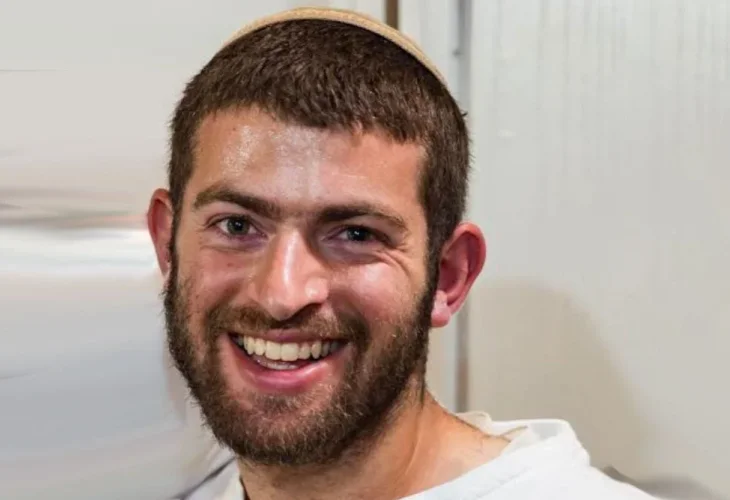 Noam Weinberg
Noam Weinberg, 24, began his life as a completely regular child. He loved ball games and used to visit the neighborhood library. At age 12, during the summer vacation between sixth and seventh grade, his life turned upside down in a single moment.
“We were all driving together, the whole family, from Ashkelon toward Modi’in in the family Toyota. It was a nine-seater vehicle, and all the seats had shoulder belts except for one, which only had a lap belt – the seat I was sitting in.”
Screaming in Order to Heal
The Weinberg family slowed down in order to turn left into the community of Ganei Tal. A car driving fast on the road didn’t notice that they had slowed down and slammed forcefully into their vehicle. From the intensity of the hit, their car spun several times, and all the passengers were violently thrown forward and backward.
The shoulder belts absorbed most of the impact, but Noam’s body, strapped only with a lap belt, was not sufficiently protected, and he was seriously injured. Noam notes that he was the only one in the family who was hurt to such a degree.
“A few years ago I gathered the courage to ask my father if my condition had been considered life-threatening. My father confirmed that it was. For two months after the accident I was ventilated and sedated. After two months I began to show slight signs of waking up, what in medical language is called ‘clouded consciousness.’
“Some more time passed until I opened my eyes, and later I managed to move my head and signal yes and no. My first clear memory of being fully conscious in the hospital is from around Chanukah, about five months after the accident.”
One of the major challenges for Noam was the damage to his vocal cords, which was only discovered after he regained consciousness.
“When I woke up, I tried to speak but couldn’t. After a while I managed to produce words, but very poorly. We went for an examination, and there they discovered that my vocal cords were paralyzed, so my speech was coming from the throat.
“The doctor we saw explained that the more I speak, the more improvement I’ll see in the quality of my speech. And in fact, today my speech is much better than it used to be. Part of that is also thanks to the high school yeshiva where I studied,” Noam says, surprisingly. “In the beit midrash, many students learned out loud, and so that they’d hear me, I had to shout. That’s how I learned Torah — and ‘along the way’ my speech improved.”
“You’re In”
Several months after waking up, Noam returned home and continued with day rehabilitation.
“During the week I would travel every day to the hospital, and on Fridays my father would take me to the Talmud Torah (elementary religious school). Later, the number of days I needed to go to rehab gradually decreased.”
He shares that in the beginning, his situation was really not easy: “In the first two years after the accident, I had to be fed with a spoon because of the damage to the muscles in my arms. Even today it’s not simple for me, but after a lot of practice I manage to feed myself.”
The period of day hospitalization was not easy at all for him. He says that every day he would return from rehab around noon and then had to stay at home until evening, so he was extremely bored.
A moving moment that he remembers — one that gave him a lot of strength and hope during that difficult time, happened on Chanukah after his injury. His brother, two years older than him, was having a Chanukah party at Yeshivat Neve in the south of Israel.
In honor of the party, a special effort was made to include Noam and bring him, in his wheelchair.
“The Rosh Yeshiva, Rabbi Asaf Nemburg, ‘picked up on’ me and came over to say hello. He asked me: ‘So, in about a year and a half, when you’ll be the right age, would you like to come learn here?’ I answered immediately: ‘Of course.’ He smiled and said: ‘In that case, you’re in.’
“From that moment, I had something to look forward to. I knew that in a few months I’d enter a new yeshiva and meet friends. It also helped me focus and learn as much as I could, because I wanted to prove myself in the new place I’d be joining.”
How was the integration into the new yeshiva?
“The guys at Yeshivat Neve are really good guys,” Noam says warmly. “Socially, I had a really good time there.
“Until I came to the yeshiva, I lived at home and needed constant help from my family. When I arrived at the yeshiva, my older brother, who was learning there, was the one who helped me. He would come every morning and help me get dressed, put on my tefillin and feed me. He really took full responsibility for me.
“After two years my brother finished yeshiva and moved on, and I stayed there without him. I told myself that now was my chance to develop independence — and that’s what I did, and I really succeeded. At the same time, the friends who were with me already knew me well enough, knew what I needed help with, and made sure to offer it.”
Noam notes that his cognitive abilities were not affected by the accident. Four years later he finished his high school yeshiva studies with a full matriculation certificate, except for mathematics, from which he received a special exemption from the Ministry of Education due to the circumstances.
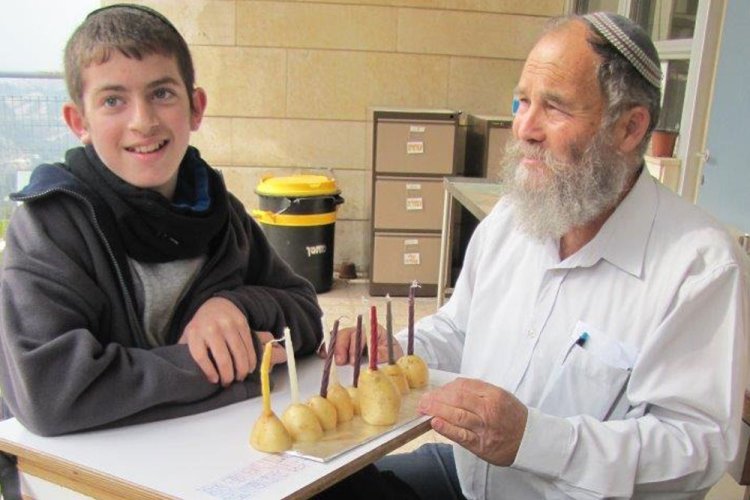 עם סבו, בשיקום
“Forget It, This Isn’t for You”
“When I finished the high school yeshiva, I was debating which yeshiva to continue to. I had two options: the yeshiva my older brother went to, or another yeshiva. I decided that in order to develop independence, I needed to choose the yeshiva where I’d be forced to be as independent as possible — and I chose the second option.”
Noam went to study at the hesder yeshiva in Elon Moreh, in the Shomron.
“The beginning wasn’t easy,” he says, “but the guys there are very good, and I integrated well. Yeshivat Elon Moreh is a hesder yeshiva, which combines Torah study with army service, and at the end of second or third year, the whole class drafts together.
“All my life it was clear to me that I’m like everyone else, and when I reached that stage I also wanted to enlist, just like my friends. It wasn’t simple from a bureaucratic standpoint, and for an entire year I pushed and spoke to everyone I needed to. After a year I got a summons for my first draft evaluation.”
When Noam arrived at the induction center, the military doctor saw him and tried to cool his enthusiasm.
“She told me: ‘Look, you’re insisting on something that isn’t for you. I’m writing that you can enlist on condition that you live at home and do day-service only (going home every day).’
“I saw in my mind how all the efforts I’d invested until that point were erased in a second,” he says. “I didn’t give up. I refused to accept it. In the end, I won — she approved that I could also serve in places that don’t allow sleeping at home.”
Like Everyone Else
Noam enlisted in an intelligence role at the Palmachim base, near Rishon LeZion. For four months he studied and trained for the position, and along the way received compliments from senior officers for his unique personality, willpower, and persistence.
“After four months I was suddenly informed there had been a misunderstanding and that there was no position for me there. I had to leave the base.”
He returned to the yeshiva — but did not give up. He refused to be discharged from the army and continued to check and push for another placement.
“After half a year, my efforts paid off and I was accepted to Northern Command, where I served for a year and two months. I was discharged a few weeks before the ‘Iron Swords’ war broke out.”
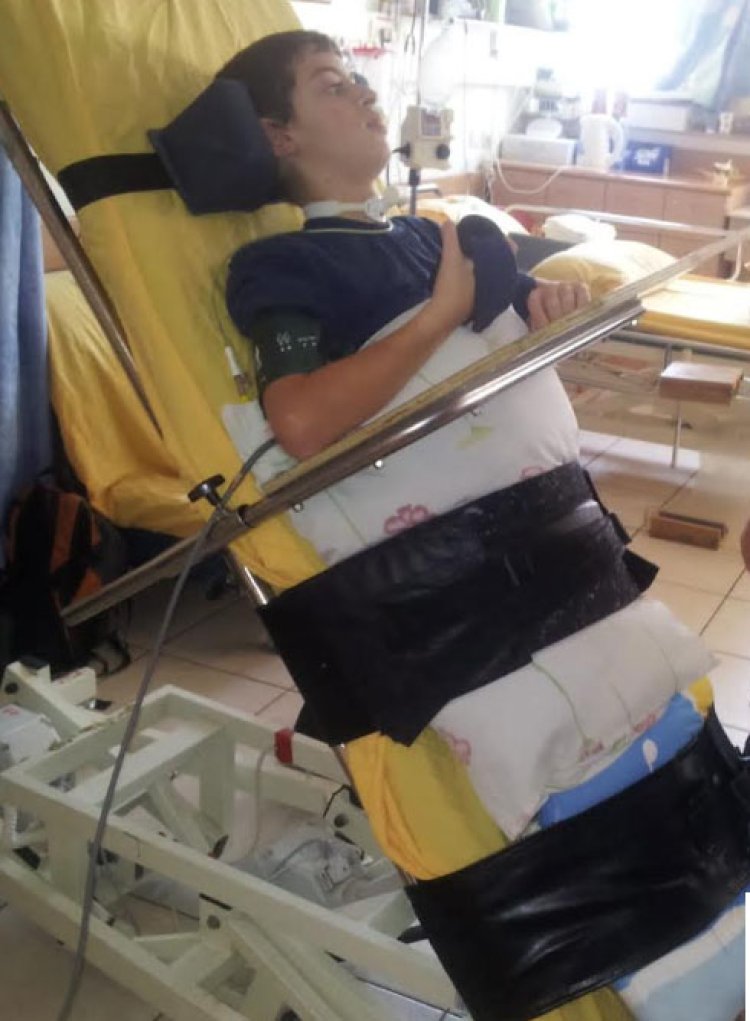 בבית החולים
Where did you find the strength to insist on independence and face all these challenges?
“From the day I woke up in the hospital, my father kept repeating to me that I am like everyone else, that I must behave accordingly, and that I must not sink into self-pity. It was so important to him to instill this in how he raised me that we don’t even have a disabled parking tag on our car.
“As a child I would complain about my father’s approach,” Noam shares. “I didn’t understand, for example, why I had to walk more on foot just because of this insistence.
“Today I look back at the education I received from my father with admiration. I know that thanks to that spirit, I got much further, and I understand how meaningful it was.”
“I define myself as a regular person with a few difficulties, and I actually have a strong aversion to the word ‘disabled.’ Not long ago a friend wrote me something beautiful on the subject. Among other things, he wrote that it’s a mistake to call ‘disabled’ a person for whom basic actions are hard, but who still makes the effort to do them. A person like that is a hero. ‘Disabled’ is someone who does negative things.”
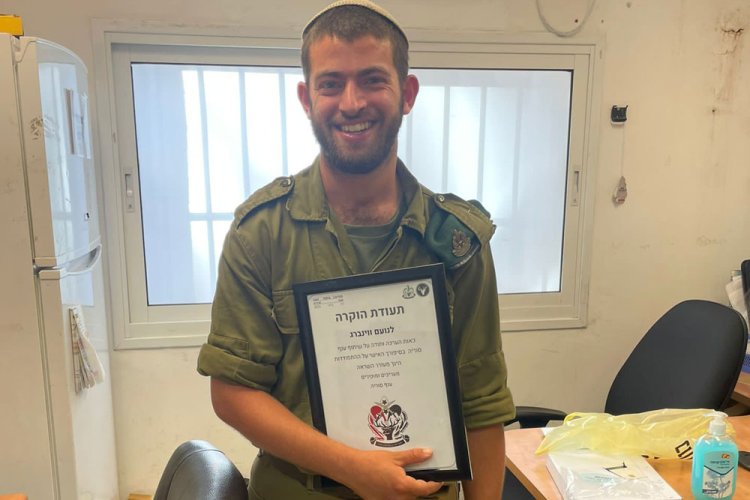 במהלך שרותו הצבאי
“Giving Up Won’t Help”
Weinberg shares another important insight that became another anchor of strength for him.
“I realized that if I give up on myself and stop insisting on making an effort, it will only be harder for me. I’ll give you an example: when I started ninth grade at Yeshivat Neve, I used to go to an excellent physical therapist. At one of the first sessions she gave me a few exercises to improve my hand function, and emphasized that I must do them slowly: ‘If you do them quickly, the brain won’t have time to register the change we’re aiming for.’
“Despite her warning, I really wanted my hand to recover as fast as possible, and instead of doing the exercises slowly, I invested, on average, about an hour every day. After two years of daily practice I saw she’d been right — and there was almost no noticeable improvement.
“It was very discouraging, and I could easily have fallen into that despair. But I told myself: ‘What good will it do me to give up? I’ll stay exactly where I am if I fall into that. If I want to move forward, it’s worth making the effort and continuing.’”
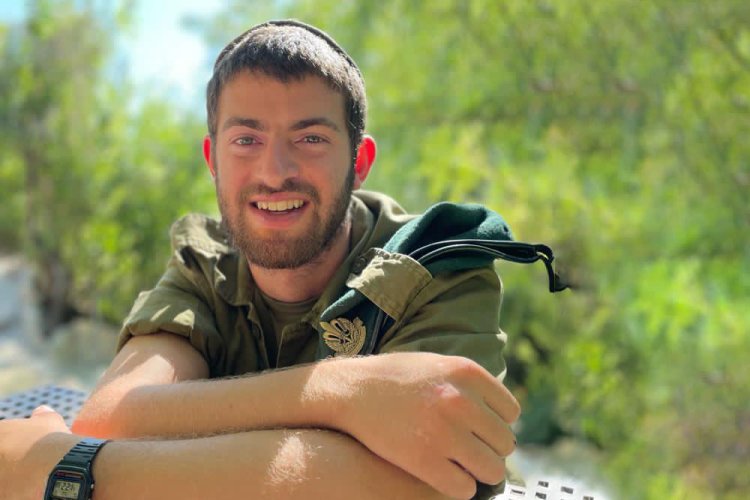 בעת שרותו הצבאי
Do you feel there are character traits you developed specifically because of what you went through?
“I think that because of my experiences I learned more to listen and to greet others with warmth. In the army, for example, I had opportunities to do that — and I saw how meaningful a listening ear and genuine attention can be for people around you.
“Today I tell myself that maybe I can’t do that much physical kindness, but this kind of kindness — emotional presence and listening — is also a form of chesed, and I can do a lot of it.”
Noam tells of a female soldier on the base where he served, who once offhandedly told him that his smile lights up other people’s day.
“When I heard that, I realized it really makes people feel good — and since then I make an even bigger effort.”
Where are you today?
“A year and a half ago I was discharged from the army and returned to yeshiva,” Noam says, “and at the same time I started giving a talk from time to time called ‘The Power of Will,’ about my life story.”
At the end of the interview, Noam shares that in the near future he plans to enter the job market — and alongside that, he hopes to merit building a home of his own with a woman whose aspirations and way of life match his.


