
Magazine
A Proud Jewish Voice at the Venice Biennale: Architect Eli Armon Presents “Jewish Architect” Exhibition
Israeli architect unveils a bold, heritage-inspired installation in Venice, to share Jewish identity, culture, and architectural vision with international audiences
- Hidabroot
- |Updated
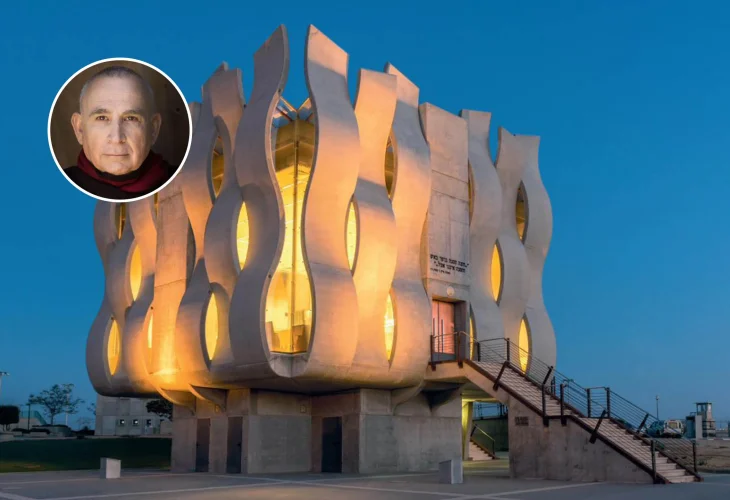 A synagogue showcased in the exhibition (Photo: PR)
Once every two years, Italy hosts a unique international exhibition known as the Biennale — one of the world’s most prestigious, influential, and longstanding art and architecture events. Held in Venice, it attracts artists, curators, gallerists, collectors, and art enthusiasts from across the globe.
This year, attendees are in for an unexpected surprise: Israeli-Jewish architect Eli Armon has chosen to launch an independent exhibition titled “Jewish Architect,” opening alongside the Biennale.
“Contributing to Israel’s Public Diplomacy”
“Not only is the name of my exhibition Jewish — the entire space radiates Judaism,” explains Armon.
Visitors enter a nine-square-meter open space, passing between two beams of light that evoke the lighting of Shabbat candles. At the center stands a synagogue prayer stand with an open Torah scroll and a Yad (pointer) placed on it. Nearby is a lamp symbolizing the verse “You shall meditate upon it day and night.” Suspended above the space is the seven-branched Menorah — one of the central vessels of the Temple, and today a national symbol of the State of Israel.”
Where did you find the courage to present such an overtly Jewish exhibition at a time of rising global antisemitism?
“For me, it was never even a question,” Armon says.
“I was fully aware that it might provoke people — especially since two years ago the Israeli pavilion here was vandalized by pro-Palestinian rioters. Still, I came here with my head held high. It is important to me to bridge the worlds of spirit and material, and to present Jewish and Israeli culture to tens of thousands of visitors and diplomatic delegations expected to arrive.
“My hope is to contribute something meaningful to Israeli public diplomacy on the international stage — through direct dialogue with the nations of the world, including those that are not necessarily sympathetic toward Israel.”
Armon heads Armon Architects, a firm that has operated for some 35 years and works across all fields of architecture — from synagogue design to urban planning, residential projects, and employment centers.
“Architecture as Identity, Belonging, and Story”
“I am not formally observant, but I have always felt deeply connected to Jewish tradition,” he says.
“Already during my studies at the Technion, I noticed that the sources of inspiration driving my work came from my identity as a Jew. Since then, I decided that every project I design begins with a verse from the Bible. Over time, I found myself especially drawn to projects with added spiritual or cultural value — particularly those connected to places of prayer or Jewish heritage.”
“In every project I take on, I try to connect contemporary inspiration with ancient roots — Jewish tradition with the physical landscape of the land. Architecture, for me, is not only functional. It is a tool for expressing identity, belonging, and a continuous historical story. I see architecture as a mission — to give physical presence to the story of the Jewish people, through material, light, and space.”
From the Burning Bush to the Sanhedrin
Armon’s concept of “Jewish architecture” is not merely theoretical — it is expressed in real-world projects.
One example is the synagogue he designed at the IDF Officers’ Training Base (Bahad 1). “I designed it in the form of a burning bush — echoing the verse ‘and the bush was not consumed.’ Just as Moshe received his mission there, so too do the soldiers here receive their mission to protect the people of Israel.”
Another project was the Visitors’ Center built around Avraham’s Well in Be’er Sheva. “I based the architectural design on Biblical sources so that visitors encounter verses and narratives from the story of Avraham and Avimelech as they walk through the site.”
A particularly meaningful project was the ‘Trailblazers of the Jewish People Visitors’ Center’ in Yavne.
“When I began planning the structure, I turned naturally to our ancient sources — and found the powerful story of the Sanhedrin era, when Rabban Gamliel requested from the Roman commander: ‘Give me Yavne and its sages.’ I designed the building in the geometric form of a shofar, and inside its curved form I placed a museum honoring Jewish pioneers throughout history.”
“These are just examples,” he says. “For 35 years I have rooted my work in the Bible and Jewish heritage. It is an inseparable part of who I am.”
Who is the exhibition in Venice intended for?
“The place is full to capacity,” Armon shares. “Jewish groups interested in architecture and art arrive especially to see it — but many non-Jewish visitors also come. To make the experience accessible, I added translations of the Biblical verses on the walls into English, Arabic, and Italian.
“My first book — ‘Jewish Architect’ presents a range of my works and exploring their connection to Jewish sources.”
For now, Armon remains in Venice, embracing what he considers a personal mission. “I don’t represent any political body, and I am not here to provoke controversy,” he says. “I am simply proud to be a Jew — and I want to express a Jewish worldview.”
Then he smiles — and turns to welcome the next group of visitors.


