
Magazine
Yacht of Kindness: The Israeli Skipper Who Closed on Shabbat and Sails Soldiers for Free
How the “Sailing with Warriors” project transformed a life, by bringing purpose, resilience, and healing
- Hidabroot
- |Updated

“If you had told me three years ago that this is what my yacht would look like today, I would have laughed,” says Chezi Dayan, a veteran seaman who has been running a yacht-rental business for years at the Herzliya Marina. “Until three years ago I could have told you that the big money came from weekend business. I would practically wait from Sunday to Thursday just so I could work on Friday and Shabbat — but then everything changed.”
Dayan decided to completely shut down his yacht on Shabbat. In addition, since the outbreak of the war, he has found himself sailing mainly with reservists and their wives — entirely on a volunteer basis. “Nothing could have prepared me for this, but show me someone else who really knows what to expect in a country like ours.”
“The income is smaller — but there is blessing”
Dayan takes us back to the time when he began keeping Shabbat. “It wasn’t an easy decision,” he admits. “But once I took it upon myself to keep Shabbat according to Jewish law, it was clear to me that my business would also be completely closed on Shabbat. So that I wouldn’t even face the slightest temptation to rent out the yacht, I attached permanent stickers to it that read: ‘This yacht keeps Shabbat.’ I also have a sign that says the yacht is kosher.”
For those who ask why a yacht needs kashrut certification, Dayan explains that during the sail he likes to treat participants to snacks and wine — and it’s important to him that everything is strictly kosher.
“I embraced the religious and ultra-Orthodox public — and thankfully, they embraced me back,” he says. “At first I was very worried that my income would drop significantly, because I was essentially giving up the most in-demand workday of the week. But now, looking back after three years, I can say clearly: yes, when I worked on Shabbat I earned more money — but I didn’t see blessing from it.
“There were always unexpected expenses — car repairs, replacing furniture, a child who suddenly needed dental treatments… Every time something big came along and swallowed all the money. In recent years I may earn less, but more remains in my pocket. And that’s real profit, because I get to be more with my children and my family — and above all, I get to preserve the holiness of Shabbat.”

Sailing with Soldiers
When the war broke out, Dayan found himself in crisis. “Along with the pain and worry that everyone in the country was experiencing, I was suddenly left without work. No one felt comfortable going out to have fun — the entire marina was empty. On top of that, both of my sons were fighting in Gaza, each in an elite unit. They were among the first to rush out on Simchat Torah to defend the people of Israel.
“So I was left behind — with all the thoughts and fears, asking myself what I could do to help, and how I could contribute my part to the war effort.”
For some time no customers contacted him at all. Then one day, a reservist reached out — he had been fighting for several weeks straight and was finally given a short leave. He wanted to go out to sea “to clear his head.”
“Of course I happily agreed,” Dayan recalls. “We went out to the open sea, raised the sail — and I could literally see how the view of the waves softened him. In that moment, I had a sudden realization — this is how I would do my part: I would create a project inviting soldiers to sail for free during their leave.”
He quickly put the idea into action and published a few posts online. “To my astonishment, there was no limit to the response,” he says. “Already on the first and second day, hundreds of soldiers contacted me — and I couldn’t manage the overwhelming demand alone. I realized I had no choice — I recruited other sailing clubs and yacht owners at the marina.
“Together, over eight months, we took 3,850 soldiers out on sails — on 57 yachts. The sails left from Herzliya Marina, but also from Jaffa Port and Haifa Bay — so we could reach soldiers wherever was convenient for them. We called the project ‘Sailing with Warriors.’”
That must have been nonstop work. How did you manage alongside your business?
“That’s the thing — during that period, I completely stopped my regular business,” Dayan explains. “I put everything aside and decided that as long as there are soldiers, they come before everyone else.
“From the start I announced that this project was entirely at my expense. I wasn’t asking for donations from anyone. I told myself — when the money runs out, the project will end.
“I have to say, my amazing wife backed me the whole way. She told me: ‘I know your bank account, and I know that if you continue with this project, you’ll drain it. But I support you. Keep going — even if we end up with nothing but pita bread and olive oil. Don’t stop.’ She strengthened me the entire time, and I thank her every day. Because I know this is a huge mission.”
What happens during a sail? Is there a set program?
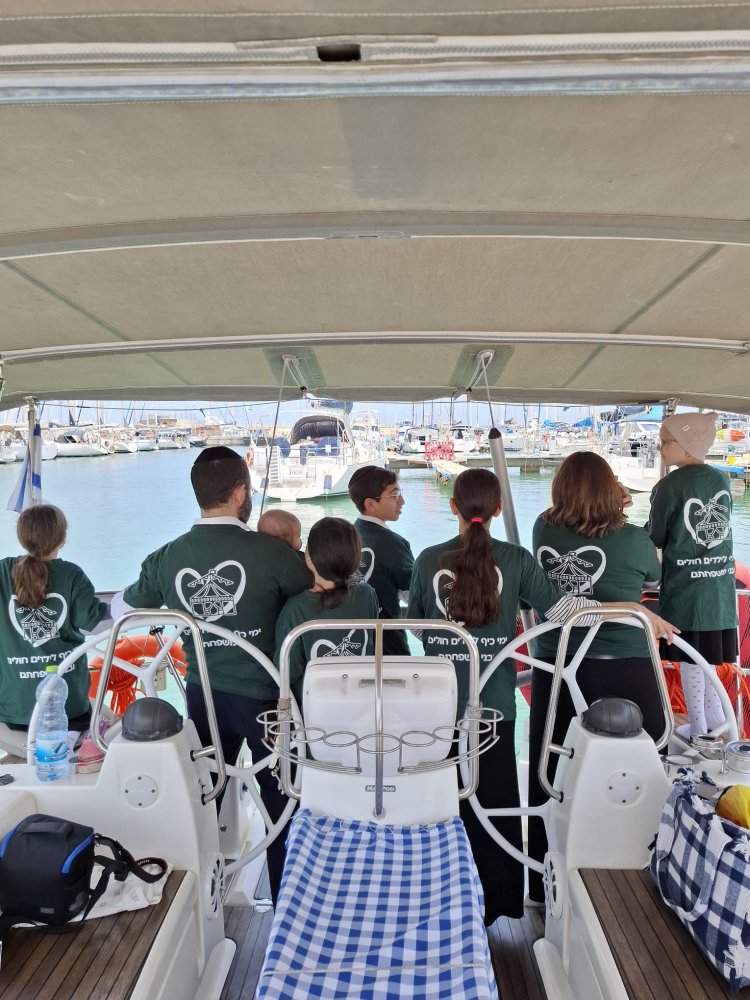
“I insisted that the soldiers come with their wives — because they are the real heroines, running the home with all the stress and worry. We go out to sea, and I let each couple decide how the sail will look. Some want music. Some want to learn about the yacht and the coastline. Others prefer silence — just to stare at the horizon.
“I let each person experience it in the way that helps them.”
Dayan — who also has a background in therapeutic sailing, says he trained all participating yacht owners.
“I told them: some of these soldiers are coming straight from the battlefield. They may not want to talk. So we don’t ask questions. But we create a safe space — where, if they do want to open up, they can.
“Again and again I saw how therapeutic it was — at some point during the sail, their faces soften. After so long smelling the battlefield and living in constant tension, the sea heals the soul. No one remains unchanged by it.”

Tefillin at Sea
Today, Dayan says he is still taking soldiers out — but less frequently, both because the need has decreased and because the budget has run out.
“Every soldier I took replaced a paying client. For months, I didn’t bring in a single paying customer. I was busy around the clock — even at night I answered calls.
“Now I have to return to normal work, but I don’t regret a second of it. Those were days of indescribable meaning — knowing I had the privilege of giving something to so many brave soldiers.”
Recently, he even added a special tefillin station inside his yacht.
“I noticed quite a few people passing through the marina who hadn’t yet put on tefillin that day — or who asked to do so during the sail. Now I’m proud to give them that opportunity. My yacht isn’t just a business — it’s a place where I try to do good in every possible way.”


