
In Search of God
Struck by Genius: How Trauma Unlocked a New Way of Seeing
After a violent attack left him with a severe concussion, Jason Padgett’s world was changed forever. Suddenly, he saw the universe in infinite patterns and discovered a rare genius hidden within his own mind.
- Yosef Yabece
- |Updated
A Night That Changed Everything
Jason Padgett, 31, dressed up and got ready to go out for a drink with friends in his hometown of Tacoma, Washington. Close to midnight, he stepped away from his group to grab a cold drink at a nearby kiosk. Padgett noticed the vendor’s eyes linger on his bulging wallet, but he quickly brushed off any concern. After all, it only held bills of twenty dollars or less. He gulped down his soda in a few swigs and headed toward the club’s exit.
Just a few steps outside the door, he felt a hard blow to his head that dropped him to his knees. At first, he thought it was a friendly shove from one of his slightly tipsy friends. Then more blows followed. As his consciousness faded in and out, he felt hands reaching into his coat pockets. When they couldn’t find his wallet, the attackers continued to pummel him with fists and kicks, cursing and shouting, before their footsteps finally scurried away into the night.
After several long minutes of losing and regaining consciousness, Padgett slowly managed to stand. He staggered toward his car, confused and unaware of where his friends had gone. Fortunately, the hospital was nearby. Tests revealed that he had suffered a severe concussion. The doctor prescribed pain relievers and sent him home. Padgett had no idea that on that night, after the violent robbery, he had left his “old self” at the kiosk entrance. In its place, a completely new Jason Padgett was born.
Seeing a Different World
“When I woke up the next morning, the world around me looked different,” Padgett recounts in an interview with Epoch Times. “I thought I was hallucinating from all the painkillers they gave me at the hospital.” As he describes the experience, he speaks rapidly and with contagious enthusiasm, making it hard to interrupt him.
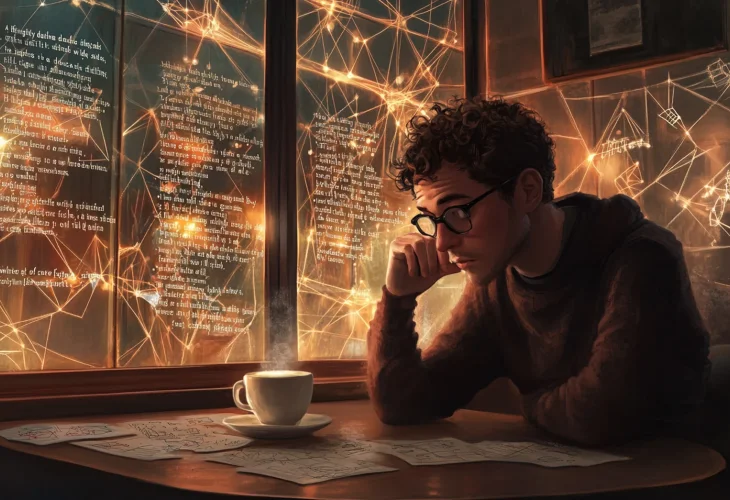
When he turned on the bathroom faucet, he saw fans of colorful rays shooting perpendicularly from the stream of water in every direction, passing through the sink and stretching into what seemed like infinity. Looking out the window, the leaves on the tree appeared as endless collections of tiny triangles, connected in countless patterns.
Trying to shake himself out of what felt like hallucinations, he made a cup of coffee. As he poured milk into it, he watched the liquid swirl into a large circle, then a smaller one, and then another, forming infinite, intertwining spirals like those found in a seashell. The entire apartment, and everything inside it, transformed into a world of geometric shapes.
A Mind Forever Altered
Padgett was certain something had gone wrong in his brain. Alongside the visual changes, he suffered severe pain, uncontrollable tremors, and muscle spasms throughout his body. Another hospital examination and brain scan showed no detectable brain damage, and he was told the symptoms would likely fade with time.
They didn’t. The world continued to appear as an intricate tapestry of geometric forms, gradually captivating him with their infinite complexity and beauty. Curious, Padgett began searching for others who had experienced head injuries like his. Did they, too, start seeing the world differently?
What began as a brief internet search grew into days and nights of obsessive exploration. Instead of the familiar world he once knew, he focused on deciphering and understanding the shapes that now filled his vision. A college dropout who had once cared only about his social life, he transformed into a self taught researcher, consumed by an intense desire to understand mathematics, especially geometry.
Discovering the Language of Nature
Padgett tells his story in his book, Struck by Genius, published in the United States in April 2014. For four years, he lived in near solitude in his dark apartment, which he experienced as a cave of wonders. From the endless geometric shapes that revealed themselves to him, and from what he learned online, he came to understand that he was seeing visual representations of mathematical formulas that explain phenomena throughout the universe.
The triangles in the leaves appeared as repeated demonstrations of the Pythagorean theorem. When those triangles intersected with circles of sunlight filtering through the branches, they resembled slices of the mathematical constant pi, that transcendent number beginning with 3.141592. The spirals of milk in his coffee mirrored the mathematics of the fractal world, articulated by mathematician Benoit Mandelbrot, shapes that repeat endlessly in nature, becoming smaller and smaller, with each part containing the whole.
Padgett began to see the entirety of existence reflected in every fragment: a leaf, ripples in water, clouds, and even the human body.
An Unexpected Turning Point
One day, four years after the incident, his self imposed isolation ended almost like something out of a fairy tale. Suddenly, Padgett found himself craving a roast beef sandwich. Determined to overcome his fear of leaving home, he decided to visit a café in a nearby mall. To feel safe, he brought along his most precious possession: his drawing bag.
As he spread out his sketches at a café table while waiting for his sandwich, a man sitting nearby asked about them. Padgett eagerly seized the rare opportunity to explain the geometric structure of the world as he perceived it.
“The man, who did not give me his name, introduced himself as a physicist from a local university,” Padgett wrote in his book. “He was amazed by my explanation and told me, ‘You understand very complex concepts, but you don’t have the words to explain them because you haven’t studied them formally. You should go learn them.’”
A Rare and Remarkable Mind
Brit Brogaard, a professor of neurology and philosophy at the University of Missouri in St. Louis and director of a multisensory research lab, later met Padgett at an international conference in Stockholm. The gathering brought together people who experience the world through blended senses, a phenomenon known as synesthesia, alongside scientists studying it.
Participants included people who see numbers or letters as colors, experience music as tastes, or perceive dates as spatial forms. Padgett’s case stood out in two distinct ways. His brain translated abstract mathematical concepts into vivid visual images, and this ability developed later in life, whereas most synesthetic experiences are present from birth.
Empathy and Interconnection
Perhaps most surprisingly, following the violent robbery, Jason developed a profound empathy for all human beings. “The truth is, empathy appeared immediately, along with the other abilities,” he says. “I feel the emotions of others intensely, their pain and embarrassment, alongside my own. I can’t stand to see someone hurt or even uncomfortable.”
This heightened empathy is deeply connected to how he perceives the universe. “Human beings are woven into all the geometric shapes of existence. You, I, the tree, the universe, everything fits together as part of a larger structure,” he explains. “In the past, I felt separate from the universe and from other people. Today, I don’t.”
Just as a nucleus is part of a cell, and a cell is part of the body, everything belongs to a greater system. In the most literal sense, Padgett believes, we are all connected, and everything each of us does affects everything else.
A Glimpse of a Greater Design
The world, he suggests, is built according to a larger plan. The human brain is capable of perceiving a glimpse of that design, both through understanding the laws of nature and through recognizing the unity of humanity and the source of the soul. Sometimes, all it takes is a small change to awaken an awareness that allows a person to grasp far more than they ever imagined.


