
Magazine
Ziva Meir on Parenting, Prayer, and Finding Strength in Faith
A moving life journey through motherhood, spiritual growth, Jewish identity, and the deep connection between family, prayer, and hope
- Avner Shaki
- |Updated
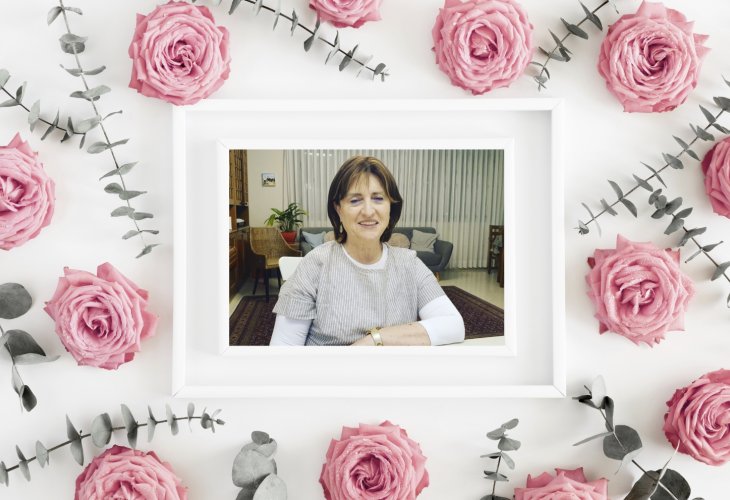 Ziva Meir
“My name is Ziva Meir, married and a mother of 11, living in Jerusalem. I am a parent and family counselor.”
Is there a childhood memory that has stayed with you?
“I remember myself as a little girl, four or maybe five years old, lying in bed and afraid to fall asleep — afraid of bad dreams, afraid that something terrible might happen.
And then, suddenly, I would hear my father learning Torah in the room next to mine, and a great wave of calm and safety would wash over me.
My father also served as the military rabbi of the Jerusalem Brigade — a strong man whose uniform looked especially dignified on him. He served at the Schneller army base in Jerusalem, and I have many memories from there.
I would lie in bed and hear the soft rustling sound of pages turning in his Gemara. In those moments I knew I could sleep peacefully — because my father was learning Torah.”
What does a typical day look like for you?
“My day begins early. I wake up around six, pray, go out for a walk from seven to eight, and then I start working. Some days are busier than others.
Share a meaningful Shabbat or holiday experience
“As a young mother, I so badly wanted my children to sing Shabbat songs. I never asked them to — because one of my sons once told me that singing must come from the heart, and you can’t demand it from someone.
Sometimes they sang, and my heart was full of joy. Sometimes they didn’t, and I was sad — but still, I didn’t insist.
Baruch Hashem, I received a great reward for that. Today, the thing that makes me happiest on Shabbat and holidays is sitting with my children around the table, hearing them sing with devotion, and singing together with them — with connection and deep emotion.”
A Jewish figure who inspires you?
“There are many — I’ll mention only a few. The Baal Shem Tov, founder of Chassidut, is a great source of inspiration.
Also great tzaddikim from more recent generations: Rabbi Shlomo Zalman Auerbach, Rabbi Aryeh Levin, Rabbi Aharon Yehuda Leib Shteinman (about whom I heard incredible stories after his passing), the Lubavitcher Rebbe, Rabbi Shach, and many others.
Each one illuminated Judaism with a unique, beautiful light.
For me, they are like sparkling diamonds — each one shining from a different angle, and all of them beautiful and full of goodness.”
A meaningful encounter in your life
“The most meaningful encounter of my life was meeting my husband. He was the only man I ever met for the purpose of shidduch — and Baruch Hashem, we have merited many good and happy years together, and we pray for many more.”
Your deepest dreams — hidden and revealed
“That my soul will always remain connected to Hashem — and that I will merit to see Hashem in light, goodness, kindness, and compassion.”
A particularly meaningful prayer experience
“The place where I feel the greatest opening of the heart is at the gravesite of Rabbi Nachman.
In Israel — it is Kever Rachel.
When I am by Rabbi Nachman, I pray to feel that same openness of heart here in Israel as well — when I pray at home, at the Kotel, in Ma’arat HaMachpela, in shul, by Rabbi Shimon, at Kever Rachel of course — and really, by all the tzaddikim.”
How present is God in your life, and how does it affect your work?
“Judaism is everything for me — it is the core of life.
There are days when Hashem’s presence is stronger in my life, and sadly there are days when I feel it less. My aspiration, of course, is to have as many days as possible in which Hashem is deeply present.
It’s not only that His presence influences my actions — and not only that my success comes through Him — but that His success comes through me. I try to be a vessel for His mission.”
A powerful life story you were part of
“My son Yitzchak fought in the Second Lebanon War. When he entered Lebanon, their phones were taken away, and of course we were very anxious.
One of my sons suggested that we create a ‘guard duty rotation’ for him — each family member would receive a half-hour slot every day during which they would say Tehillim for him and for all our soldiers.
We all committed to it seriously — and it truly helped me feel calmer. We stopped the rotation at night, assuming they were not fighting then.
After a week he exited Lebanon — we told him about it and he was very moved. Later he returned to battle and again communication stopped.
On the last Shabbat of the war, just before dawn, I suddenly heard my husband talking in his sleep — something that had never happened before.
He said: ‘The Arabs must have been terribly frightened when you entered the village.’ I woke up immediately, asked him to repeat it — and he said the exact same sentence again. I washed my hands and began to say Tehillim. After some time my husband joined me.
Motzaei Shabbat we heard that many soldiers had been killed in the very sector where Yitzchak was fighting.
Strangely, I felt calm. I told everyone: ‘We are doing what we are meant to do — and that is everything.’
Later, when we were finally able to speak with him, he told us what happened: ‘Before dawn on Shabbat we went out to the difficult battle where those soldiers were killed. Just before we entered, I looked at the clock and realized — at this hour no one is praying for me.
It’s the middle of the night in Lebanon, total darkness, we are heading into a heavy battle — and I know no one is on guard duty.’ At that very moment — my husband spoke those words in his sleep, which led us to start praying, and he was saved.
This story has stayed with me forever — because it shows how deeply we are connected to Hashem, and how deeply we are connected to one another.”
What makes you happiest?
“To merit raising our descendants to walk in the ways of Hashem — and to see more and more families whom I’ve been privileged to influence, raising generations of Jews connected to Hashem and His Torah.”
What do you fear most?
“Illness, of body or of soul. Mental illness, anxiety, and fear dim the light of the soul.
When the soul shines and we are connected to it, that is the happiest and healthiest state. But when pain or fear weakens it, something in the inner world becomes shaky. That is what I fear most.”
A song that deeply moves you
“‘Kah Echsof,’ by Rabbi Aharon of Karlin.
It touches me every Shabbat when we sing it. My sons like to sing it on Friday night — my husband especially loves singing it at Seudah Shlishit near the end of Shabbat — and it always moves me deeply.”
Professionally — are you where you imagined you would be?
“Absolutely not. I invested tremendous time learning about parenting and family — but I did it only so I could raise my own children in the best possible way.
I never dreamed I would become ‘Ima Meir,’ a figure whom people turn to for guidance.
Today I feel a great sense of responsibility — I am a messenger for many families in Israel and around the world. Before every session — and during it, I pray that Hashem will help me say and do the right things, and truly understand each situation.
I thank Hashem for this mission — and for the fact that it continues to grow and develop.”
What moves you most in Judaism?
“To see a Jewish family that is joyful and happy. Joy is the deepest expression of Judaism. When I see a family — father, mother, and children, reaching true happiness together, it is the most moving thing in the world.”
Where do you hope to be in ten years?
“Bezrat Hashem, in the time of the complete Redemption.
And in terms of work, in the same field I am in today, but with much more growth and development.
There is always room, and a need, to keep moving forward.”


