
Magazine
Living Jewish in Oman: Inside the Hidden Life of One of the Country’s Last Jews
Amid rising hostility after the Israel–Hamas war, Moshe prays in secret, fears surveillance, and refuses to give up hope
- Chaim Gefen
- |Updated
 Muscat, the capital of Oman (Photo: shutterstock)
“You can’t speak to me in Hebrew here in Oman.”
That’s the only sentence Moshe, one of just three Jews living in Oman, said to me, right before the call was disconnected. It was likely the first conversation held in Hebrew between an Israeli citizen and an Omani citizen in recent years.
This exclusive interview for Hidabroot is therefore taking place entirely through text messages.
“I’m afraid to speak with you on the phone; it’s very dangerous for me,” Moshe wrote to me moments after cutting the call. Using a messaging app that is blocked from surveillance, we speak with a Jew who is, in purely technical terms, only about a 180-minute flight away from us — but that physical distance is nothing compared to the ideological gulf separating our two countries: Israel and Oman.
The written conversation itself is held only in English. Oman’s intelligence and security services have access to its citizens’ WhatsApp and SMS apps and can monitor calls made through them. “It happens very often,” Moshe testifies, “and the last thing I need is for them to discover that I spoke or exchanged messages with an Israeli phone number — especially in Hebrew.”
So what is he even doing there, a lone Jew in a country that is almost entirely Muslim? And isn’t it dangerous for him to live in a state that maintains close ties with Iran (under Ayatollah Khamenei) and with Yemen, the stronghold of the Houthis?
Alone in the Land of Islam
The life story of 72-year-old Moshe, is a story of exile. Originally a European citizen, he has spent his life living in most of the Gulf’s Islamic states.
The first was Saudi Arabia, where he arrived in the mid-1970s for business purposes.
“In Saudi Arabia, I met a Muslim businessman who knew I was Jewish, and despite that, he still wanted to do business with me,” he recalls of his first encounter with the Arab world. “I lived in Saudi Arabia for almost ten years and did business there.”
The dramatic changes that swept across the Middle East during the 1980s also shook his local business activity in Saudi Arabia. He then moved to Bahrain, where he opened a specialized office providing engineering and architectural services — his professional field. Later, he moved on to Kuwait, where he also worked as a consultant in architecture and engineering.
When did you relocate to Oman?
“Twenty years ago,” he says. “My plan was to stay here for a few years and then move on to other places, but from then until today, I’m still here. The company I own is under contract with a leading local company that develops real estate projects in Oman, and it has built more than a million homes across the country. That’s essentially what I do nowadays.”
Describe what it’s like to live as a lone Jew in a Muslim country.
“You’re calling Oman a Muslim country, but you should know that more than once Muslims have told me: ‘You Jews were here before us.’ In Oman there is an ancient Jewish cemetery, about 200 years old, and that’s a clear proof that in the past many Jews lived here and led full community lives without fear or hiding.
“I have Omani friends who have shown me ancient scrolls linking them to the Jewish people. They told me that with the rise of Islam in the Arabian Peninsula about 1,500 years ago, many Jews from the Gulf states, including Oman, were forced to convert to Islam after suffering brutal persecution because they were Jewish.”
In the past two years, has anything changed in how Omanis relate to Israel?
“Since the start of the war between Israel and Hamas, there has been a deep shift in Oman,” he says. “Life here has become frightening and unpredictable, and it is therefore not recommended for me to take part in public or government events, for fear for my life.
“From the beginning of the war, Omani media lined up clearly on the side of the Gazans and started broadcasting openly antisemitic messages. Newspaper headlines called, and still call, for the destruction of the State of Israel, and you can tell that the citizens are influenced by this. There is no doubt that before the war, life here was better.
“There used to be more Jews in Oman, and from time to time we’d meet for a Shabbat meal and share experiences together. As soon as the war began, most of them fled Oman. Now there are three Jews left, living in different regions, and we hardly have any contact with one another.”
Isn’t it dangerous to continue living in Oman? Do your neighbors know you’re Jewish?
“Yes and no. A small minority of the people in my neighborhood don’t know that I’m Jewish, but almost all of them do. The Omani citizens themselves are generally less hostile to the Jewish people, compared to immigrants from hostile countries who define themselves as Palestinians. Recently, these immigrants have been flooding into Oman and creating an atmosphere of hatred and fear in the streets.”
Judaism at the Heart of Oman
There is no Jewish community in Oman today. Historically, though, until a little over a hundred years ago many Jews lived there — both natives and those expelled from neighboring Arab countries who later migrated in.
During World War II, the Jewish community shrank until only a few families remained. After the establishment of the State of Israel, the remaining Jews of Oman fled and moved to the United States or other countries. In fact, even in earlier times when there was a functioning community, they never had a formal synagogue building where they gathered as a community.
The religious and spiritual support Moshe receives comes from Rabbi Elie Abadie, the rabbi of the “Association of Gulf Jewish Communities,” who lives in the United States. He is also the one who connected us for this interview.
“Rabbi Abadie is my rabbi,” says Moshe. “I consult with him whenever I have halachic or spiritual questions, and he’s the one who supports me during rough times, whether personal or business-related.”
What about prayer? What about Shabbat? How do you manage to live a Jewish life in a Muslim country?
“It’s not easy at all. There are no other Jews here I can spend Shabbat with or pray in a minyan, so I have to do everything alone.
“I pray three times a day and keep Shabbat according to halacha, despite how difficult that is. We Jews are very strong, and I feel that the lonelier I am — the more carefully I keep mitzvot. The feeling of isolation actually strengthens my religious identity, and I find myself more meticulous about observances that maybe I wouldn’t keep as strictly if I lived in a Jewish environment.
“In the last twenty years I’ve hardly eaten any meat,” Moshe adds. “It’s very hard to get kosher meat here, and importing kosher meat from nearby countries is just as difficult. I brought tefillin and a siddur with me when I emigrated to Oman, and I have to obtain all the religious items I need for holidays and festivals by myself, with no external help.”
Ties With the Sultan
Oman is a very picturesque country — some even call it “the Switzerland of the Gulf.” It boasts stunning desert landscapes, traditional colorful markets, and ancient historic tourist sites.
Politically, Oman is a Muslim sultanate, currently ruled by Sultan Haitham bin Tariq Al Said, who replaced his uncle, Sultan Qaboos bin Said.
Despite the fact that Israel and Oman have no official diplomatic relations, Prime Minister Benjamin Netanyahu did meet with the late Sultan Qaboos in the past. Former prime ministers Yitzhak Rabin and Shimon Peres also met him in his royal palace. Those meetings, however, never led to normalization between the two countries.
During the current war, Oman’s official statements have consistently condemned IDF operations and what they describe as “harm” to Gaza’s residents. At the same time, whispers coming out of the White House have hinted at then-President Donald Trump’s interest in brokering historic normalization between Israel and Oman.
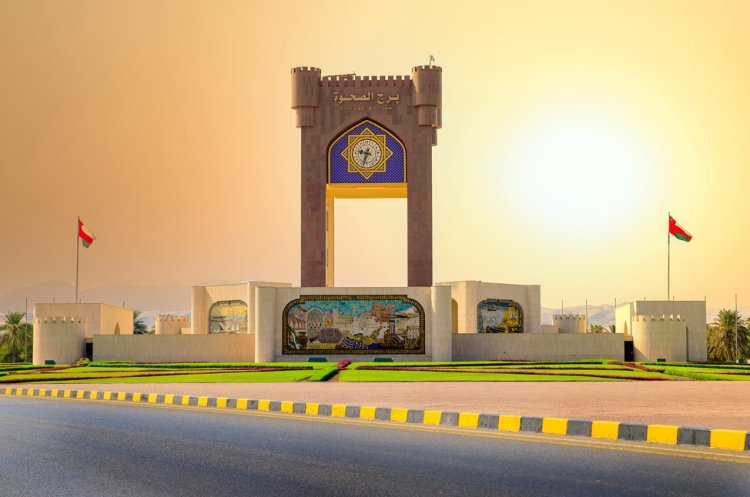 בורג' אל-סחוה, מוסקט (קרדיט: שאטרסטוק)
How does the Omani street react to the possibility of normalizing relations with Israel?
“The reactions are very divided,” Moshe reports from inside Oman. “Most citizens tend to accept the government’s position, which of course depends on who leads it.
“With the previous sultan, Qaboos, I had a good relationship. We used to meet and talk, and he never showed hostility toward me or toward Jews. The current sultan, Haitham, I barely know.
“I do know the foreign minister, Badr Al-Busaidi. He’s an avid wine lover, and from time to time I would bring him expensive wines to maintain our connection. He is married to a British Palestinian woman, and that’s one of the reasons he does not exactly like Israel, to put it mildly.”
Does Oman’s relationship with Iran negatively affect how ordinary people here view Israel?
“That’s a very complex issue,” he says. “Since Ayatollah Khomeini came to power after the 1979 Iranian Revolution, many Iranians have been coming to Oman. Their visits help generate local sympathy for Iran, and Oman’s diplomatic relations with Iran influence the political atmosphere too.
“This has many implications, including on attitudes toward the State of Israel, which is presented as an enemy state that must be destroyed.”
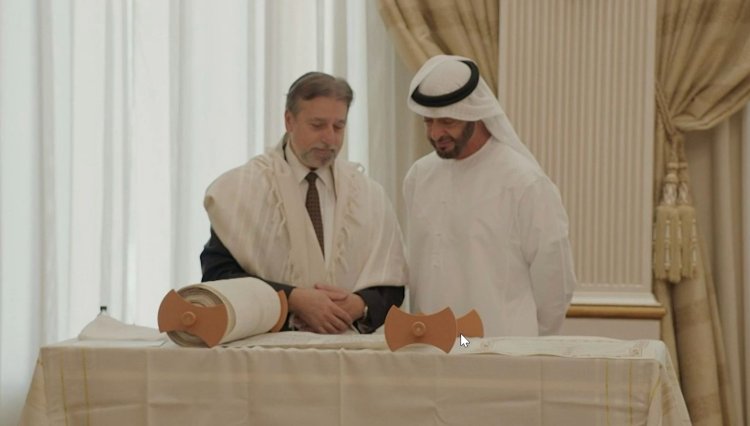 הרב אלי עבאדי עם נשיא איחוד האמירויות
Are you afraid to talk to me, an Israeli citizen?
“Yes, it could be dangerous. If this were a phone call, I would be very afraid, and I wouldn’t talk to you at all.
“When you called me at first and I heard Hebrew, I answered you briefly and disconnected. The mere fact that I speak with an Israeli citizen calling me from an Israeli phone number is highly problematic for me, and maybe even for you. And if we were to speak in Hebrew, that would be a problem that could cost me dearly. I’m not willing to take that risk.”
For this reason, Moshe refused to allow his photo to be published in the article.
“Terror organizations that are in direct contact with the Omani government — such as the Iranian Revolutionary Guard, can identify me. If they find out that I spoke with an Israeli media outlet and reported on what’s happening in Oman, I could one day simply disappear and never come back.”
Have you experienced antisemitic attacks because you’re Jewish?
“Of course,” he says. “Not once or twice, but many, many times. I usually don’t confront those attackers. Most of these incidents happen in public spaces, and I choose not to respond — just to walk away.
“Those who know me personally won’t attack me, even if they might want to, because they know you don’t really mess with me. Let’s just say they might find themselves facing some serious physical consequences,” he adds, half joking, half serious.
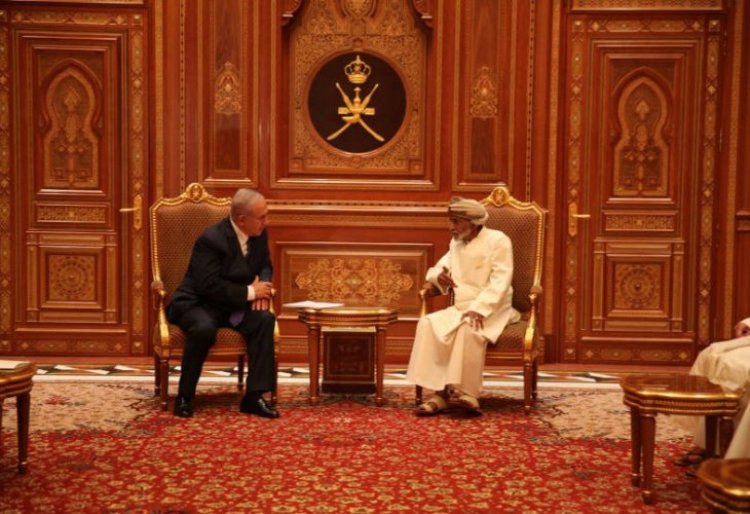 נתניהו בביקורו בעומאן, עם הסולטן קאבוס, אוקטובר 2018 (צילום: דוברות ראש הממשלה)
“Next Year in Israel”
Every Friday evening, as the sun sets, Moshe stands by the window of his home and lights Shabbat candles. A single pair of candles flickers against the shifting Omani landscape, illuminating the darkness settling over the streets and alleys.
He welcomes Shabbat alone, singing “Lecha Dodi” in Hebrew in a soft tune.
“Shabbat is my time of rest,” he describes longingly. “It’s the time when life’s race stops and I can learn and pray, read and grow wiser, and sometimes also go out for a quiet walk if the weather is nice.”
To end, I ask: When will we see you in the Land of Israel, the Jewish state?
“That’s my dream,” he says, his voice filled with emotion and a sudden spark lit deep in his heart, in the very center of hostile Oman. “My connection with the Land of Israel is deep and real, and I hope that soon I’ll find myself making aliyah, settling there, and living a Jewish life without fear.”


