
Magazine
Bar Tzabari: Music, Faith, and Finding Light in Difficult Times
The singer-songwriter on loss, creativity, prayer, and using music to heal during Israel’s hardest moments
- Avner Shaki
- |Updated
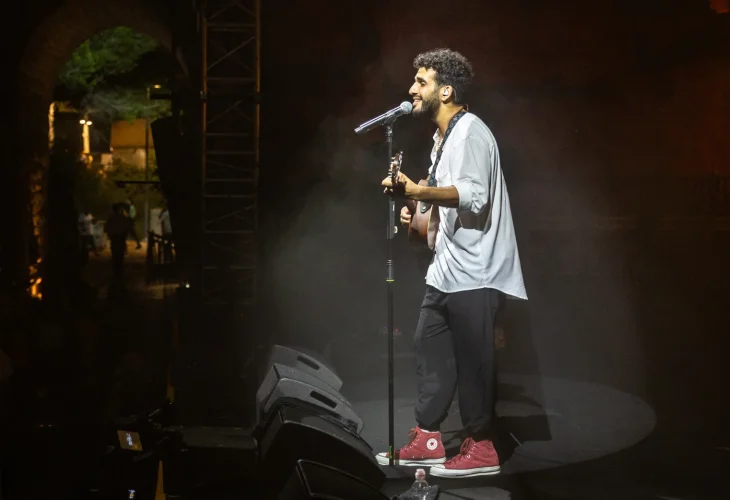 Bar Tzabari (Photo: Valda Katzman)
Bar Tzabari is married and a father of three, who lives in Hadera. He is a musician, singer-songwriter, and actor.
A Spark of a Beginning
“My first connection to the world of music took place in the synagogue. I’m fully Yemenite, as you can probably tell, and as a child, every Friday night and Shabbat morning I would go to prayers with my father and brother. We’re not a religious family, but we are traditional.
“Yemenite prayer is very special and deeply musical. The synagogue felt like home to me. I loved the melodies and being called up to the Torah, and truly, that’s where everything began.
“At the synagogue, people complimented my voice. Later, that continued at school ceremonies, and in high school I realized this was what I loved doing most. Over the years, I started writing, composing, and playing as well. I began with singing alone, and today creation is a huge part of my life — no less fulfilling than singing itself.
“At a young age, I lost my first partner, Or Chaya Shitrit, of blessed memory, who passed away from cancer. That was the moment that opened up my inner creative worlds, and the spring began to flow. I started writing, composing, and performing my own songs. In my heart, it feels like a gift she left me when she departed.”
A Spark of a Journey
“I’m on a journey with the music I create. Naturally, sometimes things flow more smoothly, and sometimes less so. One of the things that brings me the greatest joy is the audience that walks this path with me.
“There are artists who expose themselves more, and that draws attention and interest. I speak through my songs. I’ve been blessed with an audience that has stayed with me for many years, and keeps growing. It’s incredibly moving to see.
“Most of the artists I love listening to, I feel like I know them through their songs, even if we’ve never met. I try to be that kind of artist too: without background noise, simply telling my story.”
A Spark of Courage
“The war broke out shortly before the launch of my second album, Free Joy. We had started gaining momentum with performances and successful songs, and then October 7 arrived.
“Very quickly, I understood that we needed to stop everything and focus on lifting morale by bringing joy to people, visiting soldiers and the wounded, and more. We started traveling all over the country, performing dozens of shows, and realized that this was our version of reserve duty.
“During this period, we experienced many extraordinary moments that will stay with me for many years. We were at shiva houses and funerals, and we couldn’t believe the strength and nobility with which people spoke about what had happened to them.
“One of the most moving experiences I had was at the thirty-day memorial for Arnon Zamora, who was killed in the operation to rescue four hostages. His sister reached out to me with words that deeply touched me, and it was clear to me that I had to be there. It took place at Mount Herzl — a site that, sadly, has seen many new graves recently, and it was an incredibly painful and emotional event.
“During one of my visits to Rambam Hospital in Haifa, I sat and spoke with one of the wounded soldiers. He had been severely injured, lying there with his legs elevated, and he touched my heart in a special way. A few months later, I was performing at the Tel Aviv Port, and after the show I saw a young man approaching me in a wheelchair, with a woman beside him. I recognized them immediately. He came to the show with his wife, and I was deeply moved.
“After every performance for soldiers, I tell them that with all due respect, we’re just the ‘whipped cream’ — we come to add a bit of joy at the end of the day. It’s clear to us that they are the ones doing the truly important and real work. How fortunate we are to have people like them.”
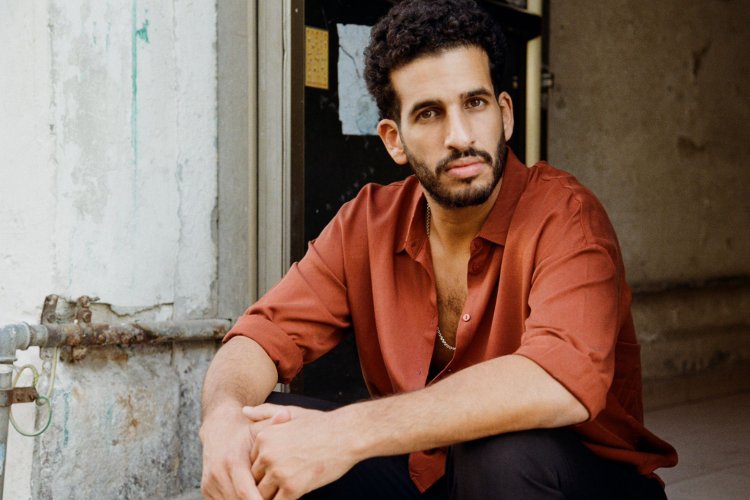 photo by Yarden Rokach
A Spark of Shabbat
“I’m not religious, but traditional, and I don’t work on Shabbat. It’s important for me to keep this day, to be with my family. Naturally, I get invited to perform on Shabbat. Not long ago, I was offered a Friday-night wedding performance, and even though they offered a lot of money, I refused. It doesn’t feel natural or right for me to perform on Shabbat.”
A Spark of a Mitzvah
“Every morning I say Modeh Ani, wash my hands, and put on tefillin. It’s important to me — it sets my day straight, sharpens my focus, and protects me.”
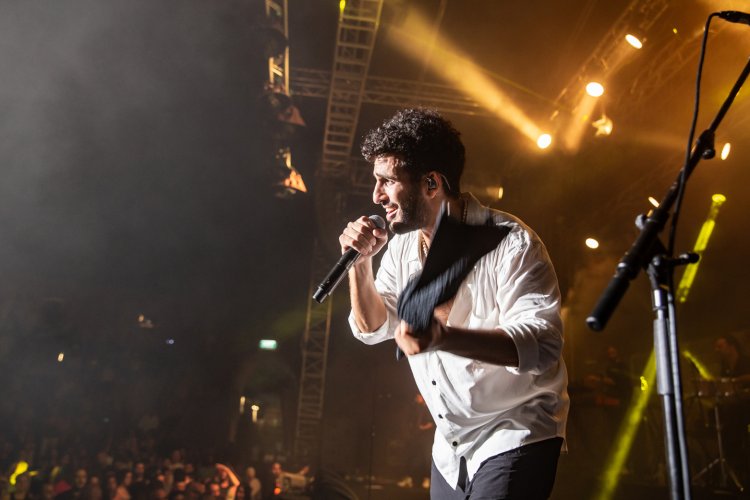 photo by Valda Katzman
A Spark of Prayer
“I talk a lot with the Creator, in the simplest way — like a father, like a friend. Sometimes I don’t even notice, and in the middle of talking to Him I’ll say ‘God willing.’ I feel God with me at every moment, and I always sense that He’s watching over me.
“I have a song called Nitzotzot (Sparks), and it’s essentially all prayer and personal meditation. This topic is very close to my heart.
“In recent years, I’ve also tried to bless God for the bad — not just the good. When things happen that don’t make me happy, I tell God that I trust He did them to spare me from something worse or more painful. I’m comfortable being in this place of gratitude and appreciation, and when I’m there, I’m happy.”
A Spark of Coping
“When difficulties appear in my life, I try not to sink into them for too long and to move forward as quickly as possible. Sometimes, when I can’t move forward, I allow myself to sit inside the difficulty.
“There are moments in life when you’re sad, and you need to know that it’s okay. At the same time, you need to know that it’s a passing feeling, and soon it will be better.
“Life is a wheel that’s constantly turning. It’s important to remember that — and to see the great good that exists within it.”


