
Magazine
From Kharkiv to the Screen: The Uncompromising Journey of Actress Shaloma Rivka Levin
A story of immigration, faith, self-acceptance, and staying true to your principles in the spotlight
- Hidabroot
- |Updated
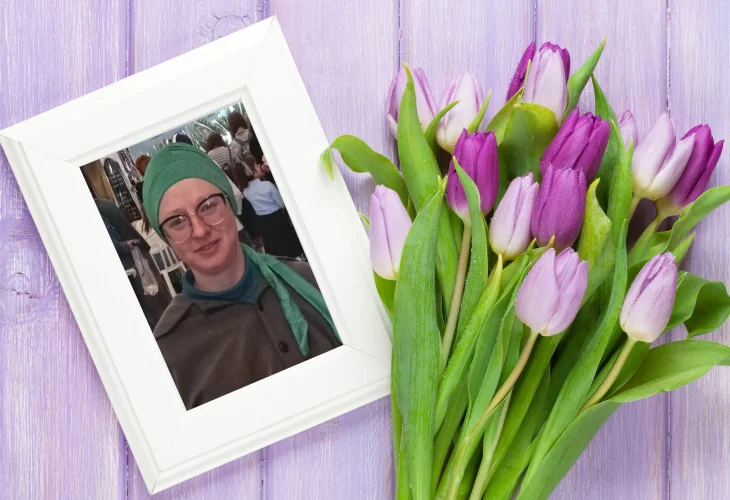 Shloma Rivka Levin
Shaloma Rivka Levin was just six years old when she immigrated to Israel, moving from the freezing cold of Kharkiv, Ukraine, to the desert heat of Arad.
“I came to Israel with my mother shortly after the well-known wave of immigration from the former Soviet Union,” she recalls. “My grandparents immigrated with us as well. At first, they lived in Ofakim, but later they moved to Arad, and since then we’ve all been there.”
Shaloma Rivka doesn’t remember the immigration as particularly difficult — neither the move itself nor the absorption process.
“My mother always made us feel that moving to Israel was the best thing that could possibly happen to us,” she emphasizes. “Arad was a small, underdeveloped place back then, but that didn’t bother us at all. On the contrary — I think that precisely because it was small, we were welcomed with open arms. There wasn’t the pressure and difficulty that often comes with absorption. Plus, there were many new immigrants around us, some of whom spoke our language, so we truly felt at home.”
A Name, a Language, and a Growing Identity
She has carried the name Shaloma since arriving in Israel. “In Ukraine, my name was ‘Slomea,’ derived from the word shalom (peace), named after my great-grandfather. In Israel, my name was Hebraized, and I became ‘Shaloma.’”
Even as a young child, she remembers attending nearly every theater performance that came to Arad — especially Russian-language productions, which were often of very high quality.
“My mother always said that if you’re going to the theater, you invest money and go to the best,” she laughs. “So yes, I saw almost every good show that arrived in Arad, and even outside the city. Already then, the thought crossed my mind that one day I would be an actress. But when I became religious and grew closer to Judaism, I was sure there was no possibility for a Haredi woman to turn acting into a profession — and I buried that dream.”
How did you become religious?
“The truth is that from first grade I studied in a Haredi framework, at a ‘Shuvu’ school, and I connected to the style because I’m a very spiritual person,” she explains. “My mother connected to it less than I did. Although she was familiar with Judaism — and even studied in Ukraine within frameworks connected to Lev L'Achim and Chabad — she didn’t really observe or keep the commandments.”
Why did she send you to Shuvu?
“The philosophy of the Shuvu network is high-level education. At that time, they specifically approached children from families from the former Soviet Union and offered studies partly conducted in Russian, with staff who deeply understood the mentality. That convinced my mother.
“At school, they taught us everything about mitzvot, Shabbat, and Jewish holidays. In school, I was fully observant — but it took time for me to decide that I wanted to observe commandments not only within the school framework, but as a lifelong personal choice.”
After finishing elementary school, Shaloma Rivka wanted to study at a Gur Hasidic high school but was not accepted. Instead, she enrolled in a traditional but non-religious school.
“I constantly missed my Shuvu teachers and the Torah-centered environment. In 10th grade, I finally fulfilled my dream and transferred to a Chabad school in Be’er Sheva.”
Wasn’t it hard to change your lifestyle?
“Externally, it was actually very easy. I never had a problem dressing modestly or eating only strictly kosher food. Internally, of course, it’s a different story — and the work on personal growth continues to this day. There’s always more to learn and further to grow.”
Acting Without Compromising Values
Over the past seven years, Shaloma Rivka has become a recognized actress, appearing in a variety of film and television roles.
How did you enter the acting world?
“It started many years ago when a TV series was filmed in Arad and advertised in the local newspaper. I decided to audition. I was sure my chances were very low, but eventually they called me back and told me I’d been chosen for a fairly prominent role in one of the scenes. That was my first appearance, and from there I kept moving forward.
“One particularly unforgettable project for me was Blue Blood by Haredi creator Miri Barzel — precisely because it was a Haredi production. I gained many experiences there, both professionally and personally, and also through my exposure to the Haredi community.”
You always appear on screen wearing a wig and head covering. How do producers respond?
“My look is very strongly associated with me, and most of the roles I receive are based on that look — because I don’t give it up. I truly see it as a great privilege to strengthen people, inspire them, and set a personal example, and my appearance contributes to that.
“At the same time, I don’t believe I should compromise my principles for a role. It’s true that my appearance doesn’t always fit, and there are many roles I don’t get because of it, but I continue walking with my truth. There’s no point in a big or leading role if it comes at the expense of my values.”
Are there roles you refuse outright?
“Yes. I turn down most of the roles offered to me, mainly for halachic reasons, and that’s very limiting. But on the other hand, when I do take part in something, I feel it impacts people precisely because of who I am. That’s when I feel I’ve arrived at the right place.”
She adds that there are several important series she would very much like to participate in, and that she has already auditioned for some of them. “I’m waiting eagerly for answers.”
Public Reactions and Respect
“There’s a lot of respect and appreciation from fellow actors, production teams, and viewers. It’s amazing to see that when a person is at peace with their principles, people simply accept them. When I say, ‘I’m Haredi by choice, and therefore I can’t do certain things,’ people respond with understanding, without questions.”
Standing Out — and Turning It Into Strength
Shaloma Rivka’s height has also become one of her defining traits: she is unusually short.
“1.37 meters,” she specifies. “It always makes me different, but for me, it’s a good kind of different. I don’t think there’s anything negative about being short. Since I never tried to ‘be like everyone else,’ it never really bothered me.”
Even as a child?
“Until about age ten, I was actually a standard height, so there was nothing unusual. Then my growth simply stopped. But by then, I already had a strong enough inner foundation to know I was good just as I was.
“In films, it usually doesn’t stand out, because there’s no direct comparison. Once, though, they cast a partner who was much taller than me as part of a comedic storyline. It didn’t bother me at all.
“Sometimes people avoid talking about height around me, trying to be sensitive — but they don’t realize I genuinely have no issue with it.”
The only time she was truly hurt was around age thirteen, when a family doctor suggested a procedure commonly used for people with achondroplasia (dwarfism) — a surgery involving metal rods inserted into the legs to lengthen them, requiring months in a wheelchair during recovery.
“Until that moment, I had never even dreamed of being taller. The suggestion really hurt me. I was comfortable with myself — why would I agree to sit in a wheelchair? For what? Even if it added ten centimeters, it clearly wouldn’t be worth it.”
She pauses and asks to use the opportunity to deliver a message: “I believe there are many girls and women dealing with something different about their appearance, or in any area of life. This is a moment to strengthen them: if our self-image is strong and we believe in our strengths, what’s around us simply doesn’t matter.”
From Personal Strength to Public Action
In recent years, Shaloma Rivka has also become active in political and social advocacy. Between 2014 and 2015, she served as a parliamentary observer in the Knesset. Today, she visits frequently as part of her involvement in initiatives to prevent harm to children, efforts to ensure permanent access to Joseph’s Tomb, and various other projects she promotes.
“The goal is for these projects to reach not only Knesset members, but also public figures, opinion leaders, and more,” she explains. “My voice is somewhat unconventional in these areas, and my appearance is unusual too. Ultimately, I believe these are my calling cards — they help me act and be heard.
“I hope I succeed in influencing as much as possible and bringing only good to the people of Israel.”


