
Unearthing Meir Ariel's Hidden Life: A Journey of Faith and Music in Tel Aviv
Was Meir Ariel, the icon of Tel Aviv's bohemian scene, quietly embracing a life of faith before his passing? Discover the secret spiritual journey of the beloved singer-songwriter through the eyes of his son, Ehud Ariel.
- Chaim Gefen
- |Updated
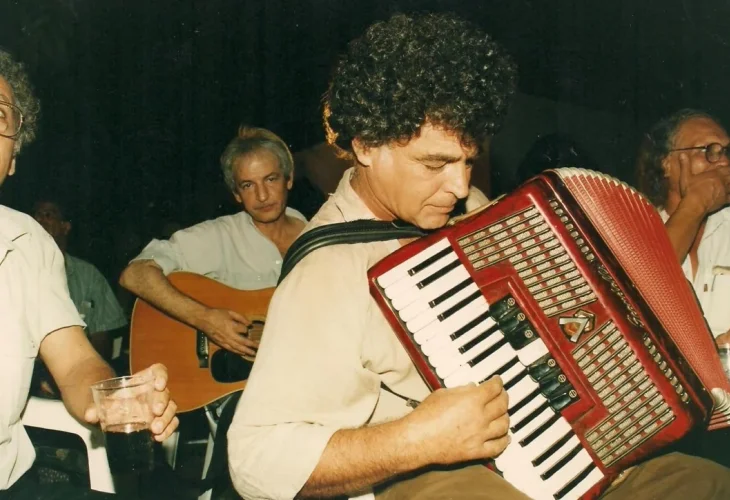 Meir Ariel, with Shalom Hanoch in the background (Photo: Courtesy of the family)
Tel Aviv's bohemian community watched curiously as the kibbutz-born singer who found fame in Israel's cultural capital wrestled with a life of contradictions. From his modest apartment at the intersection of Trumpeldor and Hayarkon streets, the melancholic melodies of Meir Ariel's accordion echoed. His distinctive lyrics shaped some of the most iconic hits of the 1990s.
At 47, Ariel moved from Kibbutz Mishmarot to Tel Aviv. Each evening, the curly-haired artist would slip away from his home, strolling down Hayarkon Street. Fans would wave hello, wondering where he was headed. Once he reached his destination, he'd cast a quick glance around and disappear into an ancient synagogue.
Every evening, Ariel would sit in a corner of the synagogue, in front of an old wooden lectern. He'd start by praying Mincha, join a Talmud study session, and end with the Arvit prayer. His family? "My father would say, 'I'm going out for a short walk,' yet he'd return hours later," recounts his son, Ehud Ariel.
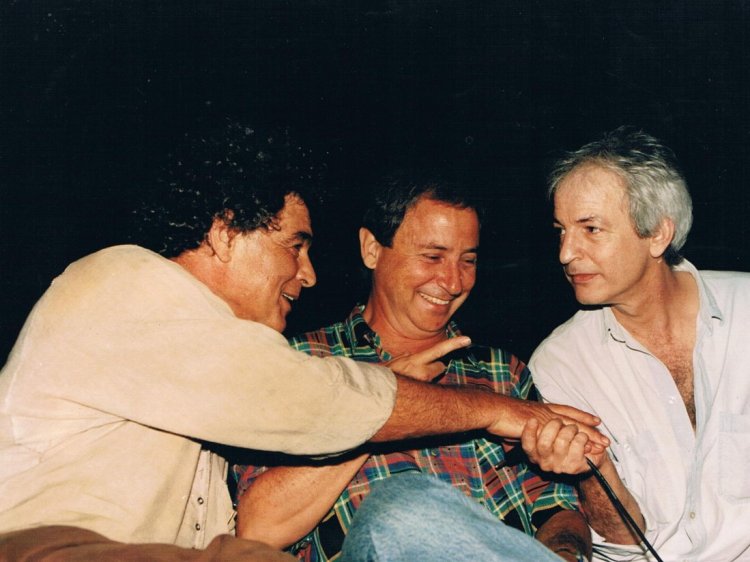 With his stage companions, Chanan Yuval and Shalom Hanoch (Photo: Courtesy of the family)
Living Between Two Worlds
What do you know about the spiritual life of Tel Aviv's bohemian icon? It turns out his closest family knew very little. By the late 1980s, Ariel was at the height of his career: his hits were at the top of Israeli playlists and aired on leading radio stations. "He was surrounded by a hive of bohemian intellectuals, making it essential for him to keep his spiritual life hidden," Ehud explains.
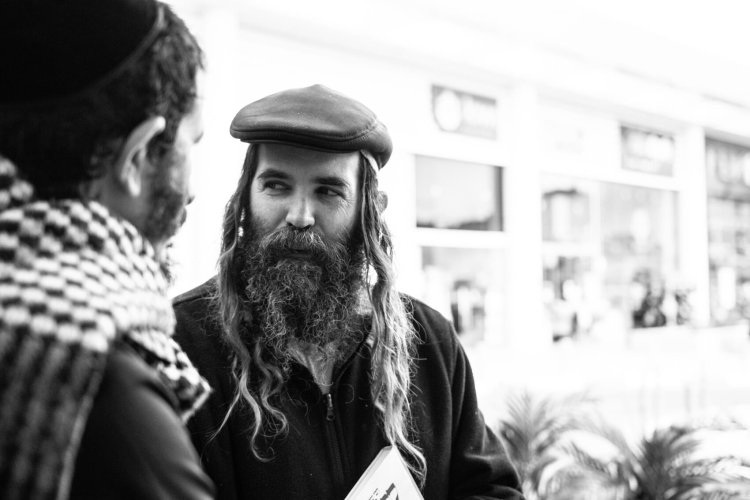
Ehud Ariel, a 49-year-old artist and creator, only uncovered his father’s secret life after his passing. "At 22, I left Israel after feeling disillusioned with life. I bought a one-way ticket and wandered around New York. Three months in, I learned my father was on the brink of death. I returned home and embarked on a long internal journey," he shares.
Why did you turn to a life of faith?
"After my father died, I felt purposeless. One day, while in his room, I fell into deep depression. I approached his library, pulled out a book, and sat down. It was 'Lekach Tov,' a commentary on the weekly Torah portions."
Every week, Meir Ariel would host study sessions on the weekly Torah portion with industry friends, and his library held many holy books. "They'd gather every Wednesday night at 10 PM, studying until 2 AM. That day, when I opened 'Lekach Tov,' I was in a deep depression. But one phrase opened the door to faith for me: 'You have a right to exist simply because you were born, and you are free to make your own decisions.' Growing up in a somewhat restrictive family, this line shocked me and helped build a new personality within me."
In what way was it "restrictive"?
"I don't want to elaborate and hurt anyone, but every family member had an opinion on my every action, scrutinizing even my smallest changes."
Like what, for example?
"When I wanted to study at a kollel for an hour and a half each morning, I wrestled with how to inform my family. We had a family business, and everyone worked together from early morning. Ultimately, I made a press announcement: 'I will now be at work only by 9:30 AM because I'm going to study at a kollel.' My mom yelled, 'Are you insane?' But I was prepared for that. They shouted at me, hurt me, thought I was entirely crazy. They were convinced I'd lost my mind."
An Adrift Child
What was your relationship with your father like?
"Not very close, but deep. I was ten when we moved from the kibbutz to Tel Aviv and found myself a lost child in the big city. The drastic change was tough. Once a week, we'd go to a movie together, and that was our 'together time.' In the evenings, he'd help me with my Bible homework—I'd read him the question, and he'd dictate the answer."
Were there any overt indications of his religious life?
"There was the weekly Torah study group with his friends. Beyond that, nothing was apparent. He was keenly aware of how the industry viewed him and didn't want to do anything that might unsettle anyone in the industry or family. Everything was intimate between him and Hashem."
Didn't this cause family conflicts?
"Not really, because he didn't impose his life on anyone. He'd light Shabbat candles, set the table, and perform Kiddush. You know what he'd call a Shabbat when he was late lighting candles? 'Embarrassing Shabbat.' During the Shabbat meal, the TV would still be on, as he never forced anyone to turn it off."
Did you share any spiritual experiences with him?
"I always looked forward to building the sukkah each year. We had a magnificent sukkah, full of decorations and colorful lights. There was a family meal on the holiday evening and a party for 200 friends afterward. There were many experiences, some deep and some symbolic—like burning chametz on the grill."
Were people in the industry aware he led a double life?
"I wouldn't call it a double life because he was very honest with himself and those around him. Both the industry and his fans sensed a change. When asked if he was becoming religious, he'd always say: 'I can't return to a place I never left.' Meaning, because he never left the religion—having never truly known it—he didn't feel he was returning to it."
Did the paradox between the 'hidden' and 'visible' ever concern you?
"Over all the years with him, I pieced together a puzzle, filling in a new part each time. I knew he loved the Bible, that he was connected to tradition, I saw him praying. He once told me, 'I have no home to fully return to; I don't belong in secular society, but I also don't feel at home in the religious community.'"
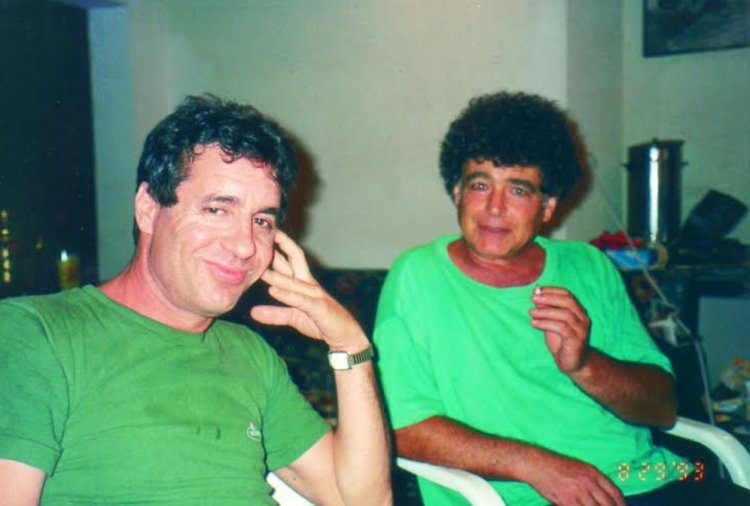 With Yehonatan Geffen (Photo: Courtesy of the family)
A Place of Reflection
Upon moving to Tel Aviv in his final decade, Meir Ariel was surrounded by industry figures and fans. Outwardly, it seemed as if nothing had changed, yet a profound internal shift occurred.
Did he study Talmud daily?
"Apparently so, with a wise old rabbi from Tel Aviv. After his passing, I discovered journals upon journals containing summaries of those lessons. Nobody knew about this, as he was very quiet and concealed his religious life."
Meir Ariel not only kept his religious life private but also guarded his inner and musical world. Today, 25 years after his death, his fan base only grows. "For years, his performances drew only 10 to 20 attendees, no more. His name became renowned only posthumously. Books are written, concerts are held, and his songs are composed anew. It's as if, even after his death, he's orchestrating the industry from above, with new songs of his still being released each year."
How would you define him in one sentence?
"I'd say he was a true center. He was both right-wing and left-wing, both religious and secular. He was accepted across the political spectrum. In major production companies, often associated with the left, he's a model of admiration. It's a miraculous phenomenon, yet he harbored all these contradictions within."
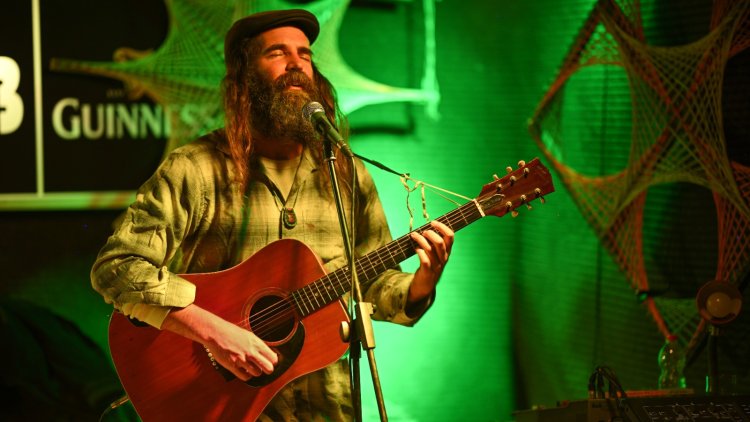 Ehud Ariel
Hello, Friend
Ehud Ariel is now working on a unique project called "3,500 – Beit Midrash for Peace." It's a virtual endeavor set to launch soon. "My father lamented that Jewish tradition was disappearing, and it pained him that secular society wasn't offered its own connection to faith. He often said every Jew should connect with their own treasures.
"That's why I chose the project's name, which signifies the 3,500 years of content and treasure behind the Jewish people," Ehud explains. "My goal is to make all the Torah's teachings and contents accessible to the secular public, to engage as many people as possible because it genuinely interests them. Everyone has an internal spark connecting them to Torah. Currently, we're fundraising, hoping to launch the project soon."
Is the project rooted in something personal?
"Yes. For many years, I asked Hashem, 'Why was I born on a kibbutz? After all, I have the soul of someone from Bnei Brak.' I can study all day without even noticing. Now I understand I was placed within Tel Aviv's bohemian scene so I could make Torah accessible to those creatives and translate everything into their language."
Is there a specific message behind 'Beit Midrash for Peace'?
"Absolutely, because without peace, there is nothing. Peace is the essence of the Jewish people. One of the most significant components of the project will address the crucial question of how we achieve peace among ourselves. I sit with individuals across the political spectrum, without naming names, and they all agree that Israel's achievements mean nothing without internal peace. We can't be a smart but divided nation, and hopefully, the moment will come when peace reigns among us."
 Ehud Ariel
