 עברית
עברית

Israel News
Netanyahu Warns Against “Empire Builders” as Israel, Greece and Cyprus Deepen Strategic Alliance
At a Jerusalem summit, Israel’s prime minister frames the trilateral partnership as a response to terrorism, regional instability and growing geopolitical pressure
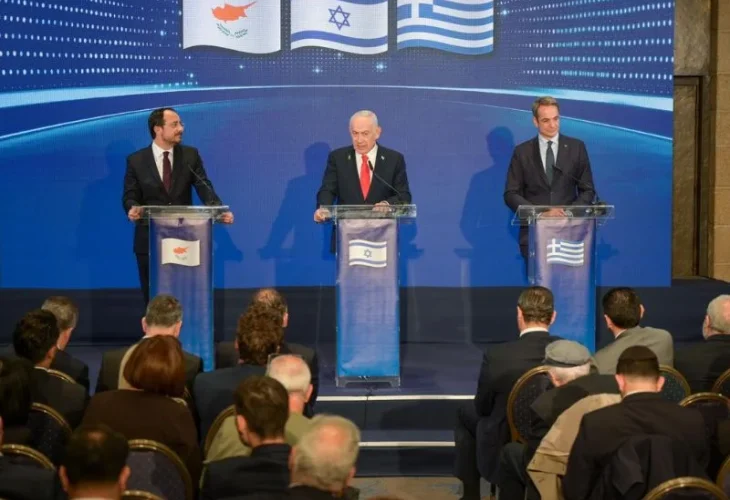 Netanyahu, Mitsotakis, and Christodoulides (GPO)
Prime Minister Benjamin Netanyahu hosted the leaders of Greece and Cyprus in Jerusalem on Monday for the tenth Israel–Greece–Cyprus trilateral summit, calling it the most consequential meeting the three countries have held. Standing alongside Greek Prime Minister Kyriakos Mitsotakis and Cypriot President Nikos Christodoulides, Netanyahu said the partnership is no longer optional in a region facing terrorism and instability.
“This is not our first meeting — it is our tenth — but it is our most fateful,” Netanyahu said, noting that the previous summit took place shortly before the October 7 Hamas massacre. The attack, he said, was a reminder that “regional stability is never guaranteed,” and said the trilateral alliance is a strategic response to those threats.
A central pillar of Netanyahu’s remarks was economic and infrastructure cooperation, particularly the India–Middle East–Europe Economic Corridor, which he referred to as the “Railway of Peace.” The initiative aims to connect Asia and Europe through Israel, Cyprus and Greece using a combination of “maritime routes, railways, pipeline systems and communications fibers linking Asia and Europe.” Netanyahu said the project, first floated in previous years, must now be turned into reality. As part of that effort, Netanyahu highlighted plans for a large electricity connection between the three countries and Europe, calling it“the backbone of the corridor.” He added that he plans to discuss the initiative in the upcoming meeting in Washington with Donald Trump.
Beyond infrastructure, Netanyahu pointed to expanding cooperation in technology, saying the countries agreed to deepen ties in artificial intelligence, cybersecurity and advanced research. He said Israeli high-tech companies are increasingly investing in Greece and Cyprus, noting, “Israeli high-tech companies are streaming to Cyprus and Greece.” Netanyahu also highlighted growing people-to-people ties, pointing to 186 weekly flights between Israel and Cyprus. “It’s unbelievable,” he said. He added that The Economist recently ranked Israel among the world’s most dynamic economies.
On the diplomatic front, Netanyahu reiterated Israel’s commitment to expanding the Abraham Accords. “We reaffirmed our commitment to widening the circle of cooperation between Israel and the Arab world,” he said. Netanyahu also expressed support for Lebanon’s sovereignty, saying military power there must rest “with legitimate state institutions, not terror organizations.”
Netanyahu also used the platform to issue a personal appeal for the return of Ran Gvili, whose body is still being held by Hamas. “I call today for the immediate return of Ran Gvili,” he said, calling the situation “a violation of the laws of war.” He added that Israel is fighting not only for security, but for a future of modern, law-abiding states against forces seeking to drag the region backward.
Netanyahu then reflected on the shared histories of Israel, Greece and Cyprus as ancient civilizations that were once ruled by empires and gave a warning. “To those who fantasize they can reestablish their empires and their dominion over our lands,” he said, “forget it. It’s not going to happen. Don’t even think about it.”
The remarks were a thinly veiled reference to Turkey, whose Ottoman predecessor ruled much of the region for centuries. Relations between Israel and Turkey have sharply deteriorated since October 7, after Turkish President Recep Tayyip Erdogan praised Hamas and accused Israel of genocide. Tensions between Turkey, Greece and Cyprus have also remained high in recent years over maritime boundaries, energy exploration and military activity in the Eastern Mediterranean.
Netanyahu also addressed Iran, confirming that Israel is monitoring recent Iranian military exercises and saying the issue will be discussed with Trump. “Any action against Israel will be met with a very severe response,” he warned.
Greek Prime Minister Mitsotakis echoed Netanyahu’s assessment of the moment, saying the trilateral framework has already delivered “tangible results” and warning that “a new geopolitical phase is emerging, with risks but also windows of opportunity.” He said the partnership provides stability at a time of growing uncertainty.
President Christodoulides emphasized Cyprus’s role as a hub for energy and regional connectivity, with the three leaders signing a joint declaration committing to deeper security and defense cooperation. The declaration stressed the importance of maritime security, safeguarding sea lanes and critical infrastructure, and called for the disarmament of Hamas and the return of Master Sgt. Ran Gvili.
Separately, Foreign Minister Gideon Sa’ar held a trilateral meeting with his Greek and Cypriot counterparts, saying, “Israel, Cyprus and Greece are three stable countries with a strong friendship in the Eastern Mediterranean. The cooperation between us benefits our peoples, the economies of the three countries and regional stability. We will continue to advance it.”
Netanyahu closed the summit by casting the alliance as a union of democracies determined to defend themselves. “Together,” he said, “we will bring stability through strength, prosperity through strength, and above all — peace through strength.”


