
Magazine
Tamir Gal on Faith, Fame, and His Powerful Comeback
Tamir Gal opens up about loss, resilience, Mizrahi music, family, and the deep faith that carried him through darkness to renewed success
- Hidabroot
- |Updated
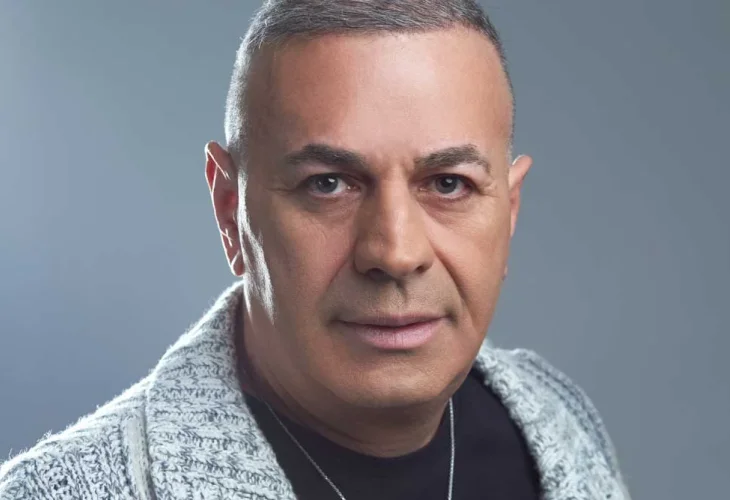 Tamir Gal (Credit: Tomer Terlan)
“Even if I leave this world — I will never truly die,” says Tamir Gal, one of the most prominent figures in Mizrahi music, with disarming honesty. “I know quite a few singers — most of them didn’t make it. They went too early. So I say thank you, and a thousand thanks, to the Creator for the gift of life.”
You don’t replace a winning horse, and Gal has undeniably become one of Mizrahi music’s winning horses. In the 1990s, he headlined the biggest stages in Israel and released countless hits. Then, suddenly, he disappeared. Recently, he’s returned — surprising everyone with a full-fledged comeback. “History is repeating itself,” he says, still in disbelief. “Here it is — it’s happening.”
“The Creator brought me into this world to bring joy,” Gal says with certainty. “God gave me a beautiful voice as a gift, and with all modesty and humility — it’s enjoyable to listen to me. It’s a privilege, and it’s my purpose in this world: to make people happy, to pull them out of depression.”
“It Heals Their Hearts”
Despite being branded for years as a “depression singer” — and even nicknamed by fans “the legend of depressive singing”, Tamir Gal (57) rejects the label outright.
“I don’t recognize this title, ‘depression singer,’” he says. “My songs are songs of reality. They’re painful experiences I went through in my own life, and I express them through music. Shlomo Artzi also has sad songs, but no one would dare call him a depression singer.”
Why not? “Because he’s Shlomo Artzi.”
“Let’s put it this way: Mizrahi singers have always been pushed to the margins. We weren’t allowed to advance. If my name had been Tamir Artzi, no one would call me a depression singer. If I were the son of Arik Einstein, they’d call me an Israeli singer.”
But today, that stigma is gone. Mizrahi music dominates.
“True — but notice that today’s Mizrahi mainstream came from the margins. And notice something else: even after breaking through, they didn’t change the genre. They’re still composing melodies one-to-one, just like authentic Turkish music.”
“We’re not depression singers — we’re soul singers,” Gal emphasizes. “These songs are healing songs. I know people whose lives shattered into a thousand pieces — and it was the songs that strengthened them. I’m talking about people who sat in prison, who fell into drugs, who came from broken families.”
Is that something you’ve actually seen?
“Absolutely. Recently, after one of my shows, a woman told me that thanks to my song ‘HaChoshech HaMar’ (‘The Bitter Darkness’), she got out of a very destructive cycle of self-harm. I perform in women’s rehabilitation hostels, in juvenile prisons, and I sing songs that reconnect them to their souls. Afterwards they tell me, ‘Tamir, these songs are saving us.’”
You do this voluntarily?
“Of course.”
“If You Had Told Me, I Wouldn’t Have Believed You”
After three years of silence, Gal recently returned to the spotlight. His songs are once again playing on Israel’s leading radio stations, and some have become playlist hits.
“I’m coming back to live shows too, with God’s help,” he says. “Not long ago, Eyal Golan hosted me at Menora Arena. Twelve thousand people sang my song — roaring in a way that’s impossible to describe.”
Did that surprise you?
“No. Throughout my career, I never swerved left or right — I always walked straight toward the goal. Even when I missed it a bit along the way, I knew I’d come back one day. I knew people missed me.
“Who would’ve believed that my genre would reach places like Menora Arena? True, Galgalatz still hasn’t embraced it — but that station dictates what the nation should listen to. Ask the people themselves, and they’ll tell you: ‘Play Tamir Gal. Play Ofer Levy.’ That’s what the audience wants.”
“Today, I’m finally getting what I didn’t get in thirty years of career — calls from the U.S. I’m about to fly out on a tour across America, and in the meantime I’m performing at Zappa. There’s a huge audience for what you call ‘depression music.’”
“If you’d told me thirty years ago that my song ‘Shvil HaOsher’ (‘The Path of Happiness’) would break through the way it has now, I would’ve told you you’re dreaming. People eulogized me, and then suddenly I came back from nowhere. If you’d told me that when I was in the dark, I wouldn’t have believed you.”
Let’s talk honestly about that dark period.
“That’s behind me. I don’t want to wake the dead.”
Still — you were at a low point and came back.
“I was never at rock bottom. Erase that word from your vocabulary. I was closed off — with my thoughts, with my depression. But even then, I was making music.”
But there was a time when you disappeared.
“I never disappeared. I just didn’t have the recognition I have today. That’s all. They said about me: ‘It’s a lost cause — nothing can be done.’ And suddenly, look what happened in one year. Anyone can fall where I fell, but not everyone can get back up,” Gal says firmly. “One day I got myself together and said: either you get up for your family, or you’re headed for total collapse.”
You were really on the brink?
“Yes. When you sit at the Shabbat table and see only two people instead of eight — because that’s all that’s left, you can fall apart very quickly. Suddenly you find your mother dead. Suddenly you see your sister in Abu Kabir. These are things that should’ve destroyed me. But I realized my wife and kids weren’t to blame for what I went through — and I couldn’t destroy them along with me.
“I looked at my wife — the best in the world, and at my kids — the most beautiful in the world. And I made a decision: what I went through, none of them will ever go through.”
Your voice breaks when you talk about this.
“Because I’m human. As much as people said I’m aggressive or bad, no one imagines how sensitive I am. I have a heart. I have feelings. I cry too. Getting out of a darkness like that without being scarred is one in a million. And I truly came out of it stronger than ever. Today my success and prosperity are a million times greater than at the beginning of my career.”
“I’m not someone who wants to eat the cake and keep it whole,” he adds. “Give me a slice, and I’m set. I always look at the half-full cup. Yes, I went through what I went through — but I came out strong thanks to myself, thanks to my family, and above all, thanks to the Creator.”
How strongly did you feel God with you during that time?
“I always felt Him with me. Without Him, I might not even be talking to you right now — and I hope you understand what I mean. Most people wouldn’t survive what I survived. God protected me, and I know He protects me all the time. He gave me endless gifts.”
And what do you give Him back?
“Shabbat. For a million dollars, I won’t desecrate it. If someone tells me, ‘Sing a short song and I’ll give you a million dollars,’ I’ll tell him to take the money and get out of my sight. I’m loyal to God. He gave me so much — Friday and Saturday, I give Him.”
Were you always connected to Shabbat?
“I was connected, but I didn’t keep it. Today, when I make kiddush with my kids, I can’t stop thinking how stupid I was to give up Shabbat for thirty years of career. Apparently, I needed that slap in life to understand that in the end, there’s nothing like Shabbat. I’m not losing my way again — I’ll never give it up.”
“No one stays alive forever,” Gal suddenly adds. “In the end, we all get where we get, and the only thing that remains is the memory of who we were. I’ll leave masterpieces behind me in this world — my family and my songs. I know many singers who didn’t make it and went too early, so I say thank you and a thousand thanks — to the Creator first and foremost, and to my family.”
And friends?
“There are no friends. When I sank deep into my fall, they called — not to check how I was, but to make sure I was still falling. When I was at the height of my success, no one called to compliment me. They didn’t know how to handle me. Only when I fell did everyone suddenly start sniffing around to see if I was sinking further. That’s the industry: when you’re down, everyone’s happy; when you’re up, everyone’s sad. In moments like that, you realize you have no one but the Creator.”

