
Magazine
From Tattoos to Tefillin: The Unbelievable Journey of Ohad Itzchakov
A life-changing spiritual awakening, miraculous meetings, and the faith-filled path that led to a Torah-centered family
- Hidabroot
- |Updated
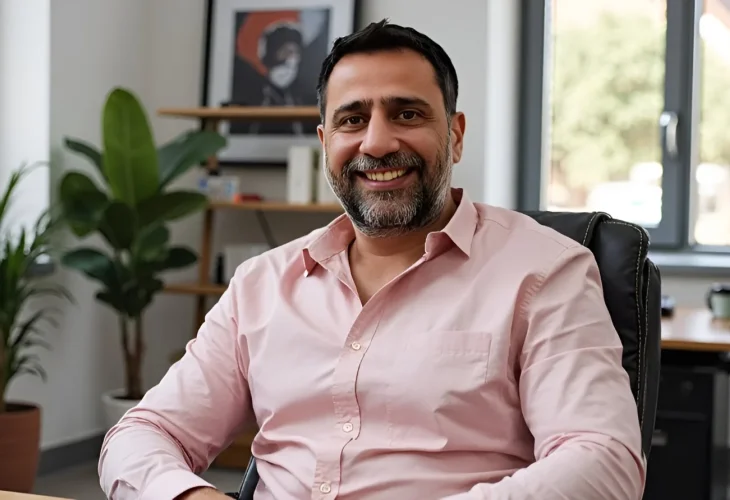 Ohad Yitzhakov (Photo: Eli Kaselman)
"Who could have imagined that the secular guy — the outstanding basketball player who spent years working in tattooing, would become religious? I certainly didn’t believe it myself,” says Ohad Itzchakov, smiling. More than 14 years have passed since the process he went through, and he still can’t quite believe the greatest turning point of his life. “It wasn’t just that I became religious,” he says. “The chain of events was truly beyond nature. It moves me to think about it, because divine providence is the only thing that led me there — there’s no other explanation.”
Removing the Tattoo
Itzchakov grew up in the Ramat Ilan neighborhood of Givat Shmuel, “a very Ashkenazi, elitist neighborhood,” as he defines it. “My parents are wonderful, kind people who raised us with great values, but with no connection to religion. The closest thing to Judaism we did was Kiddush on Friday night — and right after that, of course, we ran to watch the news on TV.
“I can hardly remember ever seeing a person wearing a kippah in my life, because there simply wasn’t even one in the entire neighborhood. Most of my friends were sons of lawyers and doctors, sent to countless extracurriculars and afternoon study frameworks to help them acquire similar professions in the future. Intellectually, they were ‘the top of the group,’ but their level of morality was so low that I remember how, in our free time, we competed over who could steal more packs of cigarettes from the corner grocery store. And I’m not talking about delinquents — these were ‘good kids,’ but with zero moral compass.
“I was one of the gang, and I looked the part, with dozens of earrings all over my body, living a shallow life but at a high level. That trend only intensified over time: I grew up, matured, found a good job, and even managed to buy an apartment while still single.”
At some point, Itzchakov decided to open a tattoo studio, which grew more successful by the day. “Unfortunately, I was deeply involved in that world, but there was a red line I set very clearly: I would never tattoo myself. I didn’t have an explanation for it, but something deep inside told me that tattoos are a bad thing — something Jews don’t do.
“One day I went through a turbulent period that led to a kind of crisis — and a decision that I did want to get a tattoo after all. The tattoo artist who worked with me at the time was shocked and tried to dissuade me, but I insisted. The moment he lifted the needle from my back, I felt with my entire being that I had made a mistake — that I was carrying a ton-and-a-half weight on my back that wouldn’t come off.
“From that moment, a clear decision formed in me: ‘I’m going to remove this tattoo,’ and I knew it would happen. After that incident I decided to close the clinic and drifted into the world of advertising. I opened an ad agency and began working in the field, and then an idea came to me: I’d look for a tattoo-removal clinic, offer the owner advertising at a discounted price — and in return he’d remove my tattoo at a good price. That’s exactly what I did. I started calling clinics that do tattoo removal; I even went to meetings with some of them. But for some reason the plan didn’t work: no one wanted to buy advertising, and the prices they quoted were extremely high — more than I could afford.
“Eventually I reached a clinic operating out of a home in Holon and met a wonderful man who was a baal teshuvah — a term I hadn’t even known at the time. He did want to buy advertising. Then I moved to the next step and suggested that instead of paying cash for the ads, he remove the tattoo that bothered me so much.
“His response was: ‘Pay whatever amount you want for the tattoo removal — but on one condition: that you start right now, this very moment.’ To be honest, I was a little scared, but I recognized the opportunity. I said I was willing to pay 2,000 shekels, knowing the real price was over 5,000. He agreed — and we started that very day.”
Itzchakov notes that unlike getting the tattoo, which took less than an hour, removing it required a series of treatments. “But I have to say that from the very first treatment I felt my luck begin to loosen, and my vitality grow,” he explains. “There’s no rational explanation — it just did me good. I kept coming for treatments, and along the way I connected with the therapist and we became close friends. In the end the tattoo was completely removed, but the connection remained. Later his business expanded and he moved to a larger place. He needed another staff member and offered me a job. I joined him and worked there for about half a year. After that we parted as friends, but I continued to come for about five years to work with him on tattoo removal — promising myself that ‘for every tattoo I did as a tattoo artist, I would remove ten.’ And that’s exactly what happened: I removed roughly ten times as many tattoos as I had done when I owned a clinic. I feel that this was a true rectification, and I thank God for granting me the merit to repair that terrible blemish.”
Along the way, something else happened to Itzchakov. “I found myself sitting with the clinic owner, talking for hours — almost the entire night, about the meaning of life and the question of all questions: ‘Is there a Creator?’ He suggested I buy the book In the Garden of Faith, and I had no idea where that book would lead me.”
“The Rabbi Promised: There Will Be Four”
Itzchakov pauses and asks to tell his wife’s story. “My dear wife, Dikla, was single and lacked nothing. She was successful in her career, very educated — but hadn’t yet found her match. A week after I myself began taking an interest in Judaism, she decided to go to Rebbetzin Kanievsky, of blessed memory, to ask for a blessing for a suitable match. When her turn came, the rebbetzin asked if she had come to request a blessing for marriage, and my wife said yes. The rebbetzin responded: ‘Don’t worry — tomorrow you will meet your husband.’ That sounded completely illogical. What were the chances that tomorrow, after such a long search, she would meet her husband — and how could one say ‘tomorrow’ with such certainty?
“Despite everything, my wife left encouraged and returned home. The next day she went to a movie with a friend, but for no clear reason her credit card didn’t work. Instead of the movie, they wandered around and went to have a beer nearby. And then something else unlikely happened: even though my wife had never smoked and her friend wasn’t a smoker either, they decided to sit at the smokers’ tables. And right there — at those very tables, I was sitting with a few friends.
“We met that very day. Half a year later we got engaged, and three months after that we were already married.” Itzchakov pauses and adds: “Only after we met did Dikla tell me that exactly a week before she met the rebbetzin, she had taken upon herself to keep Shabbat. That means it was precisely the same time that I began to strengthen as well. We both started growing together — and a week later, we met.”
But the story has another dramatic chapter. “As long as I can remember, I always wanted many children and dreamed of a big family. Since when we married we were no longer very young, I didn’t want to delay even a single day in starting a family. Unfortunately, it didn’t happen. A year passed without children, and one evening we decided to host a Torah class in our home. It was a real production, with many people invited and a wonderful atmosphere of outreach. That day my wife — without my knowledge, decided to take the pill Clomiphene. That very evening, we were blessed to conceive.
“What happened afterward was even more extraordinary. We realized that my wife was pregnant, and we were overjoyed. But several weeks later, when she went alone for her first checkup to make sure everything was okay, she called me and couldn’t speak. After long seconds she finally whispered, with difficulty: ‘The doctor said we’re having triplets.’ Then it was my turn to fall silent. In an instant I understood the meaning of the delay God had given us — it was entirely for our benefit. A delay that led my wife to take the pill, and thus God sent us three precious gifts.”
Itzchakov says that from that moment on, Dikla was placed on strict bed rest. They consulted doctors constantly, and all of them recommended “reduction,” explaining that “in a first pregnancy you don’t know how strong the uterus is, and it’s better to keep two babies than, God forbid, lose three.”
“To be honest, we almost agreed — and even scheduled an appointment for reduction,” he says. “But fortunately, a dear friend who accompanies us through the Arachim organization heard about it and suggested we consult with Rabbi Chaim Kanievsky, of blessed memory. We went to him on the very eve of the reduction. I will never forget what happend at that meeting. I was asked to write the reason for my visit on a note, which I did. The rabbi read it, lifted his holy eyes, and said: ‘The Holy One wants to give three gifts — how could one kill one?’ Just remembering it fills me with tears. I got up ashamed, not understanding how I could have even considered such a thing. I had dreamed of a big family. When the friend sitting with me asked the rabbi, ‘So, will they have triplets?’ the rabbi replied, astonishingly: ‘There will be four.’ Then he blessed me. As soon as I left, I called my wife and told her to cancel the reduction appointment so we could continue the pregnancy as usual and accept whatever news would come with love and faith in the sages.
“Thank God, at the proper time the pregnancy ended, and three healthy, wise, perfect children were born — Eitan, Omer, and Talia. By the way, five years later the rabbi’s blessing was fulfilled in full when our wonderful Yael was born, making our children a quartet.”
Slowly and Gradually
Today, Itzchakov and his wife operate their home on the foundations of Torah and mitzvot. Itzchakov works as a marketing and advertising manager at the National Mediation Center and sees it as a great privilege to share his story and strengthen as many people as possible.
You went through an extremely radical transformation — what was the greatest difficulty you had to face?
“Honestly, I don’t remember any real difficulty,” he replies after some thought. “On the contrary — I had lived very empty years, and Judaism brought a lot of content into my life and did me only good. The only difficulty was breaking bad habits that had accompanied me until age thirty. It was very hard to leave them — but thank God, in the end I managed to free myself from most of them.”
How did you do it?
“It really wasn’t simple. I’ll give an example: At first it was very hard for me to get up every morning for Shacharit. Even on Shabbat I would pray Maariv, Kabbalat Shabbat, and Mincha — but Shacharit was off-limits for me. Until one Shabbat when we visited Or Yehuda and I came to Kabbalat Shabbat. There was a friendly rabbi who greeted me warmly. When we parted, he said, ‘I’ll see you in the morning!’ I stammered that I didn’t know if I’d wake up on time. He replied, ‘Come whenever you wake up — even just ten minutes for Musaf.’ That sentence went straight to my heart. I decided that if I woke up at a reasonable hour, I’d go. The next day I woke up at ten and went to synagogue. After that I kept going on subsequent Shabbatot, and then it extended to weekdays — first only on Rosh Chodesh, then on Mondays and Thursdays, the days of Torah reading. Today I often even get up at sunrise to pray.
“The same applied to other mitzvot, such as refraining from weekday activities on Shabbat, which was very hard for me after years of playing basketball and watching TV. There too I went through the process gradually, until today I even refrain from reading newspapers on Shabbat.
“That’s also my recommendation to other baalei teshuvah who consult with me: don’t rush. Do everything gradually, at a slow and steady pace — and above all, pray to the Creator to give us all the wisdom and strength to go through the process in the best possible way.”

