
Magazine
The Last Jew of Myanmar: Living Alone Through War, Fear, and Faith
Inside the life of Sammy Samuels, the sole Jewish resident of Myanmar, guarding a historic synagogue amid civil war and rising danger
- Chaim Gefen
- |Updated
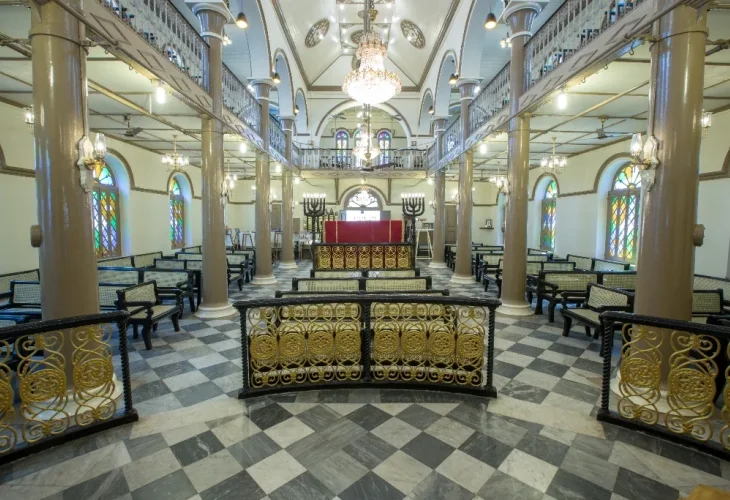 The 'Musmeah Yeshua' Synagogue in Yangon
“It’s dangerous for me to be interviewed right now — the security situation in Myanmar is very frightening.”
That short sentence, spoken to me by Sammy Samuels, the only Jew living in Myanmar, only fueled my curiosity. “What could really happen to you?” I asked. Sammy fell silent for a moment, reflected to himself, and then answered with an even longer silence.
Samuels, 45, is a local tour guide by profession and the last remaining Jew in the war-torn country in Southeast Asia. Myanmar’s history is saturated with brutal and bloody wars, driven by the political whims of military revolutionaries. The most recent one erupted in 2021, following a military coup led by the dictator Min Aung Hlaing. “It’s a bloody civil war, and it’s still ongoing,” Samuels says.
So why has he chosen to remain in Myanmar? Why hasn’t he immigrated to Israel? And how did he ultimately agree to be interviewed despite the danger?
I Walk Alone
The story of the Jewish community in Myanmar — formerly Burma, begins in the 19th century, when many Jews immigrated there from neighboring Asian countries. They arrived from Cochin and Calcutta in India, as well as from Iran and Iraq. “At its peak, the community numbered about 2,500 Jews, and Jewish life in Myanmar was more vibrant than ever,” says Samuels.
With the outbreak of World War II, the vast majority of the community’s Jews fled Myanmar. Some returned to their countries of origin, while others immigrated to the United States. Many of the Jews who remained were executed by the Japanese army. Jewish soldiers serving in the British army were captured by the Japanese, tortured, and murdered. After the establishment of the State of Israel, most of the remaining Jews of Burma immigrated there, leaving only a few behind in Yangon — chief among them, members of the Samuels family.
Why did your family choose to stay?
“The only reason my family stayed was to preserve our synagogue, which is an inseparable part of who we are. This tradition has been passed down from generation to generation, and it’s a tremendous privilege to be responsible for the synagogue — its upkeep, its care, and its dignity.”
126 Torah Scrolls
In the heart of downtown Yangon, amid the narrow alleys of a colorful marketplace, stands the Musmeah Yeshua Synagogue. It faces a row of vibrant shops and is immersed in fragrant aromas rising from piles of spices. The synagogue is large and magnificent, surrounded on all sides by a lush garden.
The synagogue contains 250 seats, a testament to the size of the community in its heyday. Along its eastern wall stands a carved wooden ark, draped in ornate embroidered curtains. “In the past, it housed 126 Torah scrolls,” Samuels says, astonishingly. “Most of them came from Iraq, where there were many synagogues. Today, only two Torah scrolls remain here. When the Jews of the community left Myanmar — some to India and others to the United States, they took the Torah scrolls with them so they could be used in the synagogues where they settled.”
Is the synagogue still open today?
“Until the coup in early 2021, I opened it every day. Many visitors came and marveled at its beauty. We hosted Jewish tourist events, sometimes with more than 300 participants. Today, all activity has been scaled back significantly.”
About a decade ago, the synagogue was declared a national heritage site. In a special ceremony attended by senior government officials and representatives of the Israeli embassy, a blue commemorative plaque was installed on its façade. “It was a very special event,” Samuels recalls. “The Burmese media covered it extensively, and it was broadcast widely on state television.”
On the outskirts of the city lies the Jewish cemetery, resting in silence. About 600 members of the community are buried there, including those murdered by Japanese forces during World War II. “From time to time I visit the cemetery, pray there, and then clean and care for it,” he says.
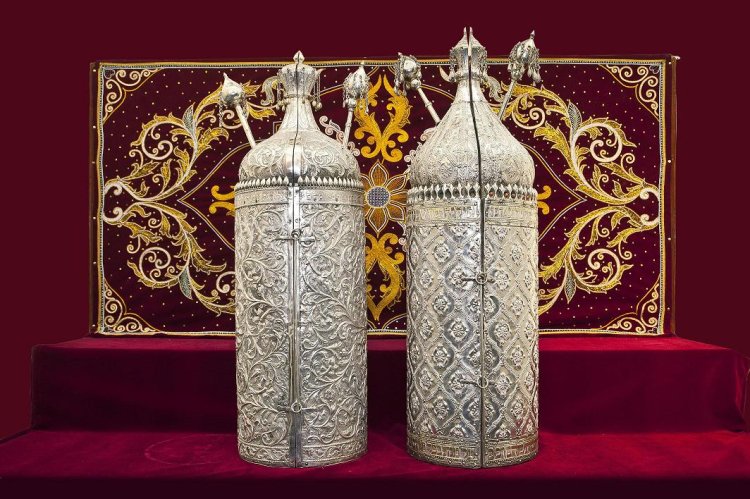 שני ספרי התורה שנותרו בבית הכנסת
Being the Only Jew
Buddhism is the dominant religion in Myanmar. About 88% of the population worship statues and idols in local temples. There are also small minorities of Christians, Muslims, and others. Samuels stands as a lone Jewish beacon in the country.
He notes that the Burmese people are generally fond of Israel and Judaism, and that he does not need to hide his Jewish identity. “Even the government itself respects and appreciates us. Some leaders have attended special community events we organized, openly and proudly.”
After Hamas’s brutal attack on Israel on October 7, Samuels gave an interview to the American VOA network in which he condemned the massacre. “A few days later, dozens of soldiers arrived at the synagogue. They told me they had received intelligence about local terrorists planning to attack it. They instructed me not to travel except between home and work. A unit of soldiers was stationed near the synagogue to guard it.
“These were days I will never forget,” he says. “I was deeply afraid — for myself, for my children, and for our precious synagogue. Because we are the only Jews in the country, we became a target. The synagogue became the means through which terrorists could reach us. The days and nights felt long and threatening; every moment felt like an eternity. After two weeks of constant protection, I received official notice that the threat had been removed.”
If it’s dangerous, why agree to this interview now?
“The interview I gave to VOA was in Burmese, so people here understood it. I assume this interview won’t be read locally. In general, I prefer to keep a low profile,” he says.
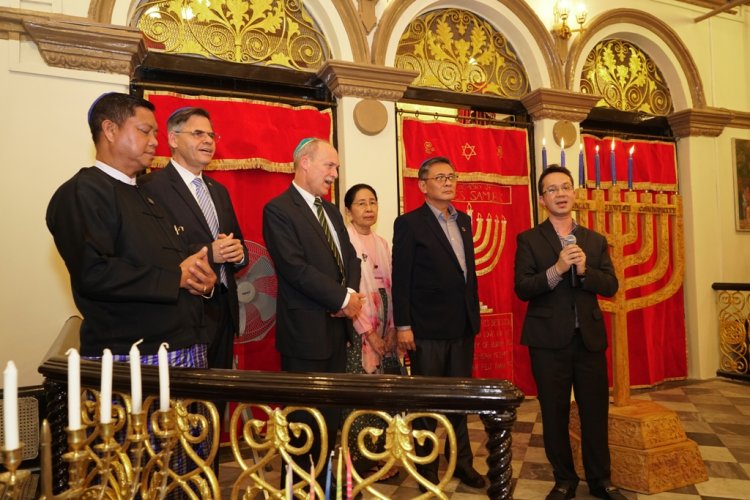 סמואלוס נואם באירוע קהילתי בבית הכנסת, בנוכחות פוליטיקאים מקומיים
Soon in Israel
Burma gained independence in 1948, and its nationalist leader, U Nu, became the country’s first prime minister. He held warm views toward Israel and established diplomatic relations with it. In 1955, he paid a state visit to Israel, becoming the first international leader to do so — despite heavy pressure from Arab countries. At his farewell ceremony, attended by Prime Minister David Ben-Gurion, U Nu said: “My friends, I was in Israel — and I fell in love with you.”
In the 1980s and 1990s, Myanmar experienced a series of military coups and uprisings. During the famous “8888 Uprising” on August 8, 1988, thousands of protesters — including many children, were killed. In 2015, general elections were held, but in early 2021 another coup took place, and General Min Aung Hlaing seized power. He has been accused by the UN of genocide and crimes against humanity. The death toll has reached many thousands.
Does the political situation affect you personally as a Jew?
“Not directly, but indirectly, very much so,” Samuels explains. “Jewish tourists have almost disappeared, and most won’t return as long as the brutal war continues. Jews who had recently moved here also fled after the coup.”
When will we see you in Israel?
“I visit Israel every year, and I miss it terribly,” he says. “I still don’t know when I’ll immigrate permanently, but I hope that one day I truly will — and may it be very soon.”

