
Magazine
From Virology to Faith: How a PhD in Biology Led Shiri Masa to Discover God in Nature
A virologist, educator, and award-winning teacher shares how science, biology, and life’s deepest questions guided her journey to faith
- Moriah Luz
- |Updated
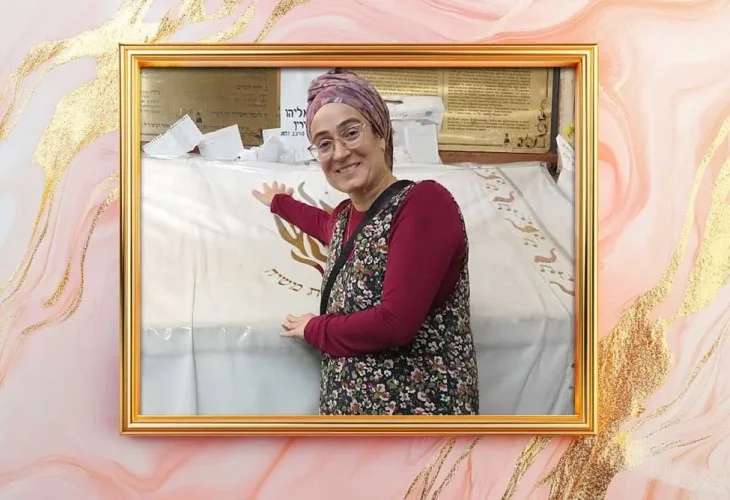 Shiri Messa visiting the tomb of Rabbi Nachman of Breslov.
Shiri Masa holds a PhD in virology, a field within biology. Her husband, Kobi, is a retired Israeli Air Force officer. Behind these impressive résumés stands a couple who, alongside their professional lives, dedicate themselves to spreading Torah. They are close to the Breslov Chassidic tradition — though Shiri is careful to emphasize: “I love all the books and all the righteous figures.”
Shiri was born into a non-religious family that nevertheless respected tradition. “My grandparents were religious,” she recalls, “so when we ate out, for example, we didn’t check whether the place was kosher, but we avoided eating shellfish. I didn’t know much about Judaism or halacha. I remember myself as a student at Bar-Ilan University, getting on a bus to nearby Bnei Brak dressed in a way that clearly didn’t match the city’s way of life. But it’s important for me to say: I didn’t do this out of disrespect, but out of ignorance. I truly didn’t know that the way I dressed could offend someone.”
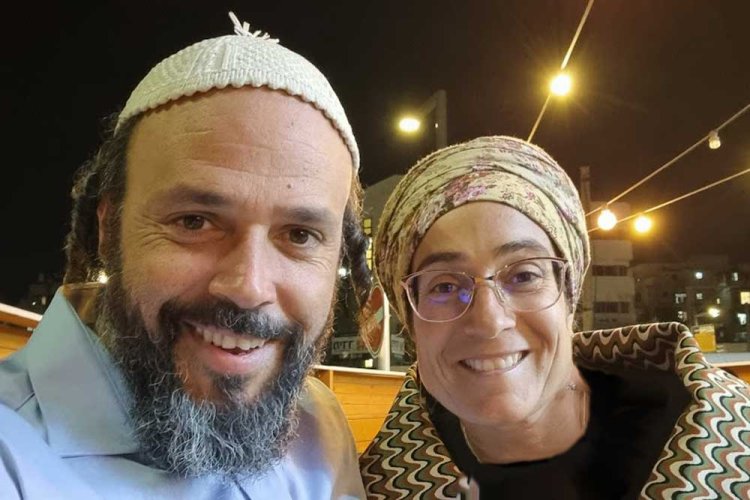 שירי וקובי מסה
How did you end up in biology?
“I was born prematurely, almost two months before my due date,” Masa says, “and I grew up as a small, sickly child who spent a lot of time in doctors’ offices. Gradually, I developed a strong grasp of medical concepts. I remember explaining to a nurse which medication she should give me and in what dosage, and reminding doctors to add anesthesia when it was a painful injection.
“I think that’s where my attraction to the field began. In the army, I served as both a soldier and an officer in the Medical Corps, and when my service ended, I wanted to study medicine. My psychometric score wasn’t high enough, and I debated whether to take the test again. After consulting with my father, I decided to begin a degree in life sciences, from which it’s possible to continue on to medical studies.”
Shiri began studying at university in the Faculty of Life Sciences and enjoyed it immensely. She says that two courses in particular shook her deeply.
“I took a course on cell biology and sat there completely captivated. The course dealt with all the molecular events that take place inside a cell in order for it to function. I asked myself: ‘How is it possible that a molecule knows exactly what its role is, the precise timing of when it needs to appear, and where it needs to bind and act as a perfect function?’ It felt too good to be true.”
Another course dealt with basic chemistry and atomic structure. Through it, Shiri learned that all of creation is made of atoms — and that an atom itself is mostly empty space.
“Anyone who truly understands what they’re learning realizes that everything we see and touch as ‘matter’ — whether inanimate, plant, animal, or human, is actually an illusion. Matter is made up of connections between particles of energy. If I had a microscope that allowed me to look inside matter at extremely high resolution, and I went really deep into the atom — what would I see? Nothing. Empty space. I just couldn’t grasp it,” she continues. “How can there be a sweet apple in front of me, or a person who speaks, lives, and reproduces — when it’s all emptiness and interactions of energy?”
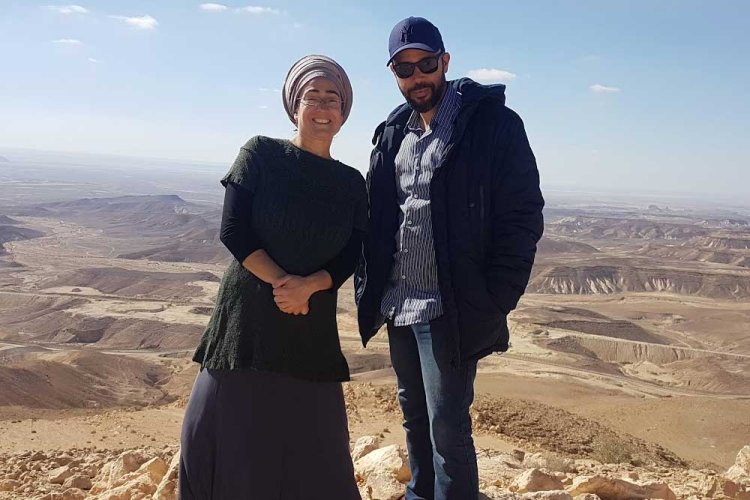 שירי עם בעלה קובי
Time passed, and Shiri continued her studies, with these and other questions constantly accompanying her.
“At some point, I reached the realization that there must be a Creator. It was clear to me that the world could not have created itself. The wisdom of the Creator was shouting at me from nature. To this day, I don’t understand how intelligent people can remain indifferent to this knowledge.”
“As part of my studies, we went deeper into biochemistry, where we learned that every protein has a precise structure that matches its function exactly. That was the first time in my life — at age 25, that I asked myself: ‘If a protein has a purpose, then what is my purpose? Why did I come into this world?’ I decided that I wanted to truly start searching and clarifying what my purpose was.”
That search led her to Judaism, and from there the path to becoming religious was short. Three and a half years later, she met her husband Kobi — he, too, was a returnee to religious life.
“Our matchmakers were my grandmother and a friend her age. Neither of us believed anything would come of the suggestion, and we both refused at first — until it finally happened. When we met, we discovered that we lived just two streets away from each other.”
Today, they are parents to five children.
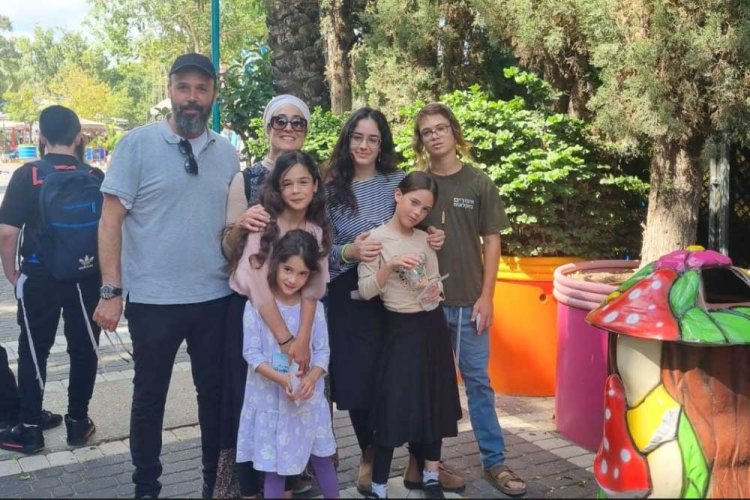 משפחת מסה
Tools for Serving God
Alongside building her family and deepening her connection to her roots, Shiri continued advancing in her biology studies. In recent years, she has been combining the knowledge she accumulated with Torah sources in a course called “Faith-Based Biology,” which she teaches at a girls’ midrasha in Mitzpe Ramon.
“One of the amazing things I discovered through studying biology,” she says, “is that within the laws of nature and scientific theories, the Creator embedded golden principles for living a healthy life and strengthening faith. Real tools for serving God — tools that allow a direct connection and relationship with Him.”
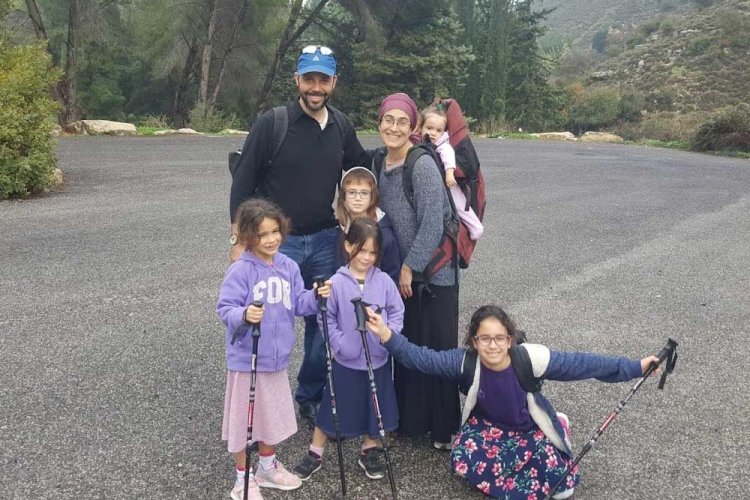 עם משפחתה בכביש חוצה ישראל
That sounds fascinating. Can you elaborate?
“Look at the ceiling light in your home, which produces white light. Physically speaking, the white light you see is made up of all the colors. If I allow that white beam of light to refract through a transparent medium — like water, plastic, or glass, it will undergo ‘double refraction.’ In that state, all the colors hidden within the white light are revealed, and we see the colors of the rainbow: red, orange, yellow, green, blue.
“In other words, a rainbow is the result of white light breaking, revealing all the colors that were already contained within it. How does this relate to us? In class, I explain to my students that every person goes through crises in life, and some people go through very difficult trials that truly ‘break’ them. But the purpose of the crisis — the breaking, is to allow a person to discover more ‘colors’ within themselves: more strengths that existed inside them all along, that they didn’t know about, because they were never pushed to a place so constricted that they needed to reveal them.
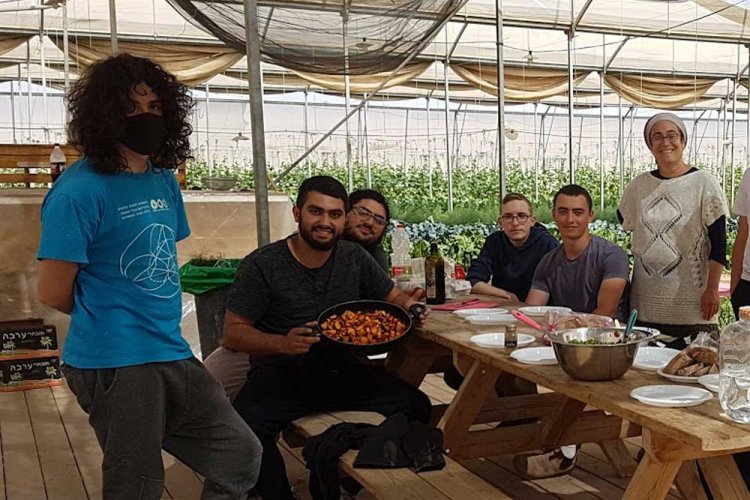 שירי עם תלמידיה בחממה - מכינים ארוחה ממה שקטפו
“As long as I stay in my comfort zone, I can keep behaving in familiar ways. But when God wants to help me grow and reveal more strengths within me, it often happens through moments of crisis. The crisis is what pushes me to a point where I have no choice but to bring out strengths I never knew I had.”
Massa continues to explain, offering example after example with great fluency, grounding them in sources such as the Zohar and Likutei Moharan. She speaks about chemical equilibrium between reactants and products — how changing one side inevitably affects the other, and draws lessons from this about social and marital relationships: any change on one side of a relationship inevitably affects the other side.
She also gives the example of a liver cell: if it “refuses” to be a liver cell and instead “wants” to be a different type of cell, the body’s system will lose it — meaning the body’s functioning will deteriorate. At the same time, the cell must listen to instructions coming from the brain and nervous system. A cell that does not follow instructions leads to illness in the body.
For Masa, this teaches about a person’s obligation to be attentive to the unique role that God planted within them and to realize it — while also listening to the laws of the Torah and to one’s broader responsibilities.
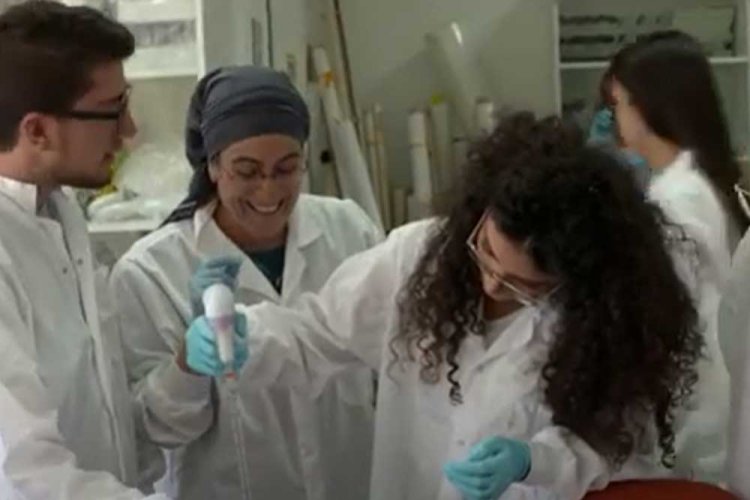 שירי עם תלמידיה בבית הספר (צילום מסך)
Today, you’re a high-school biology teacher. What led you into education, despite holding a PhD?
“I arrived in teaching entirely through divine providence. Until a few years ago, my husband served in a permanent position in the Air Force, which is why we came to live here, in Mitzpe Ramon. Very quickly, we fell in love with the place and the people. Shortly after we moved here, I was supposed to begin a post-doctoral position, but I knew it would demand a lot from me, and since my husband wasn’t around much, I decided to postpone it.
“One day, the principal of the local state high school approached me and said they were urgently looking for a biology teacher to temporarily replace the regular teacher. He was very ill at the time, and sadly passed away a few months later.”
Shiri entered the position temporarily — and thirteen years later, she’s still there. A few years ago, she was awarded the title “Teacher of the Nation.” Candidates are nominated by their students, and after a selection process by a competition committee, seven teachers receive the title.
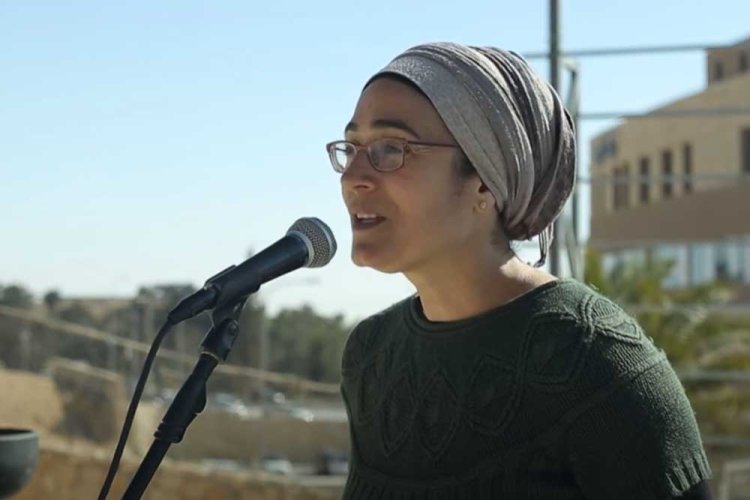 מדליקה משואה ביום העצמאות במצפה רמון (צילום מסך)
What made your students submit your candidacy?
“Students who walk into my classroom know they’re stepping into a different world. It’s not a regular lesson — it’s a lesson filled with emotion and fire in the heart. For me, when I teach biology, I’m simultaneously teaching about the Creator. I don’t mention Him by name, but the students feel it, and their hearts ignite with love, curiosity, interest, and connection.
“A student understands one thing from another, and suddenly things make sense. It settles into their heart, connects to their life, and they feel open — able to ask questions, to be curious, to observe. I’ll never say, ‘We need to rush through the material.’ That sentence doesn’t exist in my classroom.”
To conclude, Shiri shares that on one occasion she was asked: “In what place do you feel you express who you truly are best?” She answered immediately: “At school.”
She explains passionately: “When I teach biology, I’m really teaching about God. I was privileged to come to know the Creator through biology, and my entire connection to Him is through it.”

