
Magazine
Three Wounded Sons, One Unbreakable Family: A Golani Soldier’s Story
After repeated casualty notifications and devastating injuries, the Levi family shares a powerful testimony of courage, faith, and resilience during Israel’s war
- Moriah Luz
- |Updated
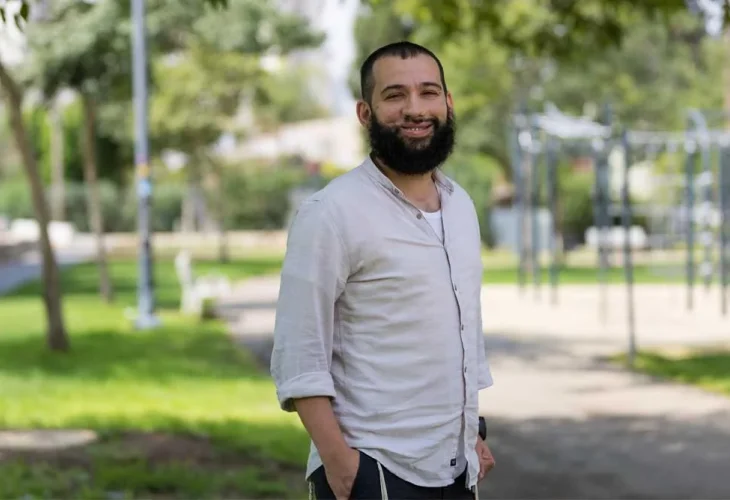 Rahamim Yishai. Photo by Liron Moldovan
During wartime, officers at the door usually bring devastating news. Rabbi Moshe and Orit Levi from Tel Aviv experienced this knock twice over the past two years — and once more through a phone call. Each time, the message was the same: “This is a casualty notification. Your son has been seriously wounded.”
Their eldest son, Rachamim Yishai Levi, the first in the family to be injured, was stationed as a soldier near Zikim Beach on Simchat Torah. Despite the severe wounds he and two of his brothers sustained, it is impossible to miss the strength of spirit and upright posture that radiate from him. Even scheduling an interview with him was not simple — between his study schedule at yeshiva and accompanying his brother Elkana, who was wounded in Gaza about a month and a half ago and lost both of his legs.
From a Pastoral Beach to a Battlefield
“I enlisted in Golani three years ago, after nine years of learning at Yeshivat Har HaMor,” Levi begins. “From the start, I told all my commanders that the basic condition for this ‘operation’ to work was that we put my date of birth aside and ignore the fact that I’m older than them. From that point on, I’m a soldier like everyone else.”
Simchat Torah 5784 caught Levi and his platoon while manning a small outpost known as Masa Erez, located near Zikim. In the early morning hours, Levi finished a night shift in the operations room and went to rest. At 6:30 a.m., he awoke to massive rocket fire on the outpost.
“I don’t usually call Simchat Torah ‘the Black Shabbat,’ but factually, the skies were black. Every rocket launched from Gaza toward the coastal area — Zikim, Ashkelon, Ashdod, and Tel Aviv, passed right over our heads. There were 13 of us in the outpost, and we gathered in the protected space.
“After about fifteen minutes, we received a radio message that the deputy company commander’s military vehicle had hit an explosive device. Another report followed — a wounded soldier in our tank positioned along the fence. Immediately after that, a Navy observer broke into the radio net and informed us that eight terrorists on paddle boats were making their way toward us.”
Did You Realize the Scale of What Was Happening?
“We didn’t understand that this was a full-scale war across the entire front — and it wasn’t expected that we would. But it was absolutely clear that we were under attack. The transition from routine to emergency was extremely sharp. And that’s exactly the moment you’re trained for as a soldier — so that the second this pastoral beach changes its face, the enemy encounters an army that will repel it.”
The Main Thing: The Outpost Must Not Fall
Minutes later, Levi and his comrades geared up in full combat equipment and ran toward the expected point of infiltration. As they ran, they still managed to consider the best defensive positioning — but heavy fire quickly settled the debate. The terrorists had already breached the outpost.
Levi and another soldier, Ofir Tzioni, of blessed memory, took position at the very front, at the corner of a fortified shelter. This position disrupted the terrorists’ plan to advance deeper into the outpost and seize it, which is why most of the fire was directed at them. Tzioni was hit by several bullets and collapsed. Levi immediately took his place — and the next volley was aimed at him.
A large-caliber bullet struck Levi’s face, shattering nearly twenty teeth and making breathing extremely difficult.
Despite the severe injury, Levi noticed a grenade thrown toward him and retreated silently. “I told myself that if I shouted ‘grenade,’ my friends would retreat as well — and the terrorists would complete their takeover of the outpost,” he explains.
After the grenade was thrown, one of the terrorists exposed himself from his hiding place and was immediately eliminated by one of the soldiers. “For the first time since the infiltration, there was a disruption in their plan. That allowed the fighters to gain more time and prepare for a stronger response. Thank God, because of that grenade incident, something shifted positively in the dynamics of the fighting — and the outpost remained in our hands throughout the battle.”
“Drive — or I’ll Take the Wheel”
Severely wounded, Levi returned to the protected space, where he encountered a cook and a kitchen assistant — neither of whom had combat training and who had been caught in the active combat zone. Shocked by the sight of his injuries, Levi sent a photo of his face to his brother, a company commander in an elite unit. His brother urged him to get medical treatment immediately — advice that proved crucial, as the injury was later classified as very serious.
After repeated failed attempts to reach emergency services overwhelmed by the chaos, the cook decided to evacuate Levi in his private vehicle. He placed him in the car, broke through the outpost gate, and drove toward Barzilai Hospital in Ashkelon.
“As we passed near the rear fence of Zikim, we came under massive fire from what we thought was one of our own military vehicles. The cook — the dear Yishai Yaakobi, stopped the car. At that moment, I didn’t know he had been shot in the back, but I understood that if we stayed still, it was only a matter of seconds before we were hit again. I screamed at him: ‘Drive — or I’ll take the wheel!’
“Apparently out of sheer panic, Yishai just kept driving. To this day, every time he sees me, he reminds me of that moment,” Levi adds with a smile.
Only two weeks later, while lying in the hospital, did Levi learn that the fire they came under was not friendly fire, but terrorist fire from a stolen military vehicle.
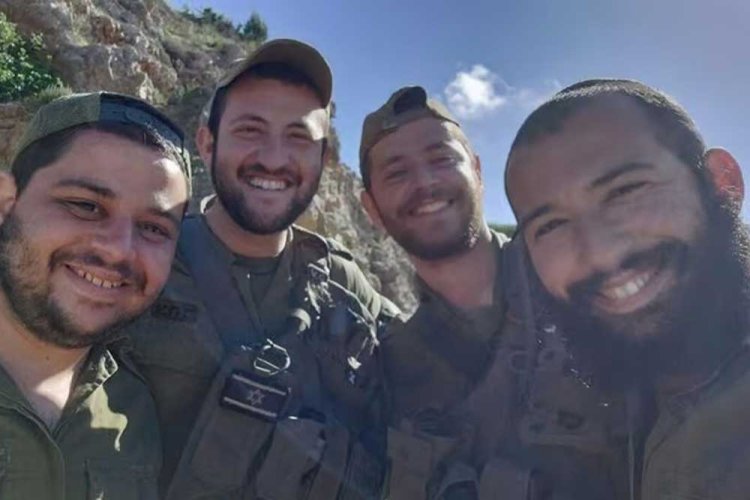 Rahamim Yishai and friends before the injury
“The Hardest Part Is Staying Behind”
By God’s mercy, Levi and Yaakobi reached the hospital, and Levi was taken into the trauma unit. He would not open his eyes again for two days.
“When I woke up, I was intubated and couldn’t speak. I communicated by writing and passed a note to my brothers: ‘Better a brother with a crooked face than a brother in a coffin. Together we will win.’
“After the tube was removed and I could speak again, I told my family that I count three wars here: the war against the terrorists who infiltrated the outpost; the war for life during the evacuation; and the third war that starts now — the war for health.
“I added that in the first two wars, the bullet wasn’t aimed personally at Rachamim Yishai Levi. The address was the People of Israel, and I fought as their emissary. That’s how I see the war for my health too — a national struggle. I draw strength and motivation for it from the People of Israel.”
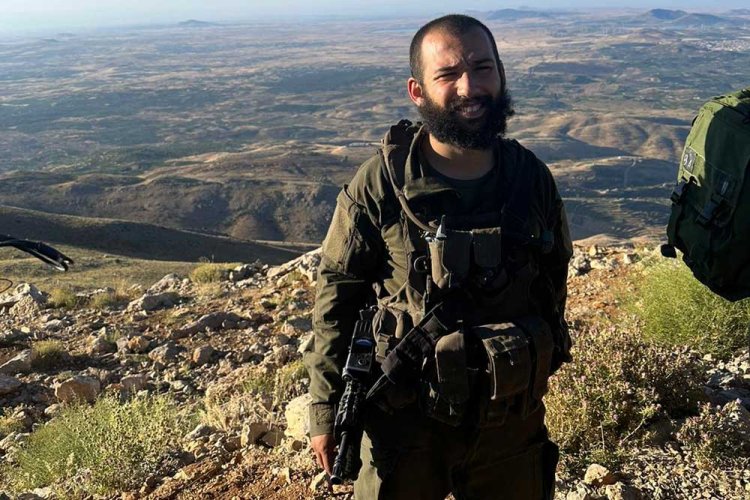 As a soldier, before the injury
What is the biggest challenge of the injury?
“Staying behind while my friends continue to fight. War isn’t our dream as human beings, but a fighter’s entire life is directed toward that moment. And precisely when the People of Israel went to war — when I was meant to fulfill my role, my fighting ended.”
Levi underwent several surgeries. The injury altered his jaw structure, and for a long time he was unable to eat solid food. After one surgery, he even suddenly lost the ability to speak for a month and a half.
“I don’t frame these as challenges,” he explains. “We are privileged to take part in the rebirth of the People of Israel. If this mission requires paying a price, then that price is paid.”
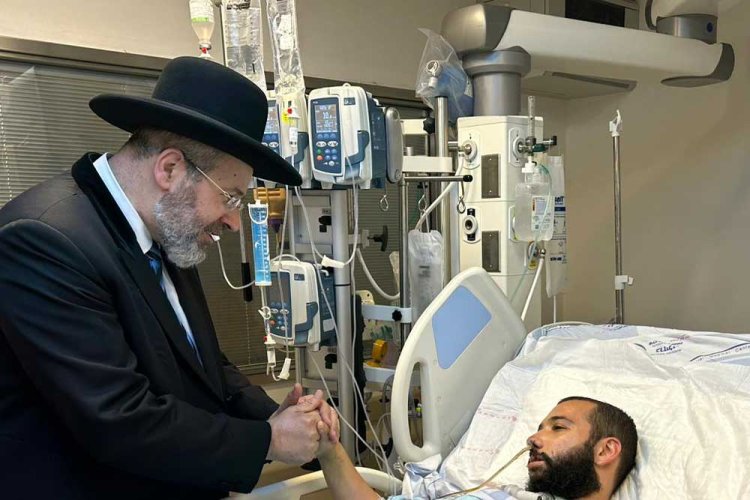 Rabbi David Lau visiting Rahamim Yishai after the injury
Another Brother, Another Knock on the Door
Several months after Levi’s injury, news arrived that his brother Y., a company commander in an elite unit, had been moderately wounded. Levi, who was hospitalized at the time in the rehabilitation department at Ichilov, welcomed him there. “I already had a résumé in rehab that he didn’t,” Levi jokes, “but he quickly earned his own place.”
Then, a month and a half ago, casualty officers once again knocked on the Levi family’s door. This time, they came to inform them that Elkana, another brother, had been severely wounded and lost both legs.
From a hospital corridor, the parents, Rabbi Moshe and Orit, released a short video with tearful eyes, addressing Elkana’s soldiers: “Support Unit 8, you are heroes, the best soldiers. You’re going through a very difficult time — a tremendous trial. As Elkana’s parents, we embrace you, believe in you, and in the spirit of Golani, we bless you — all the way to victory.”
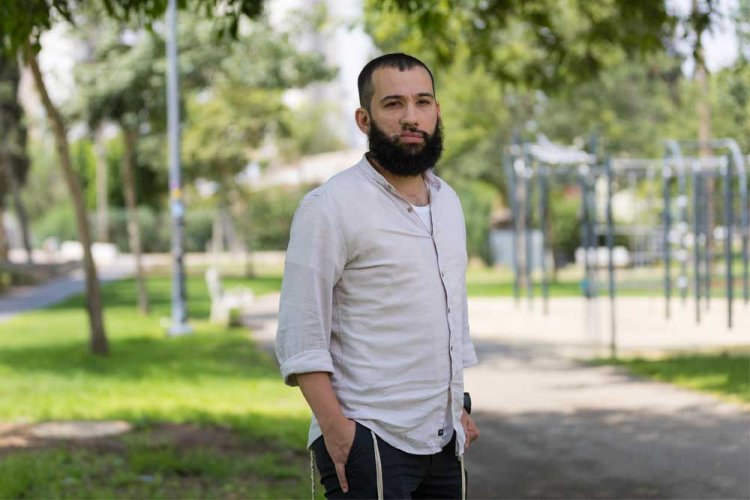 Rahamim Yishai. Photo by Liron Moldovan
How did your parents receive the third injury notification?
“That question should really be directed to them,” Levi says. “All I can say is that we grew up in a home where the greatest thing a person can do is take part and share responsibility in the missions of the People of Israel.”
He notes that his father founded a yeshiva in Herzliya, and that in the current war, three sons and a son-in-law were all serving in the army.
“Of course, for any normal person, seeing a child wounded is unimaginably difficult,” he clarifies. “But at the same time, they believe there is nothing more right than ending this war in victory — for every parameter you can name: the fallen, the wounded, the People of Israel, and God Himself.
“When you truly believe that, victory isn’t an empty slogan — it has meaning. When we are partners in determining victory, we are also partners in paying the price along the way. We look the goal straight in the eye — and stand tall.”
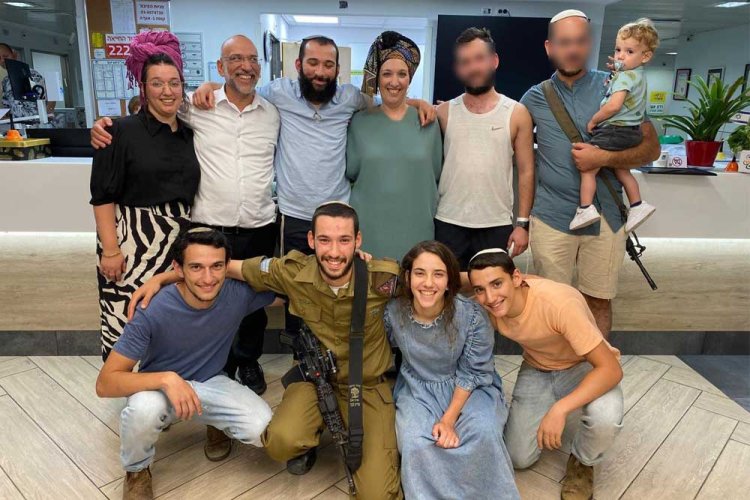 The Levy family
How is Elkana doing today?
“After a month of hospitalization at Soroka, Elkana was transferred to the orthopedic rehabilitation department at Tel HaShomer. Thank God, they managed to save his left knee. His right leg, however, was injured above the knee.
“It’s a long journey, and we’re only at the beginning. But both as individuals and as a nation, we don’t wait only for the end — we are conscious of the journey itself and even learn to love it, including the hardships and challenges.”
Levi recounts that about four months ago, he participated in a meeting with Prime Minister Benjamin Netanyahu, together with other soldiers who were severely wounded in combat.
“I told the Prime Minister that we are a people full of strength, and that over the past two years we’ve been building power from various victories. I emphasized that, with God’s help, victory in Gaza is not a question of if — only when.
“There are two things we must not do: take our eyes off the goal, or lose patience with the long road,” Levi recalls telling him. “This war is long and carries heavy prices — injuries and bereavement. But together with them, and perhaps even because of them, it carries heroism that builds victory.
“This war will end in a clear victory — one that, with God’s help, will give us great strength and a deeper understanding of who we are as a people, and how great we truly are.”

