
Magazine
A Firstborn After 27 Years: One Couple’s Journey Through Infertility, Faith, and Hope
After decades of waiting, treatments, and quiet pain, a Jerusalem couple welcomes their first child — and shares a powerful message for others still hoping for a miracle
- Moriah Luz
- |Updated
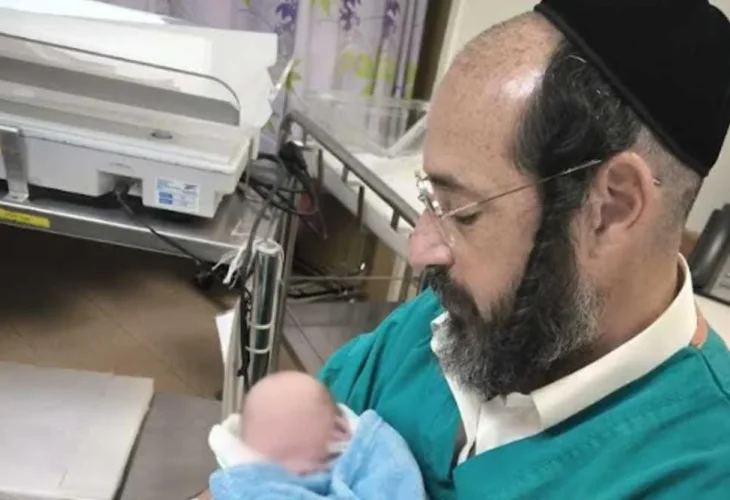
The birth of a child is always a miracle. But how do you put into words the birth of a firstborn son after more than 27 years of waiting? Perhaps best in the words of Rabbi Shalom Shtisel, the new father himself: “I woke up this morning, my child cried — and I cried together with him.”
Shtisel, an energetic and warm-hearted man, manages Sifrei HaYeshiva, a well-known Judaica bookstore in Jerusalem that serves the ultra-Orthodox community. His wife is a certified alternative medicine therapist. Despite being well-known and socially active through their professions, he says that many people — even those who worked closely with them, never knew they were childless.
“Many people, when they heard the good news, couldn’t believe we never had children,” he says. “Outwardly, we looked like the happiest, strongest people.”
“We Gave Up Hope — But Never Gave Up”
The couple married a little over 27 years ago, both in their early twenties. Years passed, and while the sounds of children filled neighboring homes, theirs remained quiet.
“About three years after the wedding, we began deeper medical investigations and entered the world of fertility treatments,” Shtisel explains. “From then on, we were in and out of treatments for many long years.”
He adds quietly, “I’m an only child. I have no brothers or sisters. My greatest pain was facing my parents — how do I look them in the eyes? Their pain cut into me even deeper than my own. I felt like our family line was disappearing.”
Did you experience moments of crisis along the way?
“Of course. You can’t describe pain like this. Treatment after treatment. One that works, then fails. Endless pain. Our sages said there are four types of people considered ‘alive yet dead,’ and one of them is someone without children. The house is lifeless. No child wakes up in the morning to say good morning — only your spouse.”
What gave you the strength to keep going?
“I say that I was the most diligent student of the alphabet, because every time I had to start again from Aleph. Another treatment from the beginning, another failure, and then again — starting over. There were many moments of despair, but we never gave up.
“Every morning, before leaving the house — no matter how sad I felt, I would place my hand on the mezuzah and say: ‘Father in Heaven, I’m leaving the house now. Hold my hand like you would a small child. I trust You. I’m walking with You. There is nothing but You.’ That was my motto.”
The Financial Cost — and the Emotional Silence Around It
Alongside countless prayers and blessings from rabbis and spiritual leaders, the couple invested enormous sums of money in fertility treatments. Shtisel explains that Israel’s health system funds treatments up to a certain limit and caps the number of attempts.
“Beyond that,” he says, “we paid out of pocket — over one million shekels and more.”
When asked about reactions from others, he avoids criticizing anyone. Instead, he reflects: “They say God will save the Jewish people not only from ‘the hands of Eisav’ but also from ‘the voice of Yaakov.’ Rumors — and there are so many self-appointed ‘rumor officers’ around us, during the waiting years and even now, are extremely painful.
“I can only be grateful that both my parents and my wife’s parents never interfered or asked questions. They prayed, they worried — but they never invaded our privacy.”
A Message to Friends and Family of Childless Couples
For the sake of other couples still waiting, Shtisel makes a heartfelt request: “Don’t ask questions. Don’t bring ‘segulot’ (folk remedies or spiritual tips). You’re not doing anyone a favor. Every ‘segulah’ feels like another knife in the heart. Just pray for them — and respect their privacy.”
Tell us about the moment you received the good news.
“We had several times when we were already in the second or third month, and the pregnancy didn’t hold. I was very skeptical and afraid this would be another failed attempt.
“When my wife passed the first trimester and the pregnancy continued successfully, we slowly began to share the news.
“Even in the delivery room, when they put the baby in my arms, I couldn’t believe he was mine. Now we can finally say: Give thanks, for goodness, for His kindness is eternal.”
Do you have a final message for couples still waiting for children?
“I’ve moved into a different club now,” he says carefully. “That means I no longer feel the pain of those in the previous club — but I will never forget it.
“I want to say to every waiting couple: Don’t give up. I know despair exists. People say there’s no despair in the world — but in this area, there truly is. Still, don’t give up and don’t raise your hands. Strengthen yourselves and believe in God. He is a good Father, and there is nothing but Him.
“We don’t understand His moves. I always say we’re like chess pieces — the bishop, the knight, the king, the queen — each thinks it’s moving on its own. But no. There is a hand from above guiding them. That’s how it is with us too.
“It’s ok to be angry. It’s ok to scream. It’s ok to ask ‘why.’ But it’s forbidden to break.
“We’re privileged to live near Rabbi Shalom Arush, may he be well. He always says to give thanks and dance. If you have a crisis at home — say ‘Father, thank You.’ But someone once told me that for childlessness, you cannot say thank you. The pain is too deep. You can’t understand it.
“So I ask just one thing: Don’t be sad. People don’t like sad people. Every day, before you leave the house, stand in front of the mirror and force yourself to smile. Make silly smiling faces if you have to. Walk out smiling.
Be joyful. And don’t give up.”

