
Israel News
Trump Aides Pitch ‘Project Sunrise,’ a $112 Billion Vision to Rebuild Gaza as a ‘Middle East Riviera’
WSJ report details a decade-long plan led by Witkoff and Kushner to rebuild Gaza cities and transform its coastline, contingent on Hamas disarmament
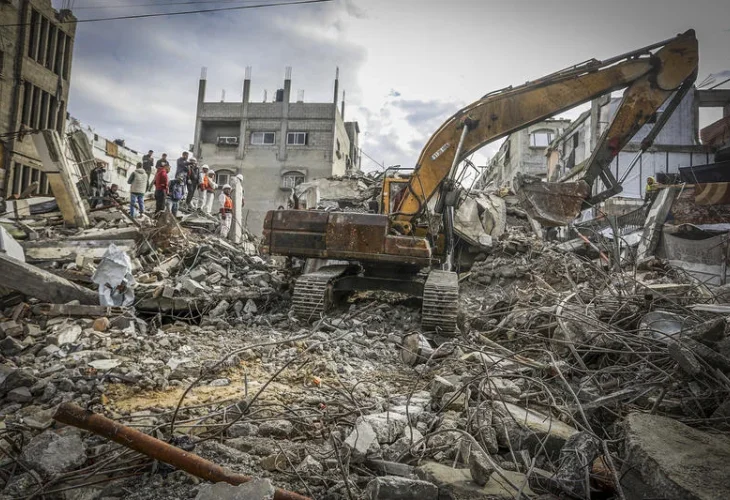 Gaza (Flash90)
A Wall Street Journal report revealed yesterday that advisers to Donald Trump have drafted a proposal to rebuild Gaza over 10 to 20 years. The proposal would replace vast areas destroyed in the war with newly built cities and turn much of Gaza’s Mediterranean coastline into what the plan calls a “Middle East Riviera.”
Known as Project Sunrise, the plan lays out a vision for moving Gaza from widespread destruction to economic recovery through new housing, modern infrastructure and large-scale tourism. The report says the entire proposal depends on Hamas fully disarming and on security conditions holding under the current ceasefire.
The plan was developed over roughly 45 days by a team led by Steve Witkoff and Jared Kushner. The presentation was a 32-slide PowerPoint labeled “sensitive but unclassified” that has been shown to Gulf states, Egypt and Turkey. The document has not been formally adopted as U.S. policy and is being presented as a proposal that would be updated every two years if pursued.
The plan envisions clearing massive quantities of war debris, removing rubble and unexploded munitions, dismantling Hamas’s tunnel network and rebuilding Gaza with modern housing, public facilities and transportation. It includes high-speed rail, AI-optimized smart power grids and what it calls “tech-driven governance,” including a Chief Digital Office and innovation lab. One executive summary slide states that while Gaza’s destruction has been profound, the plan aims to turn reconstruction into “a gateway of prosperity in the Middle East with state-of-the-art infrastructure, urban design, and technology.”
Reconstruction would proceed in stages, beginning in the south. Rafah and Khan Younis would be rebuilt first, followed by central Gaza, with Gaza City reconstructed last. One slide, titled “New Rafah,” envisions Rafah becoming the new administrative capital of Gaza, serving as the territory’s main center of government.. According to the presentation, the rebuilt city would house more than 500,000 residents in over 100,000 housing units, alongside roughly 200 schools, 75 medical facilities and 180 mosques and cultural centers.
In its second decade, the plan shifts toward generating revenue. Beginning in year 10, the presentation proposes turning roughly 70 percent of Gaza’s coastline into a zone for large-scale luxury hotels and resorts. This project, called the “Gaza Riviera,” is projected to generate more than $55 billion in long-term returns, which the plan says could eventually help fund reconstruction and repay accumulated debt.
The estimated cost for the first decade of reconstruction is $112.1 billion. The United States would be providing an “anchor” contribution of about 20 percent, while other coverage of the same presentation says the U.S. role could amount to nearly $60 billion in grants and loan guarantees. The remainder would be expected to come from wealthy regional states, though the presentation does not specify which countries.
U.S. officials quoted in the report expressed serious doubts about the plan’s feasibility. Concerns include Hamas’s refusal to disarm and whether donor countries would commit funds amid the risk of renewed fighting.
The presentation itself acknowledges those obstacles. Its opening executive summary includes a red-boxed warning that reconstruction can only proceed if Hamas fully demilitarizes and dismantles its weapons and tunnel network, a demand the terror group has rejected. Beyond the security issue, the plan also leaves major practical questions unanswered, noting temporary housing and medical facilities during construction but offering no clear explanation of where Gaza’s population would live throughout years of rebuilding.
Project Sunrise is not part of Phase Two of Trump’s ceasefire framework but is dependent on that phase moving forward. Phase Two includes Israeli troop withdrawals, the establishment of an interim authority to replace Hamas and the deployment of an international stabilization force. Israel has said it will not advance to Phase Two until the body of Ran Gvili is returned.
Despite the skepticism, some Trump administration officials argue that presenting a detailed, optimistic vision for Gaza’s future is preferable to assuming the territory will remain trapped in a cycle of destruction and humanitarian crisis. In response to the Journal report, the White House said the administration is working with partners to sustain a durable ceasefire and lay the groundwork for a peaceful and prosperous Gaza.

