
Magazine
“My Son Came to Repair the World”
Yifat Hadad on faith, loss, and the power of guarding one’s speech
- Hidabroot
- |Updated
 Illustrative image. Inset: Yifat Hadad
“Even when I was a very young child, I understood that if someone is buried in the ground, there must be something that continues afterward. As a child who grew up in a secular home, I didn’t know the concepts of ‘spirit’ or ‘soul,’ but I felt that it simply couldn’t be otherwise,” says Yifat Haddad, who today, at the age of 51, understands the depth of those feelings far more clearly — after being forced to bury her firstborn son.
“My life story is very complex,” she prefaces. “Some people might see it as an enormous struggle, but in my eyes it isn’t a struggle — it is the path the Creator chose for me, and I thank Him for it every single day.”
“I Will Not Take My Son’s Life”
The home in which Yifat grew up was far from religious. “My parents divorced when I was very young, and I think that precisely because of that, I searched for truth. I felt there had to be Someone responsible for running this world. At the age of 12, I began keeping Shabbat as best I could. Around me there was music, smoking, and Shabbat desecration, but my soul refused to give up. Every Friday night I would cry again to God: ‘Father, help me keep Shabbat and not desecrate it.’ Today I know that the merit of keeping Shabbat certainly accompanied me later in life, and it is what protected me as well.”
At 17, Yifat met the man who would later become her husband. They married, and soon she discovered she was pregnant. “It wasn’t planned at all,” she says. “I wasn’t even 18 yet, and at first it was clear to us that the only option was to terminate the pregnancy. We even scheduled an appointment with the approval committee.
“But when I went to visit my mother the night before — without telling her the news, she happened to show me a letter that had arrived in the mail from an organization that works to prevent abortions. In it was a picture of an incredibly sweet baby, with the words: ‘Please, I want to live.’ It pierced my heart. I lifted my eyes to God and said: ‘I will not take my son’s life. I will continue this pregnancy, and You will take care of me and him going forward.’”
At the time, she had no idea what a special soul she was about to raise. “I was 18 and a half when our firstborn son, Meir Chai, was born and made us parents,” Yifat recalls. “What’s interesting is that the birth itself filled me with renewed strength. Throughout my life I had faced many challenges, and in a way I had lost trust in my body and in myself. When I saw that a healthy, complete baby emerged from my body and that we had become parents, it strengthened me tremendously and drew me even closer to God.
“A little over a year later, we received another tremendous gift — a baby girl who brought us great joy and made us a family: parents with a son and a daughter. Around that time, I took upon myself to strengthen my modesty. I began covering my hair and wearing skirts.
“We had several of the happiest months imaginable, and then one night I dreamed that I saw Meir Chai’s name appearing on the Western Wall. I remember feeling that God was trying to convey some message to me, but I didn’t know what it was. A month later, the child fell ill with meningitis. His condition deteriorated rapidly, and when we brought him to the hospital, the doctors rushed him for CT and MRI scans. At the end, they determined that his brain had indeed been damaged. He was hospitalized in intensive care, and from that point on began a chain of suffering — needles and tubes, while Meir Chai was constantly sedated and on life support.”
What goes through a mother’s mind at such a time?
“At first I tried to cope with all my strength, believing that everything was temporary and would pass. I tried to be by Meir Chai’s side as much as possible, while not forgetting the baby girl waiting for me at home. But after three months of nothing but deterioration, they made it clear to me that his condition was not improving, that the doctors had no way to help him, and that they were transferring him to rehabilitation — despite seeing no chance of progress.”
Yifat sighs as she explains that the child discharged from the hospital and transferred to rehabilitation at Tel Hashomer was no longer the child she knew. “Meir Chai, who had been such a vibrant, communicative, amazing baby, lost all his abilities. He didn’t speak or communicate — just stared into space. Even in rehabilitation they told us that he would likely never emerge from this condition and would remain in a vegetative state for the rest of his life.
“But I refused to give up,” she recalls. “I ran to rabbis for blessings and prayers. I tried to help Meir Chai progress and develop on my own. In the midst of this, I discovered I was pregnant with my third child, and the doctors diagnosed it as a high-risk pregnancy and ordered hospitalization. That was the moment I broke. I couldn’t understand what God wanted from me. Lying in the ward, thinking about having left at home a ‘vegetative child’ together with a one-year-old baby, I had no idea what I was supposed to do.”
Three days after Yifat was hospitalized, her son Meir Chai was admitted to the hospital as well, after his condition worsened. “My mother stayed with him constantly and kept updating me. The doctors said his condition was irreversible and that they didn’t understand how he was even alive. Each time they said he had ‘another 24 hours,’ and then another 24 hours. In my heart I wondered what would happen first — the birth of the new baby, or parting from Meir Chai.
“But God planned otherwise. I gave birth to our third son — a healthy baby, thank God, and was discharged from the hospital while Meir Chai remained there with my mother at his side.
“Years passed. I gave birth to more children, but Meir Chai’s condition never allowed him to be discharged. He remained in the hospital, connected to breathing and feeding machines. There wasn’t a single day that I didn’t think about him and about the suffering he — and we, were enduring. The pain was daily. The thought of your son lying far away, in a bed, unable even to focus his gaze, pierces the soul.”
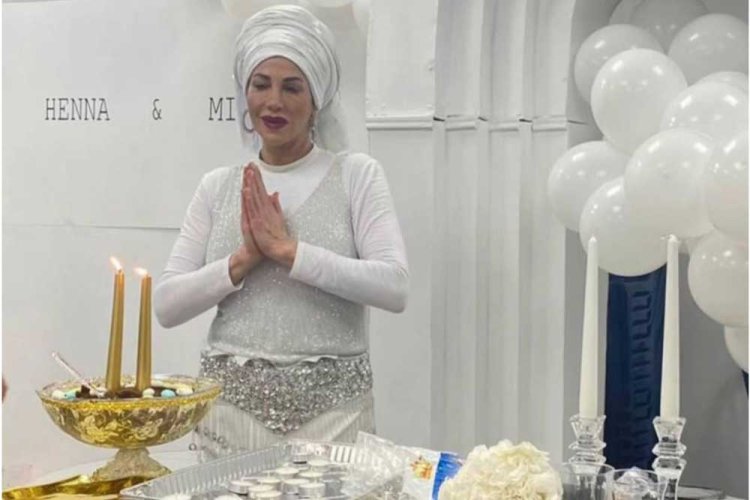 Yifat Hadad
A Message from Heaven
“After ten years, God in His great mercy sent me an important message,” Yifat continues. “Meir Chai appeared to me in a dream and said: ‘Don’t cry, Mom. I came into the world to repair the sin of gossip (lashon hara), and this is my correction. God is not angry with you — you are righteous, and soon I will finish my mission.’ That dream sent chills through me, but it also gave me renewed strength. It reinforced what I had always known: nothing from God happens by chance. Everything is planned, and there is a reason for everything.
“In the meantime, I personally took upon myself to strengthen my observance of guarding one’s speech. If my son came into the world to repair the sin of gossip, I am ready to do anything to prevent forbidden speech. I also tried to spread awareness of this around me. From then until today, this is what I occupy myself with — strengthening the laws of guarding one’s speech as much as possible. I truly see this as my mission.”
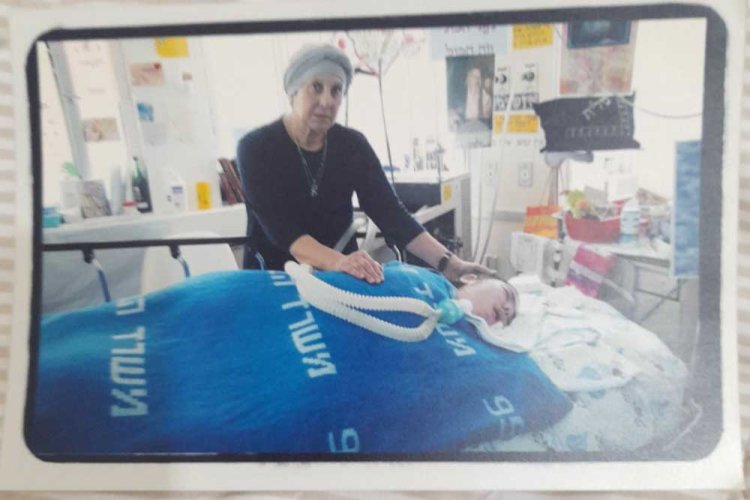 Meir Chai in hospital
Making the World Better
Twenty-four years after his birth, and twenty-three years after he fell ill and was hospitalized, Meir Chai passed away unexpectedly. “There was no warning at all, because there had been no change in his condition,” Yifat notes. “God simply decided to take him from us. It happened precisely on the 5th of Av, the yahrzeit of the Ari HaKadosh. That was the moment when we stopped being parents to a vegetative child and became bereaved parents — a challenge of its own.”
Yifat pauses and emphasizes: “My story may sound painful, but I must say that as time goes by, I increasingly feel the immense privilege that God chose us to raise this pure soul for 24 years — and no less than that, that He chose to pass through me such an important message about guarding one’s speech. Since then, I take every opportunity to share our story — not to cause pain, God forbid, but to illustrate this: our lives in this world are limited. Let us use them to see the good in others and to speak only good about them. In the end, we will all gain from it, and the world will certainly become a better place.”

