
Magazine
From India to the Chuppah: Orly Cohen’s Journey of Faith, Trust, and Finding Her Match
A religious woman’s unexpected spiritual awakening in India leads her back to Chabad, deep Torah study, and a miraculous reunion
- Hidabroot
- |Updated
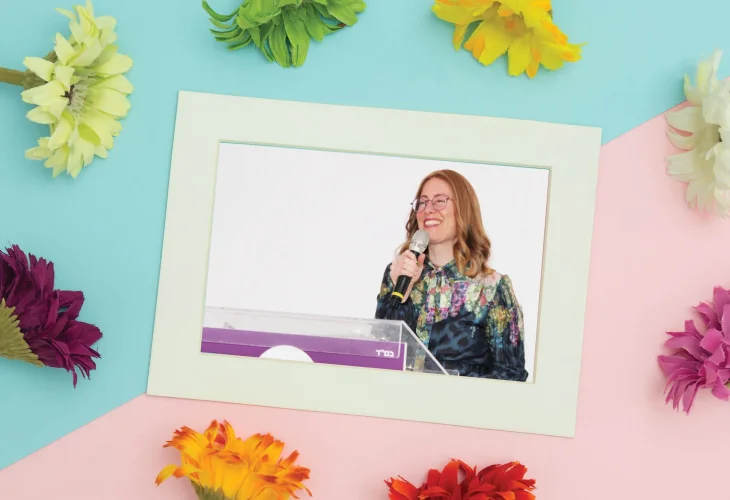 אורלי כהן
Orly Cohen was 28 when she flew to India, but unlike many young people who travel there to search for new light or to “find themselves,” her goal was very different.
“I come from the religious-Zionist community and grew up in a religious home,” she says. “For years I went through a very difficult period of matchmaking, and I felt that I needed some air — to loosen up a bit, to release myself, to be less rigid and boxed in.
“At that time I weakened a little spiritually. It’s not that I stopped keeping mitzvot — I was always religious, but things weren’t the same as before. So I set out on a trip, planning to refresh myself in India and return to Israel with renewed strength to continue life, and with great hope of finally finding my match. I never imagined that I would come back so different from the person who left.”
From Varanasi Back to Chabad
“I arrived in India and stayed there for a total of a month and a half,” Orly continues. “The entire time I was in the city of Pushkar — and that wasn’t by chance. The strangest thing that ever happened to me in my life happened there. At first, of course, I traveled and explored like everyone else. But at some point I found myself at a Chabad House, and the Rabbi told me that he was giving a ‘Kabbalah course’ and invited me to join.
“In truth it was a Chassidut course, but he called it that to make it sound more appealing. At first I didn’t want to participate. I said I hadn’t come here to study Torah — I could do that plenty in Israel. In the end, I agreed to try just one class, and suddenly my eyes were opened.
“After one of the classes I continued traveling with a group of friends, and they told me they were leaving Pushkar and heading to Varanasi — a city full of idol worship, where bodies are burned and other horrific things take place. Spiritually it didn’t bother me, but naturally I told them, ‘I’m not coming with you. It’s important for me to stay one more day to attend the Kabbalah course.’
“I expected them to leave without me, but it turned out that the next morning they simply didn’t wake up on time. Then they said, ‘Okay, we waited for you one extra day — tomorrow you can join us.’ I agreed, and the next day we set out together for Varanasi.”
Orly pauses and emphasizes that she is the last person one could describe as imaginative or prone to strange experiences. And yet, throughout the journey she heard a real, inner voice saying: “Go back to Pushkar. Go back to the Chabad House. Why are you going there? What are you looking for there?”
“It was such a powerful voice,” she recalls. “Along the way, when we reached the transit city, I told my friends that I wasn’t continuing with them and that I had to go back. They laughed at me: ‘They told us India is full of people who flip out — but this much?’ However, I was completely certain. What I needed to do now was go back to the Chabad House.”
“I Collapsed — I Knew It Was Him!”
“I arrived back at the Chabad House after a difficult journey, alone on a train, completely in tears,” Orly remembers. “There were a few young men there who asked what had happened, and when they saw that I couldn’t stop crying, they got worried and said, ‘Don’t worry, we’ll call the rebbetzin.’ She came, and when she understood what was going on, she promised that for the entire week I could study there.
“And that’s exactly what happened. For a full week I stayed at the Chabad House, with the rabbi and rebbetzin investing in me personally and teaching me so much. Meanwhile, I felt a spiritual strengthening I had never experienced before.
“After a month and a half in India I returned to Israel, but I felt that I couldn’t remain even one more moment in the box I’d been in before, working as a teacher in Jerusalem. I’m originally from a kibbutz, but I felt I couldn’t go back to the kibbutz either. Around that time a friend told me about a midrasha in Tzfat where they study Chassidut, and I decided to join and study there — ‘like in India.’ It was a kind of detachment from life,” she recalls.
“For a full year I stopped dating and stopped matchmaking altogether. I simply studied in the midrasha and strengthened myself spiritually.
“I only returned to the world of dating as I approached age thirty — and then something interesting happened. Even though, as I said, I’m a very rational and analytical person, I felt in my heart that I knew who my match was. It was a man I had met at the Chabad House in India.
“Unlike me, who arrived there already observant, he had become religious thanks to the shluchim about a year earlier. By the time I was there, he was already teaching Tanya himself. Throughout the entire year I was in the midrasha, I remembered him. After a year, I called the rebbetzin and asked her if it seemed relevant. She checked, got back to me, and said, ‘It doesn’t work.’
“For me, that was enough. If it doesn’t work, then apparently God is preparing something else for me. I continued walking my path of singleness and loneliness, among other things guiding groups in Tzfat.
“One Shabbat, I happened to be guiding a group — and discovered that the same man was there as well, also guiding. That’s how I learned he had come back to Israel. Even then, it never crossed my mind that something could come of it. When we met, I simply wished him ‘Shabbat Shalom,’ and that was it.
“But to my surprise, on Saturday night the rebbetzin contacted me and asked, ‘Is it still relevant for you?’ I remember collapsing onto my bed. I knew it was him! My feeling had been right!
“Our first date was on Rosh Chodesh Av. Two weeks later we decided we were getting married, and on the 22nd of Elul — less than two months after everything began, we were already under the chuppah.”
Her Husband’s Journey
“My husband grew up in the secular community of Nir Yisrael. At some point he went on a trip to India — unlike mine, his trip was long and extended. He grew closer to Judaism after traveling with a friend in the Himalayas and suddenly feeling a spiritual awakening. When he realized it was the eve of Rosh Hashanah, he decided to observe the holidays and fast on Yom Kippur. He did so and experienced something deeply spiritual. According to him, that Yom Kippur passed incredibly quickly — like it lasted only an hour.
“Then he decided he wanted to put on tefillin. He went to a Chabad House, but they didn’t offer him tefillin, and he was too embarrassed to ask. He went to another Chabad House, but all the tefillin were in use. Something inside him rebelled, and he made deals with ‘cosmic energy’: ‘If there are no tefillin, then I don’t need to put them on.’
“He continued traveling and reached Pushkar — the city where I was. Before that he had been in Dharamsala, where the Rabbi told him: ‘We’re on the eve of Sukkot. Take these aravot and give them to the Rabbi in Pushkar.’
“Throughout the journey he felt the aravot rattling in his hands. When he arrived in Pushkar, he practically ‘threw’ them at the Rabbi and said, ‘Take the aravot and give me tefillin!’ But the Rabbi replied, ‘It’s Sukkot now — we don’t put on tefillin during the holiday.’
“My husband almost shouted, ‘So what am I supposed to do?’ And the Rabbi explained: ‘We’ll take the Four Species, and afterward we’ll learn Torah and Chassidut. After the holiday, you’ll put on tefillin.’
“So my husband stayed in Pushkar for a while, learning and being exposed to the world of Torah. Later he returned to Israel, but completely changed his path and entered a yeshiva in Ramat Aviv.”
Simply to Believe
Today, Orly and her husband stand at the head of the Digital College for the Study of Tanya, which they founded together. They serve as Chabad emissaries in the moshav of Nir Yisrael and employ dozens of teachers who teach students primarily via Zoom.
“I’m responsible for the women’s content, and my husband for the men’s,” she explains. “In addition to the digital learning, we also run various activities with women from all over the country, from every sector — religious and traditional, Ashkenazi and Sephardi, from every place and every type of community. We have everything. The goal is to offer a wide variety of classes for anyone who wants to grow and deepen their knowledge.”
The phenomenon of “women studying Torah” wasn’t always recognized. What changed?
“That’s not entirely accurate,” Orly says. “The Lubavitcher Rebbe always empowered women, including in Torah study. Even 200 or 300 years ago, you could find women learning Torah. In recent years it has grown stronger because women today do everything — they study every field and earn degrees in anything imaginable. There’s no reason Judaism should be left out.
“Personally, I always connected to Torah study, but since I merited to establish the college, I feel that the first one who benefits from it is me myself. Every day I give thanks again for the privilege of being involved in this.”
A Message to Single Women
“I understand more than anyone what someone who’s been searching for a long time goes through — feeling that there’s nothing left they haven’t tried, that there’s supposedly no hope anymore.
“I remember myself surrounded by people who didn’t understand what my problem was: ‘What’s so hard about going on a date? At worst you’ll enjoy one evening and it won’t work out.’ They didn’t understand that when I went on dates, I came with all my expectations and fantasies — already seeing in my mind what the sign on our front door would look like, how many children we’d have, where we’d live, what our life would be like.
“It’s no wonder that every time a match didn’t work out, I felt shattered. To some extent, despair also began to seep in — ‘From where will my help come?’ What more needs to happen for me to finally find my match? I heard about friends getting engaged and cried. It was so painful and frustrating.
“Out of that frustration, I tried to make changes in my life — I became less conservative, spoke more with men, wore pants, and so on. As part of that came the trip to India. I mistakenly thought that if I were less ‘religious,’ it would help me find what I was looking for.
“But in the end, it turned out that specifically when I entered a midrasha and experienced the greatest spiritual strengthening of my life is when I found my match.
“Because God wants exactly this change from us: not to stay stuck in one place, but to draw closer to Him and deepen our connection with Him. That’s the message I pass on to other women in this situation as well — don’t stay in the same place. Try to see where you can strengthen and grow. And most importantly, don’t lose hope.
“You simply can’t compare a woman who comes to a date disappointed and without expectations to a woman who believes that everything is guided by Divine providence, and believes in the Creator that her partner will arrive — at the best, most precise, and most correct moment. Only that kind of faith makes it possible to get through this period.”

