
Magazine
From Nightclub King to Family Man: A Journey of Faith and Self-Discovery
How a chart-topping singer traded fame and fast nights for family, spirituality, and a deeper sense of meaning
- Chaim Gefen
- |Updated
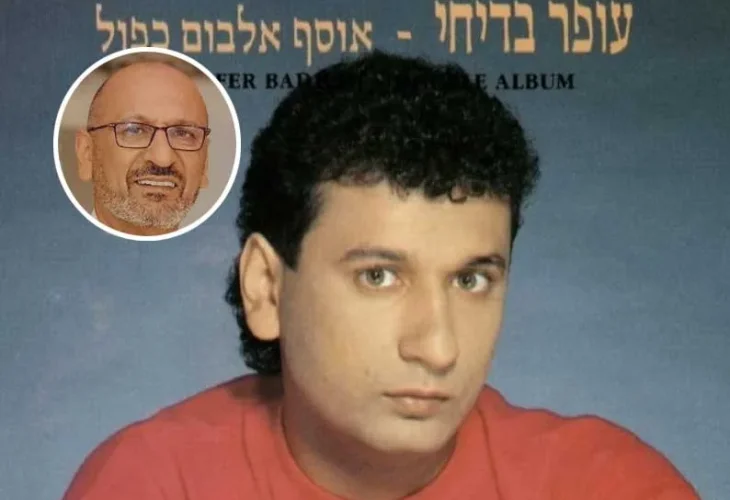 Pictured: Album cover from the 1980s. Inset: Ofer Badichi today.
It was one of the big hits of the 1980s: with a deep voice and vocal flourishes you’d expect from an 80-year-old veteran singer, Ofer Badichi’s song “The City Snake” took over Israeli playlists. Surprisingly, it quickly became a club anthem — despite its piercing lyrics about the false glamour and empty promises the world has to offer.
The name Ofer Badichi may not ring a bell today, but shortly after his breakout into the music industry, his songs rapidly became hits. Yet after only a few years in the spotlight, the man dubbed “the King of the Clubs” suddenly disappeared. Rumors circulated that he had become a shuttle driver, and fans reported seeing him in the evenings at a Jerusalem synagogue, quietly studying Chassidic texts on his own.
Of Badichi’s dozens of songs (61 in total), “The City Snake” became the one most closely identified with him. “When the song exploded on the radio, it immediately became a hit,” he recalls.
Were you surprised by the success?
“Of course I was. Looking back, everything happened far too fast — so fast that I nearly collapsed from the pressure. Imagine going from at most twenty performances a month to sixty. I reached a point of three or four shows a day, all over the country — three times what I was used to. I’d get home at two in the morning, everyone already asleep, and I was completely exhausted. I realized I had to cut it — to disappear from the industry.”
You quit suddenly, all at once — not gradually.
“That’s right. As they say, I hung up my shoes. I couldn’t do it anymore. I didn’t want it anymore. It finished me. I told myself, ‘Change direction — enough with this career.’ Instead of continuing down the road of fame, I yanked the steering wheel sharply toward family. I had colleagues who managed to combine career and family, but I was different.”
If you had continued, would you have lost your family?
“Yes, absolutely. I was kind of a wild type, a bad boy, and I realized I had to get myself together, and fast. Sometimes I’d come home late at night after a club show, collapse on the couch, and say to myself: ‘What’s your deal in this world? Outside everything looks great, and people admire you, but what about home? What about your wife? Your children?’ I was afraid of losing them.”
That’s a rational conclusion — but emotionally, how do you give up a successful career you invested so much in?
“I’ll tell you a secret: the guitars are still at home. When I feel the need, I sit down and play. Sometimes I call all the kids together and we make a little celebration — we sing songs of holiness to God. Bottom line, I didn’t leave music; I left the industry. Music is still inside me. It’s an inseparable part of who I am.”
“A Taste of Heaven”
Aside from his voice — which hasn’t changed, Badichi of then is not Badichi of today. Faith in God has become increasingly present in his life and occupies a significant part of his daily routine. “Whether through prayer, Torah classes, or studying the book of Tanya,” he explains. “It’s a deep book that I’m very connected to.”
During your career years, did you have any connection to religion?
“Always — as far back as I can remember. I grew up in a traditional family with uncompromising values passed down through generations. I studied with my grandfalther, usually wore a kippah, and put on tefillin every day. Performing on Shabbat was never even a discussion — Shabbat was, and remains, sacred to me.”
How does that work with performing in clubs, where modesty is hardly the norm?
“You’re right — but I wasn’t strong enough back then in guarding my eyes. I was far from that. I was immersed in myself and my career, and my connection to tradition was mainly on a family level. I was ‘traditional plus,’ as they say. Today my connection to Judaism is much deeper. I study Chassidut, and I even completed the book of Tanya. When you taste heaven, you run away from hell.”
When you decided to quit, did you calculate how much money you’d lose?
“Yes — but the moment I stopped performing, the gates of livelihood suddenly opened for me. On the day I stopped singing, I built a villa. I have no idea how it happened. With all the money from performances, there was no blessing. Only when I closed the music stand did the blessing arrive. Suddenly money was released from here, money from there. Suddenly my father gave me a bundle of cash and said, ‘Go build yourself a house.’”
What did you do for work? How did you make a living?
“I started driving shuttles. For thirty years I was an independent driver, working from morning to night — picking people up, dropping them off. Only two years ago did I finally retire.”
How did you handle the change — from ‘King of the Clubs’ with fans on the street to a minibus driver?
“Deep down, I was always simple. To this day, when people stop me on the street and ask, ‘Are you Ofer Badichi?’ I say, ‘What’s the excitement? I’m a regular person, just like you.’ Sometimes I hear people behind me whisper, ‘There’s Ofer Badichi.’ Do I stop and swell with pride? No. I smile and keep walking. So when I became a shuttle driver, I cared less about what people would say.”
“The Truest Path”
Thirty years after leaving the world of music and club performances, Badichi has no regrets. “There is no happiness that compares to the happiness of seeing your children walking in the path of Torah,” he says proudly. “Each one, with their own life journey, ultimately reached the same conclusion: this is the truest path.”
Looking back today, what is the main lesson of your life story?
“Where I am today is far more meaningful than where I was in the past. My life today has meaning. I pray, I study Chassidut, and the light of Torah illuminates the darkness of the false world we live in. If I’m living in a spiritual world — what am I missing in life? Is there anything better than that?”
Do you dream of returning one day?
“I dream of continuing to record music. But going back to performing in clubs? Heaven forbid. Let me sit in the audience and applaud today’s new singers. And honestly? Give me a page of Tanya to study instead — and I’m completely set.”

