
Israel News
Bennett Admits Iranian Hackers Broke Into His Telegram Account and Leaked Private Messages
Former prime minister says breach was partial and illegal, after Iranian hackers publish contacts and chats and political reactions follow
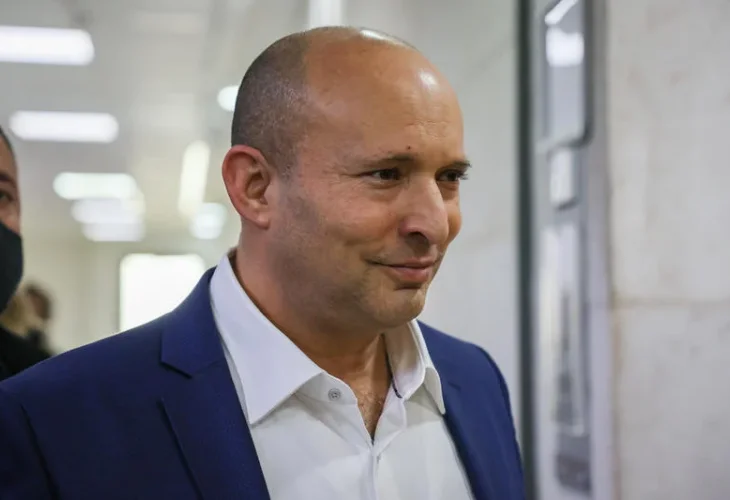 Neftali Bennet (Jonathan Shaul/Flash90)
Former Israeli Prime Minister Naftali Bennett acknowledged last night that Iranian hackers gained unauthorized access to his Telegram account, after initially denying that his personal phone had been breached. Bennett said the incident was being handled by security authorities and framed the leak as a politically motivated attack aimed at preventing his return to national leadership.
In a statement released Wednesday night, Bennett said that while his phone itself was not hacked, access was obtained to his Telegram account “through various means,” resulting in the leak of contact lists, images, and chat messages. “After further examination, it appears that my phone itself was not breached, but access was gained to my Telegram account,” Bennett said, adding that “many images and chats — both real and fake — were distributed.” He stressed that the materials were obtained illegally and said their publication “constitutes a criminal offense.”
“The matter is being handled by the security authorities,” Bennett said. “Israel’s enemies will do everything to prevent me from becoming prime minister again. It will not help them. No one will stop me from acting and fighting for the State of Israel and the people of Israel.”
The acknowledgment followed hours of conflicting messages from Bennett’s office. Earlier in the day, after the leak was first reported, his aides said that “the matter is being examined and handled by the relevant security and cyber authorities,” adding that the device in question “is not currently in use.” A later statement said that “after the examinations conducted, no indication was found that the device was breached.” Only after large volumes of data were released online did Bennett concede that access to his Telegram account had occurred, while maintaining that the phone itself was not penetrated.
The incident began when an Iranian hacker group calling itself “Handala” claimed it had infiltrated Bennett’s iPhone 13 Pro as part of what it dubbed “Operation Handala.” To support the claim, the group published screenshots it said were taken from the device, including contact lists, private correspondence, personal photos, and calendar-related materials. The hackers also released 141 pages of phone numbers, which they alleged belonged to Bennett’s contacts, including journalists, senior Israeli officials, and foreign leaders. Some of the numbers were later verified.
Alongside the data dump, the hackers issued a lengthy taunting message directed at Bennett. “Dear Naftali Bennett,” the group wrote. “You once prided yourself on being a beacon of cybersecurity, parading your expertise before the world. Yet how ironic that your own iPhone 13 has fallen so easily into the hands of Handala. For all your boasts and bravado, your digital fortress was nothing more than a paper wall waiting to be breached.”
“Consider this a warning and a lesson,” the message continued. “If your personal device can be compromised so effortlessly, imagine the vulnerabilities that lurk within the systems you once claimed to protect… Welcome to a new era, where your secrets are only as safe as your weakest password.”
Based on assessments circulating in Israel’s cyber community, the breach may not have involved a direct hack of Bennett’s phone but rather access to a synced account or a computer used to back up data from the device. There has been no official confirmation of the method used, and Israel’s security agencies have not commented publicly on the incident. Officials have also warned that files circulating online could contain malicious software.
Among the leaked materials were chat excerpts described as embarrassing or potentially damaging. Some messages included disparaging remarks attributed to Bennett or his associates about political figures, including Avigdor Lieberman, Ayelet Shaked, and Benny Gantz. Bennett said that some of the content was manipulated or fabricated, and the authenticity of several messages remains disputed.
Gantz, the chairman of the National Unity party, responded publicly after references to him appeared in the leaked correspondence. “With all due respect to curiosity about what Bennett wrote about Lieberman, about me, or about Ayelet Shaked,” Gantz wrote, “there are communications that truly matter. After more than two years, the public deserves a state commission of inquiry.”
The episode has drawn attention due to the sensitivity of Bennett’s former roles as prime minister and defense minister. As a former head of government, Bennett is protected by the Shin Bet, and unauthorized access to his private communications could raise concerns about democratic institutions and national security.
The incident also carried an element of irony. Just last week, Bennett warned at a cyber conference at Tel Aviv University of an Iranian cyber scenario that could cripple Israel’s infrastructure, arguing for the creation of a national “cyber Iron Dome.”
For now, the investigation continues. Bennett insists the breach was limited in scope but significant, and that distributing the leaked materials is illegal. Security authorities remain silent as additional files continue to circulate online.

