
Israel News
Netanyahu Approves Israel’s Largest-Ever Gas Export Deal With Egypt
Recorded statements by Netanyahu and Energy Minister Eli Cohen present the agreement as historic deal valued at 112 billion shekels
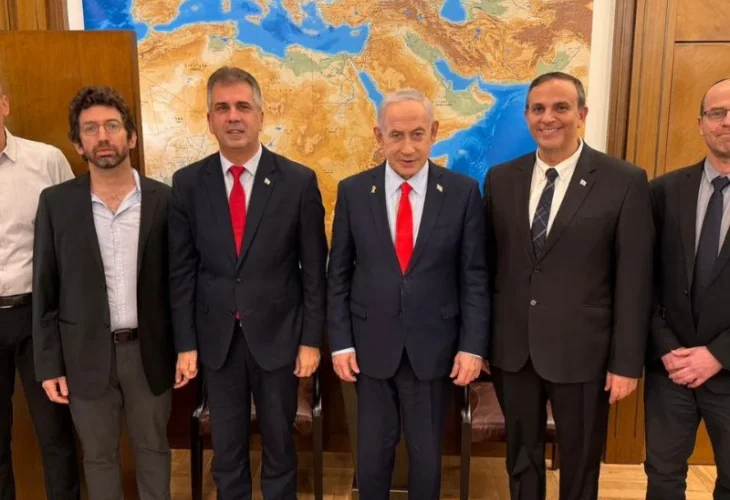 Bibi Netanyahu, Eli Cohen, and other leaders (Prime Minister’s Spokesperson's Office)
Prime Minister Benjamin Netanyahu announced Wednesday evening that he had approved the largest gas export deal in Israel’s history, authorizing a major expansion of natural gas exports from the Leviathan reservoir to Egypt. The decision was revealed in a recorded message, alongside a separate statement by Energy and Infrastructure Minister Eli Cohen.
According to Netanyahu, the deal is valued at 112 billion shekels, with 58 billion shekels expected to flow into state coffers through taxes and royalties over the life of the agreement. The gas will be supplied from the Leviathan offshore field to the Egyptian market over roughly 18 years, making it the largest export agreement ever approved by the Israeli government.
“Today I approved the largest gas deal in Israel’s history,” Netanyahu said. “The deal is worth 112 billion shekels, of which 58 billion shekels will go directly into the state treasury.”
In his statement, Netanyahu framed the agreement as a long-term national asset, stating that the revenues would strengthen core public services. “This money will strengthen education, healthcare, infrastructure, security, and the future of the next generations,” he said, adding that the deal significantly bolsters Israel’s regional standing. “The deal significantly strengthens Israel’s status as a regional energy power and contributes to stability in our region.”
Energy Minister Eli Cohen echoed that message in his own recorded remarks, calling the approval “a historic moment for the State of Israel, both in the security-diplomatic dimension and the economic dimension.” Cohen said the agreement represents the largest export deal in the country’s history and anchors Israel as a leading regional energy supplier on which neighboring countries rely.
Beyond government revenues, Cohen highlighted the scale of domestic investment tied to the deal. “State revenues from taxes and royalties are expected to reach approximately 58 billion shekels, alongside direct infrastructure investments exceeding 16 billion shekels, which will create jobs and strengthen the economy,” he said. The investments include expanding production capacity at Leviathan and upgrading gas transmission infrastructure inside Israel.
The agreement involves Leviathan’s partners, led by U.S. energy giant Chevron alongside Israeli companies, and includes phased gas deliveries to Egypt. The first stage is expected to begin next year, with larger volumes following after infrastructure expansion is completed. Government officials say the project will significantly increase Israel’s annual gas production capacity.
However, it remains unclear whether the deal will actually lead to lower electricity bills for Israelis. Israel produces most of its electricity by burning natural gas, which leads many to assume that exporting more gas and expanding production should make electricity cheaper at home. In practice, electricity prices depend less on how much gas exists and more on the price at which gas companies sell it and on long-term contracts already in place. In the past, disputes between gas producers and the Israel Electric Corporation, which buys the gas to generate electricity, have shown that even when Israel has greater gas supplies, prices do not automatically fall and have at times risen. Critics therefore argue that while the government says consumer protections are built into the agreement, their real impact will only be proven if households eventually see relief on their electricity bills.
The government also stressed that the state retains future flexibility. From 2032 onward, Israel will have the ability to reduce export volumes if domestic needs change, a provision officials describe as a safety valve to protect long-term energy security.
Netanyahu closed his remarks with a symbolic note in connection with the fourth night of Chanukah. “Tonight, on the fourth candle of Hanukkah, we brought another jug of oil to the people of Israel,” he said. “But this flame will burn not for eight days, but for decades.”

