
Magazine
“At the Threshold of Heaven”: Identifying the Victims of the October 7 Massacre
The harrowing mission at Camp Shura, the unbearable weight of uncertainty, and how sacred duty, unity, and resilience carried a nation through its darkest hours
- Moriah Luz
- |Updated
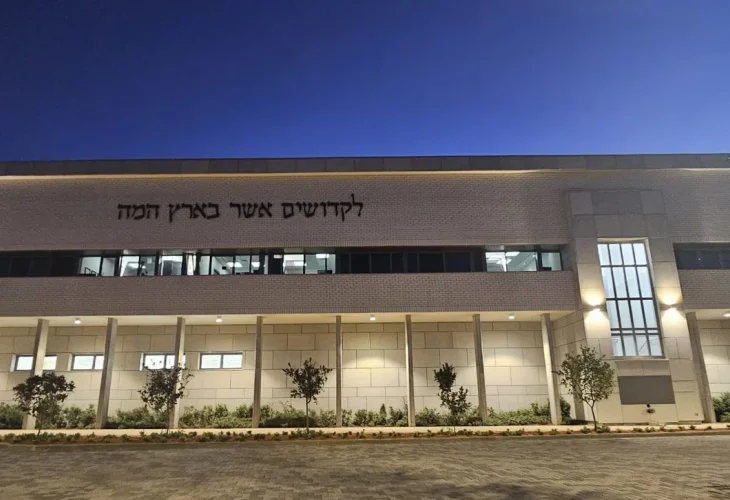 "The Zvi Center" at Camp Shura, where the fallen were evacuated during the war.
For a month and a half, Arye Minkov barely left Camp Shura, where the victims of the massacre were identified. At home, his wife and five children were waiting for him — the youngest just two months old, but before his eyes stood the families of the fallen. The knowledge that if he went home for even a few hours, a bereaved family would be forced to continue waiting in painful uncertainty about their loved one, drove him to devote himself completely to the mission.
“We Touched the Threshold of Heaven”
“There is a debate in the world about whether Shura is hell or heaven. I think Shura was both. In many ways, the place felt like hell; yet at the same time, we knew and felt that we were standing at the threshold of heaven.
“We were doing something unimaginably difficult, but we were caring for the holiest of the holy — those killed sanctifying God's name, martyrs before whom no living being can truly stand. We knew we were doing something of national, spiritual, and historical significance, something deeply meaningful for all of us. It was a privilege none of us would have been willing to give up.”
Minkov shared these words in a special interview, a year and a half after serving as a commander in the Civilian Fallen Identification Unit.
From Combat Soldier to Military Rabbi
“In my regular service I was a combat soldier, and that continued in the reserves,” he explains. “When our reserve company was disbanded, I chose to become a military rabbi in the reserves.”
That decision stemmed from his extensive Torah background of 12 years in yeshiva and rabbinic ordination.
Arye completed the military rabbis’ course shortly before the massacre. “On Simchat Torah, the course graduates hadn’t yet been assigned, so we weren’t called up. On the night after the holiday, in the middle of the night, I got a call telling me to report to Camp Shura. They didn’t explain why. I thought I was going to serve as a battalion rabbi heading into combat. Only when I arrived did I realize I was going to be dealing with fallen victims.”
Why Shura Became the Central Identification Site
“Shura is a military base near Ramla. Several IDF units are stationed there, including the headquarters of the Military Rabbinate — the Chief Military Rabbi’s office and senior officials. On the base there is a building called Merkaz HaTzvi, used for handling fallen IDF soldiers. That building became widely known during the war because nearly all the fallen — both military and civilian, were treated there.”
Was the facility prepared for such enormous numbers?
“The decision to build it has an interesting backstory,” Minkov says. “At the previous Rabbinate base in Tzrifin, there were only two treatment rooms — meaning two fallen at a time. The Abu Kabir forensic institute also has a limited number of rooms. “When the Rabbinate moved to Shura a few years ago, its leaders insisted — almost inexplicably, on building a massive structure, and somehow secured the budget to do so. They built a facility with 17 treatment rooms.”
Absolute Certainty and Maximum Speed
On Simchat Torah, once the scale of the disaster became clear, it was decided that Shura was the most suitable location. Although it was intended for IDF casualties, some rooms were allocated for civilian victims. As the load increased, additional temporary treatment areas were set up in the gravel yard of the base.
“I arrived at Shura the night after the holiday. Together with other soldiers, we unloaded bodies from trucks into the treatment rooms.” On the very first day, Minkov was asked to take responsibility and coordinate the personnel. He later served as operations officer and eventually as one of the field commanders.
“To identify a fallen person, you can’t rely on anything that isn’t 100% certain. The process includes intake into the systems and a detailed external description. Each fallen person was assigned a number that accompanied them throughout the identification process — because when they arrived, we didn’t yet know who they were.
“After initial intake, identification begins: fingerprints, DNA samples, dental imaging.” Every detail had to be meticulously documented, with the utmost sensitivity and respect. “It sounds simple, but when you multiply it by nearly 1,200 victims and thousands of bags containing body parts, it’s anything but simple.”
A Nationwide Effort
Multiple agencies worked together:
The Military Rabbinate hosted and managed operations.
Israel Police handled sampling and the identification process.
Forensic units, investigators, and Interior Ministry officials oversaw case management.
The Health Ministry, whose doctors confirmed death.
The Ministry of Religious Services, which ensured burial.
ZAKA volunteers, who assisted tirelessly on the ground.
“All of this was done to complete the process with absolute certainty and maximum speed.”
How long did it take?
“Within ten days, we reached 90% identification. After about a month and a half, 99%. Today we are at 100%.
“In similar-scale events elsewhere in the world, years later they’re still around 70% identification at best.”
What is life like during such a period?
“The work never stops. You don’t eat, you don’t sleep, you barely go home. You don’t even pray. But we understood the magnitude of the moment. Without that understanding, the task would have been impossible, both mentally and physically.”
One soldier stayed for three consecutive days. “I was afraid he’d collapse. I forced him to go home for a few hours. The psychological burden is indescribable.”
Despite everything, everyone grasped the gravity of the hour. “A secular colleague, a PhD in anthropology who worked with us, told me this was the most important thing he’d ever done in his life. That sentence stays with all of us.”
Coping, Humanity, and Dark Humor
Joy, Minkov explains, is not the right word. “You survive with dark humor to keep your sanity. Once, when I managed to get home, someone asked me how things were at Shura. I said, ‘Everyone there is dying to see me.’”
He is quick to stress: “Those jokes were never said near the fallen or their families. They never diminished the awe and reverence we felt. We knew these were martyrs, holy souls. It was simply how we survived.”
There was no emotional numbness. “We stood by every vehicle leaving for burial and said Kaddish. Efficiency improved over time, but it was never technical or detached.”
A Great Merit
Minkov speaks with deep gratitude about his wife, who had given birth shortly before. “She understood the mission and strengthened me.” On one occasion, he was supposed to go home, but with her blessing he stayed — and his presence helped resolve a complex case so that a family could bury their loved one the very next day.
The exposure to death, pressure, and chaos took a toll. Some soldiers struggled to return home or see their children sleeping. Minkov acknowledges that some colleagues now suffer from post-trauma and need full professional support.
Personally, he chose to focus on the immense merit of the mission. “You feel how effective and meaningful you were. You take the hardship and turn it into something that elevates you.”
“Traumatic Growth”
Today, after completing an unusually long reserve service, Minkov has returned to civilian life as head of the Religious Affairs Department at the Beit El Council. He also gives talks about his experience, both as a form of therapy and a sense of mission.
“Research shows that about 65% of people who experience severe trauma undergo post-traumatic growth, while about 10% develop PTSD. Those who need treatment must receive it fully. But those meant to grow from it cannot return to life unchanged — they must transform the experience into greater meaning.”
Unity as the Lesson
As a commander, he relied on professional resilience teams and, above all, the strength of the group. “We are still in daily contact.”
He concludes with one message: “I believe God shook us awake from internal divisions and said: this cannot continue. If we can bring even ten percent of the extraordinary unity we experienced in the treatment rooms at Camp Shura into our everyday lives, then we have learned our lesson.”

