
Magazine
“I Imagined Him Surrounded by Light”: Iris Haim on Loss, Faith, and Choosing Hope
How optimism, perspective, and a refusal to hate became a mission of connection after unimaginable tragedy
- Moriah Luz
- |Updated
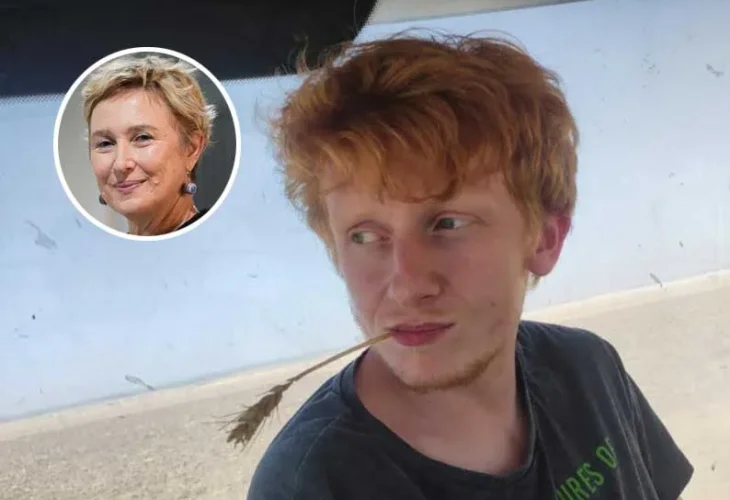 In the photo: Yotam Chaim z"l. In the inset: Iris Chaim (Credit: Lior Shalom)
For three and a half weeks, Iris Haim did not know what had happened to her son, Yotam, until it became clear that he had been abducted to the Gaza Strip.
Yotam, a resident of the young adults’ neighborhood in Kibbutz Kfar Aza, was a talented drummer and a farmer. He also struggled with mental health challenges and suffered from a painful autoimmune disease, in which the body “attacks” itself.
During the period of uncertainty and captivity, Iris completely stopped consuming news and imagined only the most optimistic scenarios. She gave interviews on various channels and platforms, carefully avoiding blame and choosing to focus on the good.
Even after receiving the bitter news of her son’s tragic death, Iris continued to adhere to a positive outlook and to act for connection and unity. As is known, Yotam, together with two other hostages, managed to escape captivity. IDF forces mistakenly identified the three as terrorists and shot them dead.
“I Imagined Yotam Surrounded by Light”
“I am a nurse by profession,” Iris begins. “Until October 7, I worked accompanying terminally ill patients. From the moment Yotam was abducted until he was killed, all I did was give interviews, speak, travel abroad, and write.”
During the 70 days leading up to the tragic end, the Israeli public was surprised to hear the voice of a hostage’s mother bringing an unusually optimistic tone to studios and radio stations.
Have you always been optimistic?
“Yes, always. I’m a very optimistic person. Even in those moments, my default was to believe things would be okay, that Yotam would get through this, that help would arrive and rescue him any minute.
“Even in the first period, when Yotam was considered missing, I told myself a story. I told myself that Yotam was alive — even though I didn’t know if he was. I imagined him surrounded by light and drumming, as he loved to do. Yotam dealt with an autoimmune disease that required strong pain medication, and I told myself that surely they were giving him his medicine.”
Was your family on the same wavelength?
“It took time for me to instill that way of thinking in them. At first, they were under enormous pressure. My husband had already spoken with the kibbutz, asking whether it would be possible to bury Yotam there. Tuval, the eldest son, imagined the worst scenarios of how they might be torturing him.
“I kept telling them: Guys, until you hear that he’s dead — he’s alive. Until you know they’re torturing him, they’re not torturing him. Why throw yourselves into the worst possible place? Gradually, thankfully, I managed to convey these messages — not only to my family, but to everyone around me.”
Iris says that before long, Tuval also asked to stop consuming the news. According to her, the grim forecasts about the hostages’ condition distressed him deeply. “That’s how we took control of the situation, instead of thinking only what others were pushing us to think. That’s also why we didn’t go to meetings of hostage families or to demonstrations in the square — we didn’t want to hear the harsh talk. We were on a different frequency of faith, hope, and calm, not of anger and blame.”
She notes that positive thinking is a way of life for her. She studied and practiced it long before the massacre, so she already had an arsenal of coping tools.
Yotam died as a free man
After 54 days, the first group of hostages was released. One of those freed was a Thai worker who had been held together with Yotam. He reported that Yotam was strong in spirit, drummed even in captivity, and that the Red Cross had indeed delivered the medication Iris had sent him.
Karina Ariev, a surveillance soldier who was released from captivity after 477 days, wrote Iris a letter after her release. She described her encounter with Yotam in captivity: “I saw how happy he was when he could drum rhythms he knew for us. He always radiated optimism, believed everything would end, cared for us, took interest in our stories, contained me and listened. The smile never left his face,” she wrote.
Tell me about the moment you learned of Yotam’s death.
“When they told me he was killed by IDF fire, I said that they didn’t even leave us room to be angry — because how can we be angry at our own soldiers? Then the crisis came, real despair, and I’m someone who had never despaired before. I didn’t understand how I was supposed to go on living. How can I breathe when they tell me I will never see my son again?
“Two days after the news, my husband and I went to therapy with my psychodrama teacher. She arranged several chairs, pointed to them, and named each one. For example, one chair was called ‘The Day of Release.’ She asked us to sit on the chairs and speak as Yotam.”
Iris sat on the chair and tried to think what her son would say. The words that came out were: “Mom and Dad, I escaped captivity — I was able to do it. I took action, I tried to save myself and my friends. I want you to know that if I died, at least I died as a free man.”
“That was the point that pulled me out of the black hole,” she shares. “I understood that Yotam was a hero, that he acted, that he wasn’t a victim of circumstances. In addition, for me, Yotam’s act was connected to the Jewish people. I realized we are part of a larger event, a rolling story that began in the days of Avraham our forefather. As in every generation, now we are the generation they want to destroy. That was my turning point, and after just two days I managed to regain my footing.”
“On the day Yotam was killed, I understood that this is probably my mission in this world — to bring more connection, respectful dialogue, goodwill, and non-judgment.”
How many lectures do you give a day?
“A lot. Every day I have at least one, sometimes two or three. I talk about Yotam — about the story, the heroism, the choice, and also about perspective and outlook.
“There are more plans ahead. We established an organization called ‘Chayei Yotam’ (Yotam’s Life), through which we’re planning additional activities focused on connection within Israeli society. I reach many people, but I want to expand the reach of these messages even more.”
What are the messages — unity?
“Unity has become a somewhat worn-out word. Basically, what I would really like is not necessarily unity, but simply that there be no hatred. To enter a different kind of discourse — more respectful, less inflammatory and extreme, like what we unfortunately see today.”
You’ve undergone a significant change over the past two years, and you mentioned it in a post you wrote after the latest deal.
“I learned that I didn’t really know the people of Israel. I was very disconnected: I lived in the Gaza envelope, grew up in a very secular family, watched very specific channels, listened only to them, and heard only things I already knew. By the way, I think there are many people like me who listen to only one thing their whole lives and think that’s how the world works.
“In this war, I met many people and saw things I didn’t know — but that I loved and that moved me. For example, I saw people praying for Yotam without having known him. Those people didn’t say that because Yotam wasn’t religious or didn’t keep Shabbat, they wouldn’t pray for him.
“I realized I had been stuck in a very limiting perception. It was a kind of slavery that constrained my thinking — I was enslaved to worldviews. I categorized people: ‘If you’re religious, that means you…,’ ‘If you cover your hair, you want to make me religious.’
“The liberation from slavery to freedom came the day I said to myself: ‘You don’t understand anything and you don’t know the people of Israel. Open your mind and start getting to know them — but not through those limiting lenses.’ I love this renewed perspective and I’m happy about it.”
How was the day when the last living hostages were released for you?
“The deal stirred great excitement in the country, but it also produced scenes I personally didn’t connect with. Our honor was trampled on October 7, but precisely because our soldiers fought so hard to restore that lost honor — giving all the credit in the end to Trump? I didn’t like that.
“The deal also raised many fears in me about the heavy price we might have to pay afterward — perhaps things we didn’t fully consider when we signed it. Various demands for a kind of fake peace in the Middle East, bowing our heads to Turks and Qataris, and who knows what else.”
As the mother of a hostage, how did you experience the release day?
“Emotionally, it was very difficult. It brought me back to the moment I understood my son would not return. Not only for me — for many bereaved families and families of terror victims. Especially when so many terrorists were being released.
“On the other hand, I also felt relief that they were here. Maybe now we can begin to heal ourselves. By the way, I believed it was a moral obligation to bring them back, at any price.”
Do you think the divisive discourse exists among us as a society, or only in the media and politics? Are you optimistic about this?
“I think there are deep resentments within the people of Israel that have been going on for years — starting with Ben-Gurion, Begin, Altalena, and even earlier. We didn’t invent anything. After all, the destruction of the Temple happened because of baseless hatred among people. There have always been waves of division that lead to hatred.
“I don’t have a problem with division,” she adds. “Everyone thinks differently, everyone has a different opinion — that’s natural and normal. My problem is the discourse, the hatred, and the anger.
“I’m on my way now to a meeting that’s about thinking how to change this. There are many groups in Israeli society trying to create change. I think there are many projects in the country focused on this, and at the same time, we’re still not there. But the moment there is awareness — we’re already in a better place. There are many people who want change.”

