
Magazine
A Journey Back to Roots: Finding Faith Through Music
A musician’s path to Torah, teshuvah, and creating soulful Jewish music
- Hidabroot
- |Updated
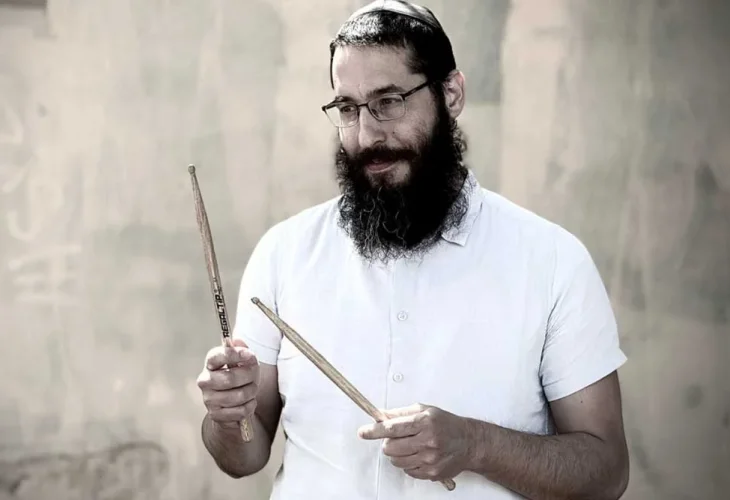 Nadav Karm
In the heart of the Jezreel Valley, among cultivated fields and a rural atmosphere, lies the moshav of Kfar Yehezkel. This is where Nadav Kerem grew up — deeply connected to the land and to the pioneering values that characterized the community, while at the same time strongly drawn to the world of music. He would listen to music for hours on end and later taught himself to play the guitar.
“Kfar Yehezkel is a very Zionist, deeply rooted moshav,” Nadav explains. “I felt very connected to the land and to the pioneering values that came to me from my great-grandfather, who was among the founders of the moshav. I received religious values mainly from my mother. It wasn’t that we strictly observed halacha, but she was the one who gave the home its traditional atmosphere. Back then, I never imagined that tradition would one day become my way of life — certainly not that I would return to Judaism and begin observing mitzvot.”
“I Felt That God Was With Me”
When Nadav was drafted into the army, he was assigned to the ambush unit of the Military Police. After his discharge, he worked in the security field in order to save money for a trip abroad. “Looking back, I know that already in those days questions and thoughts about life began to surface,” he testifies. “I remember myself sitting at the end of a workday and thinking, ‘Why are we even living here?’ But these thoughts remained just thoughts and didn’t lead to any real awakening.
“Immediately after I had saved enough money for the trip, I left everything and flew to South America,” he continues. “I traveled across the continent, and it was fascinating and enjoyable. During the trip I felt that many inner barriers were opening, and that I was also experiencing spiritual moments — real miracles and instances of Divine providence that surprised me greatly.”
What do you mean? Can you share an example?
Sure. I wear glasses and really need them. One day I went with friends to a market in Peru, and when we were in a taxi on the way back to the hostel, I suddenly realized I had left my glasses in one of the taxis. My friends agreed to go back with me, and we retraced our entire route. When we arrived at the market, my heart sank when I saw a sea of yellow taxis — it seemed hopeless to find the glasses. But I knew I couldn’t continue the trip without them, so I prayed to God to help me. Then I felt a kind of impulse to approach a specific taxi that was parked nearby. I simply walked toward it, and when I looked inside, to my astonishment I saw the same driver who had taken us earlier, and on the back seat were my glasses… I opened the door, said ‘hello’ and ‘thank you very much’ in Spanish, took the glasses, and walked away. And that’s just one example — there were many other cases where I felt great Divine assistance, a sense that God was truly with me.”
Did that change something in your life?
“It was inspiring, but in practice nothing really changed, because after some time you ultimately return to routine.”
“God, Don’t Take Him!”
But in Nadav’s case, the real awakening came later. “After I returned to Israel, I felt I needed to go abroad again,” he shares. “So I went to work as a security guard on a cruise ship. There too I had a few experiences that stirred my spirituality, but the most powerful one happened when one day we received an urgent call to come quickly to the ship’s dock.
“I was there with a group of Israeli security guards, all of us after combat service, and we ran in a long line along the huge ship until we reached the dock. There we saw the ship’s doctor performing CPR on someone whose color was changing, while his wife stood beside him screaming, ‘God, don’t take him!’
“I don’t know exactly what religion he belonged to, but time passed and his pulse and breathing still hadn’t returned, and I began praying for him as well, because it hurt me deeply. I saw other guards around me also praying, even though none of us defined ourselves as religious. After long minutes, he suddenly coughed and the color returned to his face. I felt in a very tangible way that all of our prayers had worked — we asked, and God gave him back, against all odds.”
Even then, Nadav says, he still didn’t see a direct connection to God. “I continued working on the ship for a while, then returned to Israel and began studying for a degree in music and percussion. At some point friends suggested that I join them in a musical ensemble. At first I hesitated, since it had been a long time since I had performed in front of an audience, but they persuaded me, and in the end I was happy to join. That’s how our musical group was born. We started moving from event to event, while at the same time I was studying for my bachelor’s degree and gradually drawing closer to Judaism.”
How do you get closer to Judaism through a bachelor’s degree?
“It wasn’t through the degree itself, but thanks to the ‘Nefesh Yehudi’ program at the university, which offered a scholarship to students who studied Judaism. Through the program I had the privilege of learning with wonderful yeshiva students, and above all I was inspired by their character and their attitude. I was hosted by some of them for Shabbat, and their hospitality was incredible. That’s how I progressed further and further in Judaism — being exposed to concepts I had never known or even heard of before, and feeling that they fascinated me and that I wanted to understand them.”
Ten Years of Research
Unlike people who undergo a sudden transformation, Nadav says that for him it was nothing like that. “I felt that before taking something upon myself and committing to it, I wanted to understand it and be sure it was right. As an academic student I was always exposed to skeptical thinking, and I tried to research every detail in depth to see if it was true. During those years I sat and researched many areas — among them the revelation at Mount Sinai, the national revelation to the Jewish people, the chain of generations from Moshe until today, the relationship between Torah and science, near-death experiences, and much more.
“For ten years I researched and read extensively, using many books, including the works of Rabbi Zamir Cohen, which helped me greatly. There was also a period when I studied in yeshivot in Jerusalem and later in a hesder yeshiva.”
Did you get answers?
“Yes, I got answers. But today I know that I went a bit too far, because there’s a limit to how much investigation one can do, especially when it comes at the expense of other things. In any case, eventually there always comes a moment when you have to jump into the water. That moment arrived, and today, thank God, I live a full life of Torah and halacha. In recent years I’ve somewhat let go of the desire to ‘prove’ things, and I focus more on daily learning, prayer, and stories of the righteous — I feel these strengthen me more than anything else.”
His music, too, underwent a noticeable transformation. “Right after I finished my degree, I was offered a position as a percussion teacher at the Jezreel Valley Conservatory, and I’ve been working there full-time ever since. Over the years I also taught myself piano and began composing niggunim (melodies).”
After he published his first niggun, he heard enthusiastic reactions all around him, with one comment repeating itself over and over: “This is a Chassidic niggun!” “Only later did I learn that there’s a specific scale for Chassidic melodies — something I wasn’t aware of at the time,” Nadav reveals. “Later I composed a niggun in memory of a dear woman who passed away at a very young age, leaving behind two orphans. I called it ‘Niggun for Yael,’ and after that more melodies followed.
“In addition, I renew and arrange ancient Jewish melodies, many of them by the Chabad Rebbes. I feel a great privilege in doing this. Alongside that, I’m a partner in an ensemble called ‘The Nadav Kerem Trio.’ We perform in various places and are about to release our first album soon.”
What do you feel during these days of the month of Elul?
“I’m excited to do teshuvah. I love these days when I feel connected to myself, and I also try to be forgiving toward myself and not judgmental. Today it’s already clear to me that returning to Judaism isn’t something that ends in a single moment. It’s part of an entire life journey, in which on the one hand you must be determined to adhere to Torah and mitzvot, and on the other hand understand that it’s a long process — one in which you begin climbing a ladder set on the earth, whose top reaches the heavens. The aspiration is to ascend step by step, gently, and to remember that each person has their own unique journey.”

