
Magazine
Rabbi Shneur Ashkenazi and the Torah Class Watched by Millions
How a Chabad rabbi’s weekly Parsha lesson reached over 25 million views — and why Chassidut speaks so powerfully to our generation
- Hidabroot
- |Updated
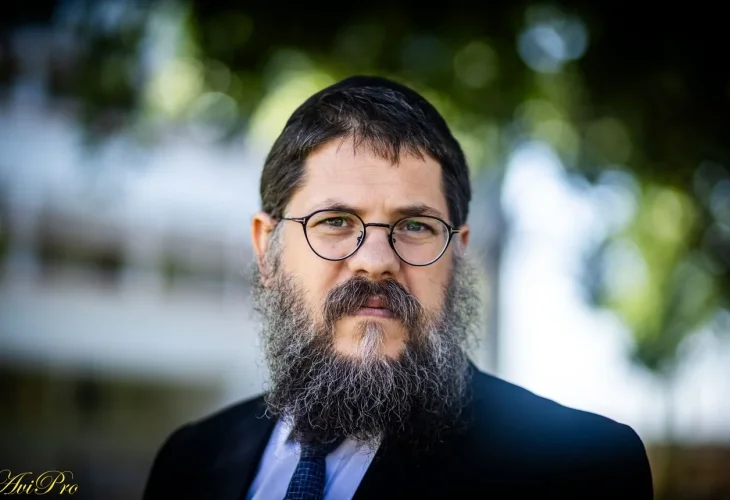 Rabbi Shneor Ashkenazi (Photo: Avraham Friedmann)
A few weeks ago, Rabbi Shneur Ashkenazi’s YouTube channel crossed the milestone of 25 million views. That was only one landmark in the remarkable story of what has become one of the most listened-to and watched Torah classes in the Jewish world.
Rabbi Ashkenazi is involved in several areas: he serves as the rabbi of the central synagogue in Rishon LeZion, edits and writes Chassidic books, publishes a weekly bulletin, and more. But it is clear that the crown jewel of his work is the weekly class he gives on the Torah portions and the Jewish holidays. His lesson is broadcast on his YouTube channel, on Kol Chai radio, on Hidabroot’s site and channel, and in additional venues.
On the day we mark Yud-Tes Kislev, also known as the “Rosh Hashanah of Chassidut,” it is especially fitting to speak with Rabbi Ashkenazi — a Chabad Chassid and expert in Chassidut, about the unique power of this precious Torah.
“Chassidic teaching began to be revealed in the world about 300 years ago through the holy Baal Shem Tov, founder of the Chassidic movement,” he explains. “It spread thanks to the self-sacrifice and righteousness of his extraordinary disciples, among them Rabbi Shneur Zalman of Liadi, the Alter Rebbe, author of the Tanya, who founded Chabad Chassidut. On Yud-Tes Kislev we celebrate the Alter Rebbe’s release from the Russian prison, which was essentially a heavenly sign that permission had been granted to spread the teachings of Chassidut on a broad scale.
“One of the most basic and important foundations of Chassidut is placing the individual at the center, and I try to make sure that this idea is reflected in the classes I give as well. God is constantly advancing the redemption, and we are now at an important stage on the way there. Of course we must not abandon the collective — every Jew is part of Knesset Yisrael, the collective soul of the nation — but the work of the individual is also extremely important as part of the whole.
“People often ask me what the secret of the class’s success is, and I think this is the heart of the matter. When I prepare the lesson, the first and main thing I think about is: How will what I say touch the person listening? How will it feel connected and relevant to their life?
“And in that spirit, I can add that tonight, on Yud-Tes Kislev, I will be participating in the central farbrengen of the ‘Tzama’ fair at Binyanei HaUma in Jerusalem, and there, amid great joy, we will continue engaging with these important messages.”
In recent years Rabbi Ashkenazi’s class has enjoyed major success, but as he admits candidly, it was not always that way.
“I started giving the class in our synagogue in Rishon LeZion, and it was one of many classes given at the time. I invested a tremendous amount in preparing it — three full days every week — but despite that, it received very few views, something like 100–200 per week. The low number disappointed me, and I felt it wasn’t worth the effort. Something wasn’t taking off. In addition, the class didn’t provide me with any livelihood, and a few years ago, on the eve of Passover, I decided I was going to stop giving the class.
“A few days later, I suddenly saw a sentence that hit me — and to a large degree changed my life. I felt as if angels had hung it there especially for me: ‘Never stop doing something you’re good at.’ I knew the classes I had given were good and interesting, and even though very few people watched them, I understood I needed to continue — that this was probably my mission in the world.”
The Rise of the Generations
“On the point I mentioned earlier — the important place of the individual — I think we need to expand much more,” the rabbi continues.
“If I look historically, we need to understand that we are standing at a very significant point in history — a truly formative moment. In fact, all of history is a continuous, gradual descent of the Divine Presence down into our world. As time passes, the stature of the great leaders declines, but the power of the simple person rises.
“The Torah began with four books in which God speaks, and the Book of Devarim is already Moshe speaking to the Jewish people. The prophets who came after Moshe were not on his level, but there were more of them. After that, the Sages did not have the prophetic authority, but they were more numerous. And so it continued through all the generations — and thus the Mishnah, the Gemara, the writings of the Rishonim and Acharonim were written, down to our own day.
“What is unique about our generation is that we are the first generation in history in which each one of us is essentially a broadcast station, a station of light. The influence of each and every one of us can be enormous. We don’t have Moshe, we don’t have Rabbi Yehuda HaNasi, not Abaye and Rava, not the Rambam and Ramban — but every person has tremendous power. Anyone can film themselves on a phone and reach millions of people. That has never existed before. And this is truly preparation for the days of Mashiach.”
Chassidut indeed touches the personal life of every individual, and it seems that this is one of the secrets of its success.
“Exactly. In my eyes, the message of placing the person at the center — and the immense potential impact of every individual, is the essence of Chassidut.
“The most basic statement that stands behind the Tanya appears in the Zohar, in Parashat Terumah. Its content is that when a person subdues the evil inclination and overcomes it, God’s light spreads through all the worlds. God created the world in order to reach new places, and that is what provides Divine delight.
“Some people think a person’s goal is to get through this world with as little damage as possible. But Chassidut comes and says that what seems like hell is actually a Garden of Eden. These are the messages we want to spread more and more. And therefore, we are currently in the midst of a fundraising campaign to strengthen the weekly class. We hope that as many people as possible will help us in the important work we are trying to do.”
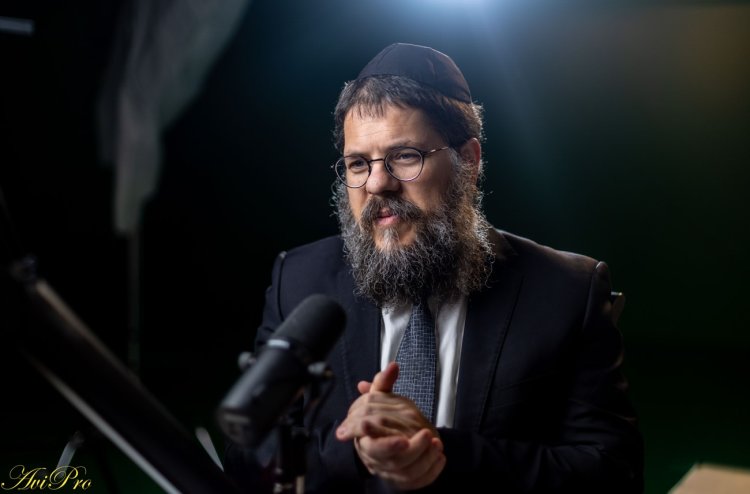 (Photo: Avraham Friedmann)
The Power of Torah
Alongside the great success of his weekly class, Rabbi Ashkenazi speaks candidly about the difficulties that accompany his work.
“There are several challenges I deal with day to day, and one of them is simply being at home. I return home almost every night very late, and I’m hardly with my wife and children. Still, I have a rule: when I’m working, I work all the way — and when I’m home, I’m only home. Thank God we have Shabbat, which helps tremendously in this, and on Shabbat I invest a great deal in the family.
“Another challenge I deal with is my own personal growth — my progress in my private service of God. I ask myself: Where am I challenging myself? How am I conquering goals I haven’t reached yet? How am I bringing God into new places? I try to break boundaries both publicly and personally.
“Recently, for example, I took on learning Chassidut in depth for an hour and a half every morning — to learn deep discourses of the Rebbe Rashab and summarize them. It doesn’t come easily to me, but one of the greatest gifts a Jew can give God is effort and exertion for His sake — fighting against your natural tendencies, for God.”
Speaking of challenging yourself — where did you draw strength from to encourage others during the last two years, which naturally were not simple for you either?
“Indeed, since the outbreak of the war it has been hard for all of us — and still is. But when I saw how much Torah can give encouragement and hope, it gave me more and more strength to continue teaching.
“The war has exacted a very heavy price from bereaved families, from the hostages and their families, from the soldiers and their families — and it is still not over. But within this immense hardship, you can also see that very great and good things have happened.
“At the beginning it was even difficult to say the words ‘Simchat Torah.’ What joy? What Torah? Where was the Torah that protected? October 7 was the day on which the most Jews were killed since the Holocaust. But alongside the enormous pain, we now see how that day has changed the Middle East — and the entire world, for the better. Before what happened, we were caught facing enemies on seven fronts. Today our hand is stronger against our enemies in all those places.
“A Jew, when pressured, reveals his goodness and strength. When he fears for his existence, he begins to ask the big questions — and we saw this across every part of society.
“More than a year ago I was interviewed by a woman who was far from Torah and mitzvot, and she asked why specifically now, when we are so threatened and in the middle of war, many people want to grow their families. I told her: this is the secret of the Jewish people — ‘And the more they oppressed him, the more he multiplied and spread.’ When we have our backs against the wall, we act like lions — at the front and at home.
“In ordinary times we don’t like to say we are a special people, because it’s a demanding statement. But when you see people in many places around the world demonstrating in favor of Hamas terrorists and against Israel, you understand that something exalted is happening — spiritual, beyond rational explanation. The nations sense, deep down, the Jewish soul and the holiness within the people of Israel, and they oppose it because of the light it carries.
“Thank God, the people of Israel, with God’s help, will defeat all its enemies, continue to rise, draw ever closer to our Father in Heaven, and hasten our redemption, which is drawing near.”

