
Magazine
From Secular Activism to Tanya: The Remarkable Journey of Dr. Yechiel Harari
How a former government official and left-wing activist couple became leading voices in Chassidic thought
- Hidabroot
- |Updated
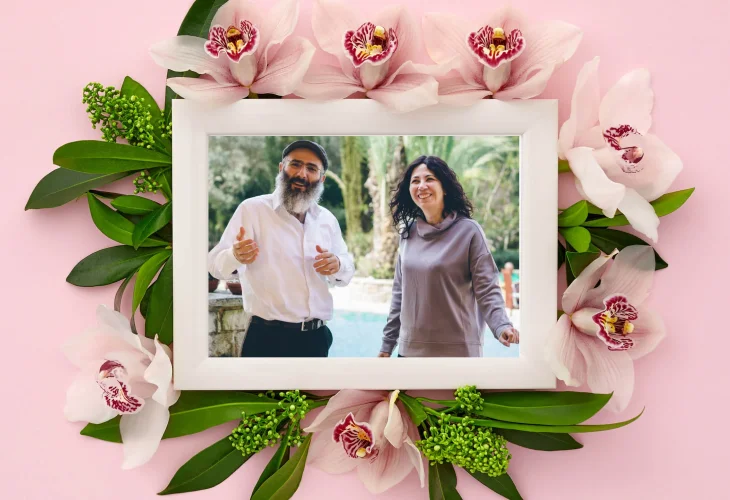 Anat and Dr. Yechiel Harari
Behind Dr. Yechiel Harari — who has written and edited 12 books, including bestsellers, and in recent years has been teaching classes on Tanya — lies a rich life story, parts of which are very far removed from the worlds of media and writing, and even more distant from the world of Judaism.
His wife, Anat, who is also involved in coaching and lecturing based on the Tanya, was herself once very far from Judaism — a successful attorney and an active member of the Meretz party and Peace Now movements.
How did their lives really change? And how is it possible that they — who once stood so far away — became some of the most active lecturers spreading Torah and Judaism?
Life Takes a Turn
Dr. Yechiel Harari completed his PhD at age 29, and shortly afterward served as chief of staff to the Deputy Minister of Industry and Trade. From there he moved on to become chief of staff at the Ministry of Construction and Housing. At age 30, he experienced a dramatic turning point in his life when he began a process of returning to Judaism.
That shift did not prevent him from forging a path as a journalist, teaching at various universities, and writing 12 books.
In recent years, however, he made a surprising turn, devoting himself to a completely different field: teaching the inner life of the soul, Judaism, Chassidut, Kabbalah, and Jewish thought across a wide range of platforms, while also being very active on social media.
“It almost started by accident,” he says. “About three years ago I began uploading my videos to YouTube, and I was amazed to discover that the very first one already had more than 40,000 views. Since then, the numbers have only grown — reaching into the millions. It’s incredibly strengthening and gives you the energy to keep going.”
Anat, Yechiel’s wife, also comes from the opposite end of the spectrum — even more extremely so than her husband.
“For years I was a left-wing activist, a very active social justice fighter against religious coercion, while at the same time studying law and practicing as a lawyer,” she says.
“When Yechiel returned to Judaism, we were already married. I remember the day he surprised me by coming home wearing a kippah. It was a complete shock. I knew he was editing a Torah book and understood that it might influence him, but I never believed it would actually happen. At first, I watched the process he was going through mostly from a distance. It seemed strange, threatening, and very far from me. But after eight years of living as a mixed couple — trying not to interfere with one another, I eventually joined him.
“This wasn’t a decision made in a single moment. It was a process that slowly ripened over the years, as I watched Yechiel from the side, saw what he was going through, read the texts he was editing — many of which dealt with the Tanya, and felt that it was affecting me too. In the end, the change happened almost on its own, until I joined him as well.”
In recent years, Anat decided to follow her husband professionally as well. “I stopped working as a lawyer and closed my office,” she explains. “Since then, we work together.”
Do you miss your previous life?
“Not for a moment. I was very active and loved the action, but those things don’t lack for me at all today. On the contrary — when I sit with women or couples and teach them the Tanya, and even coach them using the method of hitbonenut (contemplative practice) based on Chassidut and Tanya, I feel that this is not just work — it’s a true mission.
“By the way, during the time I was active in the Meretz movement, we lived in Modiin. As part of my role as a lawyer and chairwoman of the allocations committee, I blocked the establishment of the local Chabad House, seeing it as the most dangerous and problematic thing imaginable. Years later, I began drawing close to Chabad Chassidut — and suddenly found myself reaching out to the very same Chabad figures whose activity I had once opposed so strongly.
“That illustrated for me one of the deepest ideas in the Tanya: ‘Reality is never against you — it is always for you, and even those who oppose you ultimately serve your good.’ In the end, I merited to help establish a Chabad House in Modiin in a better location, and it became clear that the reality that initially seemed so difficult ultimately led only to good.”
What is the secret of your approach? How is it that so many people are drawn to the Tanya through you?
Yechiel: “Our approach isn’t new. It’s based on the Jewish bookshelf that has existed for generations. The central idea of Chassidut, which applies across all areas of life, can be summed up in one sentence: Instead of focusing on your weaknesses, difficulties, and failures — try to bring a new, higher light into your life.
“When it comes to education, for example, this means that instead of focusing on a child’s difficulties or problematic behaviors, we learn to see what is good in them — and elevate and strengthen that. In relationships, instead of trying to solve disputes or change your partner’s opinions, we learn how to renew love, how to become excited again. And the same applies to every other area of life.
“Another central thread running through Chassidut is the idea that a person must learn that they are a messenger, placed here by Divine providence, exactly where the Creator intended them to be — in order to bring repair and influence to the world from that place. This understanding has a profound impact on all aspects of life.”
You work together closely. What, then, are the differences between you?
Anat: “While Yechiel tends to focus in his classes on higher-level concepts and presents them in a more analytical way, I translate those ideas into tools suited to the busy daily lives of women who work, raise children, and seek light and renewal — as well as couples who want to learn together how to make their lives better. My goal is to show them that it’s possible in any situation and under any circumstances.”
Recently, it seems that more and more people are studying the Tanya. How can this be explained?
“First of all, it’s not accidental,” they smile. “We, along with many others, are working hard to make these teachings accessible. Once they’re accessible, more people are exposed to them — and they connect.”
Yechiel adds: “The magic of the author of the Tanya lies in the fact that through proper contemplation of his writings, one can transform life into something better and more elevated. The Tanya doesn’t address just one topic or field — it’s built on a very deep understanding of how the soul is structured and how a person’s inner forces operate. When someone truly understands this, they receive a key that unlocks many Jewish treasures — and that’s what creates such excitement.”
Many secular Israelis are also showing interest in the Tanya. How do you explain that?
“Because even a secular person experiences anger or sadness, anxiety or stress,” Yechiel explains. “They’re looking for tools to better understand themselves. When they’re exposed to the writings of the author of the Tanya, it helps them in every area of life.
“The Tanya reassures us right at the outset that we’re not perfect — and that’s okay. There’s no flaw or mistake in that; it simply means there’s work to be done, and that’s very calming. One of the foundational ideas introduced at the beginning of the book is that a person always has free choice, and that it’s always possible to repair and improve. From there, you can work on any area of life — and from personal experience, it simply works.
“That’s why people are so drawn to these teachings today: they offer healing for this generation. From my familiarity with my students, about 70% of those who study with me are not religious at all.
“My goal is not, even for a moment, to turn everyone into Torah-observant Jews,” he emphasizes. “And by the way, that’s not the goal of Chassidut either. The aspiration is to bring a light of vitality — to help people feel alive again, to rediscover excitement in life, and for each person to see the Creator within the reality of their own life. Whenever people ask me who the classes are for, I explain: Anyone who wants to understand their soul and taste from the wellspring is welcome. There are no special criteria — it truly suits everyone.”
“We encounter more and more moving stories from across the entire spectrum of society,” Anat adds. “We’ve met bereaved parents who shared how studying the Tanya gave them strength to go on; couples who were already on the path to divorce but stayed together because of the learning; and personally, I’ve met women who experienced various hardships and, for the first time in their lives, understood that it wasn’t their fault — and were able to break free from a painful cycle.
“This isn’t a one-day process; it’s life work. But already at the very beginning, you can see truly remarkable changes, and that’s incredibly moving.
“People sometimes ask me what method I use, and I always explain that it’s not a method I developed — these are simply the tools of the author of the Tanya. Yechiel teaches purely through study, while I also incorporate CBT tools. And both of us watch with awe and excitement how making this ancient Torah accessible has the power to profoundly help our generation. It’s a privilege to be messengers who bring it to the people.”

