
Magazine
Avraham Fried: Four Decades of Chassidic Music, Faith, and Soulful Song
The legendary Chassidic singer reflects on Yud-Tes Kislev, the power of music during wartime, Chabad niggunim, and his lifelong mission through song
- Hidabroot
- |Updated
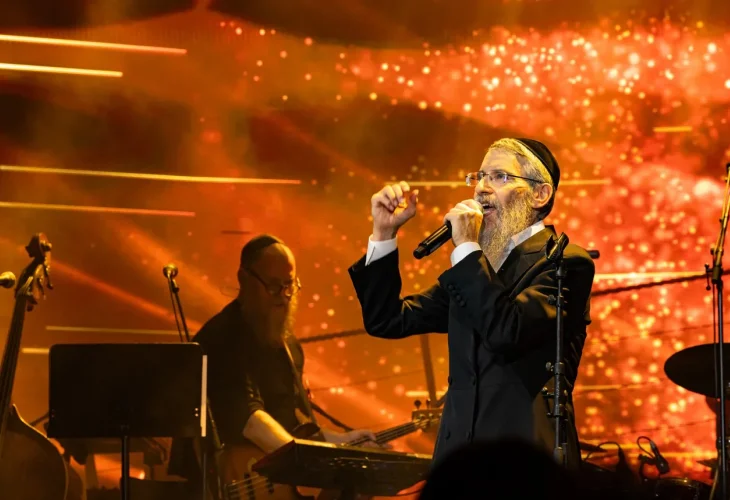 Abraham Fried (Photo: Chaim Tuito)
It’s hard to speak seriously and comprehensively about Hasidic music over the last two generations without mentioning Avraham Fried. Fried, 66, one of the greatest Chassidic singers in Israel and worldwide, has left his imprint on the hearts of millions of Jews across the globe over four decades of career — and from his perspective, it seems this is only the beginning.
“I started singing at a very young age,” Fried says at the start of our conversation, held in the rehearsal studio for the “Tzama” performances, which begin this week at Binyanei HaUma in Jerusalem. “In my parents’ home we would sing the Shabbat zemirot with all our hearts, and more than once neighbors and friends would come to hear us sing. I believe that’s also why quite a few members of my family are involved in music too: my nephew Simcha Friedman is busy almost every night bringing joy to brides and grooms, and he’s released powerful and successful songs; Benny Friedman, who succeeds both in releasing albums and in his performances around the world; the brothers Shmuly and Bentzi Marcus, known as ‘8th Day,’ who are successful with their English songs, meaningful messages, and uplifting, joyful melodies; and Eli Marcus, who thank God is succeeding with his unique style as a singer and as a musician on guitar, piano, and drums. I’m very proud of them, and I wish them blessing and success going forward.”
Why did you change your last name from Friedman to Fried?
“I started singing professionally when I was a yeshiva bochur, and back then it was rare and not so accepted for a yeshiva student to release songs as a solo singer. I wanted to keep my anonymity, so I changed the name. One day I played one of the first songs I released for my learning partner in yeshiva, and he had no idea it was me. Of course I didn’t tell him — I wanted to know if he truly liked this new singer.”
Like the Resurrection of the Dead
In a few days it will be Yud-Tes Kislev, also known as the “Rosh Hashanah of Chassidut,” and as every year, the Tzama festival will take place around that time.
“For quite a few years already I’ve been coming to Israel for Yud-Tes Kislev and the Tzama events, and I truly look forward to it. Yud-Tes Kislev is a holiday that lets the soul celebrate — to step a bit outside the narrowness and limits of the body, and to draw closer to the Creator more easily. On that day the Alter Rebbe was released from the Russian prison, and permission was granted from Heaven to spread the teachings of Chassidut.”
Speaking of Chassidut — how do you explain the great thirst for Judaism since the outbreak of the war?
“What happened on October 7th and throughout the war caused people to feel their souls strongly — that truly divine spark within them. And it happened even to people who were, so to speak, very far away. I see clearly in many people that their hearts are much more open today, that their souls feel more alive. In the last two years at Tzama we sang and rejoiced because we had no choice — we’re not allowed to stop, but our hearts were broken and crushed. This year, with the good news about the hostages returning, the joy will certainly be much greater.
“The events of the war affected me too, of course. I’ll never forget, for example, the invitation to sing for the the military rabbinate camp at the beginning of the war. The grief, pain, and shock that those soldiers carried in that room were at an intensity I never imagined I would encounter in my life. It’s something difficult to describe. Those people had seen up close the most horrifying things a human being can see. And yet, by God’s kindness, with each song we sang, color slowly returned to their faces, their breathing deepened, and little by little they began singing together with me. If I had any doubt until then about the power of song, that performance erased it completely. I watched with my own eyes something like the resurrection of the dead. After an hour and a half of songs, we even began to dance — and those moments stay with me to this day. I would want to give a heartfelt hug to every single soldier of the IDF. You can’t stand in the presence of our soldiers without feeling the enormous privilege they have — to protect the Jewish people and the Land of Israel.”
Over the years of your career you’ve performed in many difficult situations. What gives you the strength to do that?
“Of course, the source of all strength is Hashem, and I thank Him for granting me the privilege of receiving a special mission from the Lubavitcher Rebbe. I’m most moved and strengthened when people tell me, ‘Avraham, you’re the Rebbe’s emissary — a traveling emissary.’ When people feel that way, it’s a sign for me that, thank God, through the singing and through the content of the songs, I’m succeeding in strengthening them and awakening them to feel their souls and draw closer to our Father in Heaven.
“For example, on Purim night last year I was in Los Angeles. I finished Shacharit and was already on my way out of the synagogue. Suddenly a young man approached me and said in Hebrew that he had to share something with me. He told me he had met a wonderful girl, they had been together for a few years, and in recent months they were already preparing to get married. The girl wasn’t Jewish, but it didn’t bother him at all — he was on cloud nine that they were about to get married. A few days before the wedding, he somehow heard the song ‘Yaakov’ that I recorded years ago — a song about a Jewish young man who was offered a marriage to a non-Jewish woman, and because of his self-sacrifice he ran away from the city, and so on. That Israeli young man said the song deeply influenced him. He left that girl, and today he’s married to a Jewish woman and is a father to children. I gave him a big hug. I don’t have words to describe what I felt then — and what I still feel, because of that story.”
When the Soul Shines
Fried, who holds an entire treasury of classic assets in Chassidic music — and yet never stops innovating and creating, speaks with special passion when he talks about the songs he has recorded.
“I pray a lot that what I do will succeed. And at the same time, of course, I also make practical efforts — like vocal training and exercise. In general, every day I think about what the next song I’ll release will be. Usually I turn to well-known composers, but sometimes I also try composing myself.”
In what ways has Chassidic music changed over the last forty years?
“Honestly, ‘Chassidic music’ has become a very general term. Today, someone who wants to listen to Chassidic music has many different shades and styles to choose from. When I started singing, it was very limited, but today it’s a different world, and the abundance only grows from day to day. The level and quality of the material has also risen compared to what it used to be. That said, in my opinion, the main thing is to keep the Jewish flame alive in our music — that it should never, God forbid, lose its wonderful, sweet Jewish taste.
“In addition, I’ve always loved what are called ‘Eretz Yisrael songs,’ and they are very close to my heart. From the time I was a child listening on the radio to Yehoram Gaon, I fell in love with those songs. They were so different from what I was usually used to hearing. Many years after I was first exposed to them, I also performed and recorded some of them. The first Israeli song that broke the dam for me was ‘A Little Leaf of Mine.’ Yishai Lapidot, who wrote and composed the song, sent it to me, and after I performed it, my desire grew to release more songs in Hebrew. And indeed, I released an album of Hebrew songs that was very successful, thank God.”
It seems you have a special place in your heart for Chabad niggunim — almost like something you grew up on from childhood.
“Without a doubt. It’s clear to me there’s something special about Chabad songs, and many people know and feel it. When such great tzaddikim — like the Alter Rebbe and the Lubavitcher Rebbe, for example — compose niggunim, they are aiming toward very lofty spiritual worlds, and it penetrates your heart and your soul. If it’s an upbeat song, the joy of the soul bursts out. If it’s a quiet song, the heart is flooded with longing and yearning. And in general, your desire strengthens to climb higher and higher in serving Hashem. These are songs I’ve loved and known from the day I was born, and they will continue to accompany me for the rest of my life.”

