
Israel News
Netanyahu Cuts Testimony Short, Meets Paraguayan Speaker Inside Courtroom
Judges end hearing early after prime minister says trial schedule forced diplomatic meeting to take place during testimony
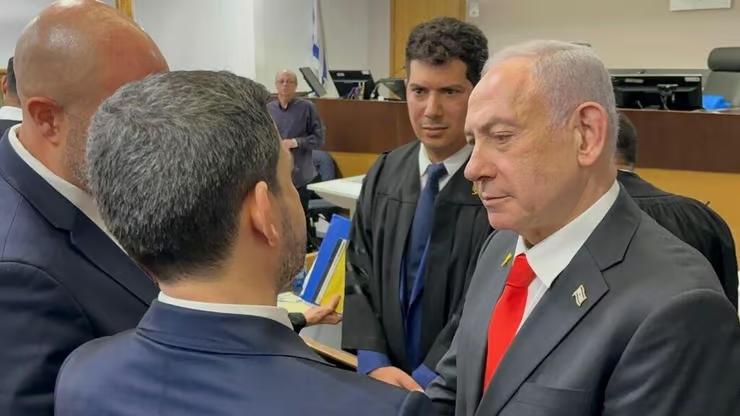 Netanyahu and Raúl Latorre(Photo used in accordance with Section 27A of the Copyright Law)
Prime Minister Benjamin Netanyahu’s testimony in his criminal trial was brought to an early end today after judges acknowledged that diplomatic and security considerations had not been fully presented to the court, a realization that came only after Netanyahu was compelled to meet the Speaker of Paraguay’s parliament Raúl Latorre inside the courtroom itself.
Netanyahu is standing trial on corruption-related charges, which he denies, stemming from allegations involving media coverage and business ties. The trial has been ongoing for years and has required him to testify multiple times a week. In recent weeks, Netanyahu has repeatedly voiced frustration over the scope and frequency of his testimony, arguing that the trial’s schedule makes it increasingly difficult to balance legal obligations with the responsibilities of leading the country.
At the start of the session, Netanyahu openly challenged the court’s refusal to cancel the hearing in advance. “We did not ask for this morning to be free for no reason,” he told the judges. “The speaker of Paraguay’s parliament is arriving. Something very big is happening right now in Latin America, and part of the discussion relates to that. It is embarrassing that I cannot meet with him even for fifteen minutes.”
Netanyahu said that without a change to the schedule, the only way he could briefly meet Paraguayan Parliament Speaker Raúl Latorre was if the meeting took place inside the courtroom. Shortly afterward, Latorre entered the hall accompanied by Knesset Speaker Amir Ohana, creating an unusual scene in which diplomatic protocol intersected directly with criminal proceedings.
Despite the exchange, the judges initially insisted that the hearing continue until its scheduled end at 11:30 a.m. Netanyahu responded that while he was making “a supreme effort” to meet the court’s demands, there must also be consideration for the needs of the state. The prime minister further cited a second diplomatic obligation later in the day: a meeting with Trump’s Middle East envoy Tom Barrack, which he said involved Syria-related issues. “There is another meeting today that will reach the media — a very, very important meeting,” Netanyahu told the court. “This is a meeting of the highest level. Meetings of a prime minister are secured in advance and require preparatory briefings.”
Beyond the immediate scheduling dispute, Netanyahu used the moment to again criticize what he described as the unprecedented burden imposed on him by the trial. “There is something absurd here,” he said. “I am not aware of any case where a person is required to testify three times a week. If we are talking about one law — no one is above the law, and no one is beneath it.”
Following consultations between the judges and the legal teams, the court reversed its position. Judge Friedman-Feldman announced that the hearing would end immediately. “After we were exposed to the full picture, we decided to end the hearing,” she said. “Had we known, we would have canceled today’s session from the outset.”
Coalition figures rallied behind the prime minister. MK David Bitan said that despite medical issues, he appears in court without receiving any leniency, and praised Netanyahu for prioritizing the management of the country.
Raúl Latorre, Speaker of Paraguay’s parliament, also voiced public support, telling Netanyahu: “We are here to express our full support. I admire you and believe you are one of the most important leaders of the free world.”
The hearing ended roughly an hour earlier than planned, allowing Netanyahu to proceed to his diplomatic meetings.

