
Israel News
Netanyahu, Lapid Clash Over Draft Law, Oct. 7 Inquiry, and Pardon Debate in Fiery Knesset Session
PM rejects claims of diplomatic collapse as Lapid accuses him of moral failure and abandoning soldiers
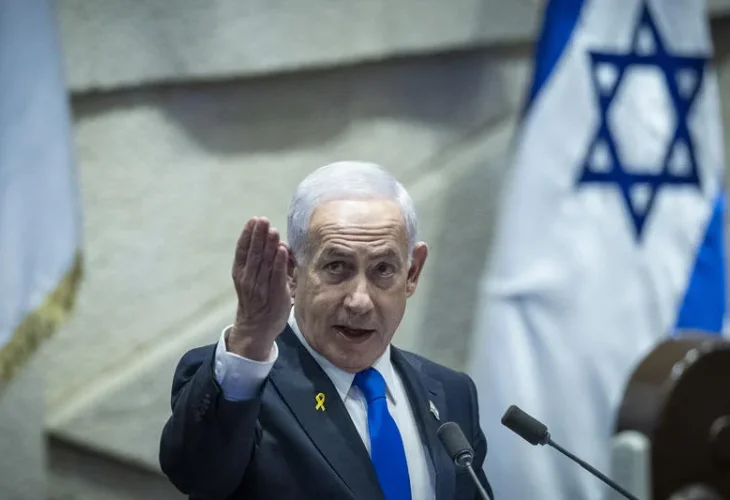 Israeli Prime Minister Benjamin Netanyahu at a 40 signatures debate, at the plenum hall of the Knesse (Chaim Goldberg/Flash90)
Prime Minister Benjamin Netanyahu and Opposition Leader Yair Lapid faced off Monday in a heated “40 signatures” debate in the Knesset, a special session that forces the prime minister to appear after 40 MKs request it, convened under the title “the collapse of Israel’s international standing,” battling over Israel’s international standing, the Chareidi draft bill, the Oct. 7 inquiry, and Netanyahu’s ongoing criminal case. The session, initiated by the opposition, drew sharp exchanges from both sides.
The debate opened with Netanyahu dismissing the opposition’s claim that Israel’s global position had collapsed. He called the argument “completely detached from reality,” insisting that Israel “is stronger than ever” and “the strongest power in the Middle East.” He cited a strong shekel, low unemployment, and German Chancellor Friedrich Merz’s visit to Jerusalem as signs of Israel’s resilience. Netanyahu said these indicators, along with improving strategic ties, showed that “states across the world are seeking closer cooperation with us.”
He pointed to next month’s meeting with U.S. President Donald Trump at Mar-a-Lago, saying it would be “another meeting with my friend President Trump.” Netanyahu added that Israel maintains steady great-power relations and revealed that he holds ongoing conversations with Russia’s leader: “I speak with President Putin on a regular basis,” demonstrating Israel’s diplomatic confidence and international relevance even with powers like the USA and Russia.
Regarding the war, Netanyahu said Israel is nearing the conclusion of the first stage of Trump’s “20-point plan” and is now focused on “dismantling Hamas’s military capability and demilitarizing the Gaza Strip.” He addressed the family of the last remaining Israeli held in Gaza. “We will not relent in the sacred mission to bring Rani Gvili home,” he said.
Netanyahu devoted a large portion of his speech to defending the Chareidi draft law, calling it “the beginning of a historic process to integrate the Chareidi public into IDF service.” He said the proposed targets represent “a quadrupling” compared to previous legislation and argued that “every new regular battalion from the Haredi community frees ten reserve battalions.” The law, he added, protects Torah learners while creating a realistic pathway toward greater participation in the security forces.
On the Oct. 7 investigation, Netanyahu announced that the government is advancing a national commission of inquiry whose formation and composition will be “equally shared between the coalition and the opposition.” He rejected calls for a Supreme Court–appointed committee and claimed opponents want “a rigged process.” The commission, he said, will be independent and credible.
Netanyahu also referenced the controversy surrounding his criminal case, saying the proceedings had already “collapsed” and that he faced a real dilemma between “exposing persecution” and addressing national priorities. “If it comes, it comes… and if not, it doesn’t,” he said, hinting at the debate surrounding a possible pardon.
Lapid took the podium afterward and opened with a direct challenge on the draft bill. “What will you tell the wounded if you pass the draft-dodging law?” he asked. He charged that “the same hand that sent them to war” is now freeing “tens of thousands of healthy young men” through what he called “a political deal of the lowest kind.” Lapid vowed to stop the bill “in committee, in the plenum, in court, or in the streets.”
He then attacked Netanyahu’s proposed inquiry committee: “You’re investigating yourselves — it’s a farce.” Lapid pressed Netanyahu with the question, “Who was prime minister on October 7?” and accused him of ignoring warnings in the months before the attack. “You sleep deeply. Nothing wakes you up,” he said.
Lapid also hit Netanyahu on the pardon question. “You want a pardon? Admit the charges and accept disgrace,” he said, arguing that any attempt to seek clemency without admission destroys public trust. He expanded his assault to Netanyahu’s past decisions: “I have no picture with Arafat,” he said, adding that Netanyahu empowered Hamas, released Yahya Sinwar, and allowed far-right ministers to “empty prisons of terrorists.”
Lapid concluded by calling for a national reset after the war, saying Israel needs “a new prime minister, a new government, and a new direction.”
Other opposition MKs joined the criticism. Avigdor Liberman told Netanyahu, “You bear responsibility for October 7… even if you bring Trump before the elections, it won’t help.” Mansour Abbas warned of soaring violence in the Arab community, saying, “We have over 250 murdered — every year under your government sets a new record.” Gilad Kariv accused him of avoiding accountability: “After every disaster you refuse an independent inquiry.” Efrat Raiten added that Netanyahu surrounds himself with “puppets.”

