
Israel News
EBU Vote Keeps Israel in Eurovision as Spain, Ireland, Slovenia and Netherlands Quit
The European Broadcasting Union adopts new contest rules at its Geneva assembly, triggering a wave of boycotts but confirming Israel for the 2026 competition in Vienna
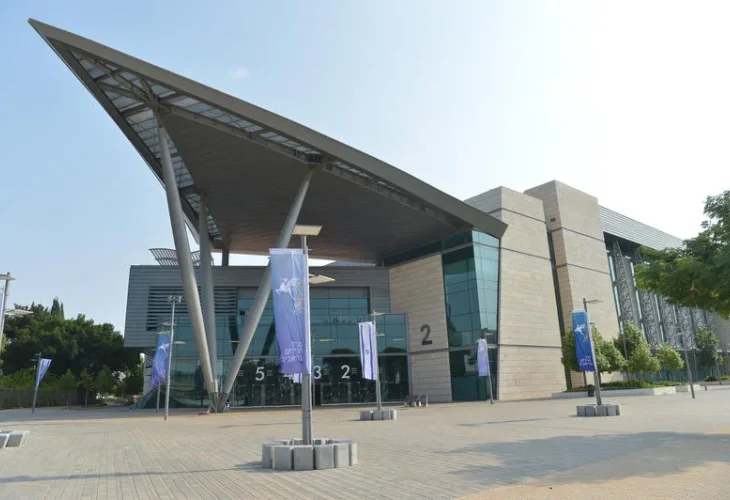 Tel Aviv fairs center (Flash90)
The European Broadcasting Union (EBU) voted on Thursday to keep Israel in the 2026 Eurovision Song Contest, ending months of uncertainty after an assembly debate in Geneva. The decision immediately sparked a wave of withdrawals by Spain, the Netherlands, Ireland and Slovenia, which announced that they would boycott next year’s event in protest.
Eurovision is the annual music contest run by the European Broadcasting Union, the alliance of public broadcasters from Europe and a handful of partner countries such as Israel and Australia. It is not a contest between governments but between broadcasters, each of which sends one artist and one original song to compete on live television. Because the competition draws hundreds of millions of viewers and combines public voting with professional juries, disputes over fairness and political influence often spill into internal debates, most notably Israel’s standing in the contest.
The EBU said that most of its members on Thursday supported a set of new rules proposed last month, and once those reforms passed, there was no need to hold a separate vote on whether Israel could stay in the contest. In the final count, 738 votes were cast in favor of adopting the reforms, 264 against and 120 abstained, a breakdown that meant only 11 countries wanted to move ahead with a direct vote on expelling Israel. During the debate, Germany and Ukraine defended Israel’s right to compete, while Spain, Belgium, Slovenia and Turkey argued that Israel should be removed from Eurovision.
Behind the scenes, Austria, which is set to host next year’s contest in Vienna, warned that it would refuse to host if Israel were expelled, and Germany signaled it would withdraw from Eurovision entirely if Israel was disqualified. Spain tried to gather enough signatures to force a secret vote on Israel’s participation, but the reform package was voted on first, canceling the need for a second vote and securing Israel’s place. According to reports, some delegations left the hall during Israel’s broadcast network “Kan”’s address.
The reforms adopted Thursday are aimed at restoring trust in the contest after criticism over Israel’s strong televote results in 2024 and 2025. Under the new rules, viewers will be capped at 10 votes per person, governments will be “discouraged” from running public campaigns for their entrants.
Israel was represented in Geneva by Kan director general Golan Yochpaz and attorney Ayala Mizrachi. Yochpaz told the assembly that “the attempt to remove Kan from the contest can only be understood as a cultural boycott… Are EBU members willing to be part of a step that harms freedom of creation and freedom of expression?” He said Kan had violated no Eurovision rules and rejected claims of any prohibited activity.
Minutes after the vote, four broadcasters announced they would leave the competition. In Spain, RTVE president José Pablo López said that such a decision “never should have gotten to this point,” adding that sanctions against Israel “should have been adopted at the executive level rather than shifting the conflict to the assembly.” The Netherlands said that participation “cannot be reconciled with the public values” of the organization. Ireland said that taking part “remains unconscionable given the appalling loss of lives in Gaza,” and Slovenia’s public broadcaster said it would not participate “on behalf of the 20,000 children who died in Gaza.”
Other countries are still weighing their decisions. Iceland’s broadcaster said its board will meet next week. Belgium’s French-language broadcaster said Friday it will participate but issued a call for stronger protections for civilians and journalists in Gaza.
Israeli leaders welcomed the EBU decision. President Isaac Herzog said, “Israel deserves to be represented on every stage around the world… I thank the friends who stood up for Israel’s right to continue to contribute and compete at Eurovision.” Foreign Minister Gideon Sa’ar said he was “ashamed of those countries that chose to boycott a music competition because of Israel’s participation,” while Culture and Sports Minister Miki Zohar said that “music connects people and countries.”
The debate over Israel’s participation has intensified since the Hamas massacre of October 7, and the subsequent war in Gaza. For two years, activists and several European broadcasters pushed for Israel’s removal, but the EBU repeatedly maintained that Eurovision is a competition between public broadcasters, not governments, and that Kan continues to meet all participation requirements. No country boycotted the contest in 2024 or 2025.

