
Israel News
Netanyahu Uses First Post-Ceasefire Q&A to Outline Next Gaza Phases and Regional Vision
At a joint appearance with German Chancellor Friedrich Merz, Netanyahu details Phase II plans, rejects Palestinian statehood, and confronts international criticism
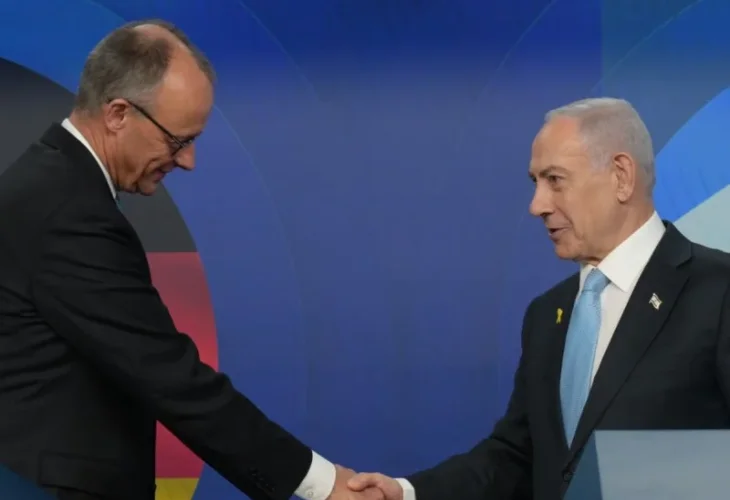 Netanyahu and Merz (Amos Ben Gershom, GPO)
Prime Minister Benjamin Netanyahu held his first open question-and-answer session since the Gaza ceasefire on Thursday, using a joint press conference with German Chancellor Friedrich Merz to lay out Israel’s post-war strategy and respond to international pressure. The appearance came at a politically charged moment in Israel, in his first taking of questions since discussions about a possible pardon deal resurfaced and since renewed debate over the draft-exemption bill, although Netanyahu did not end up addressing the bill.
Netanyahu told reporters that Israel is “almost” finished with the first phase of the ceasefire under President Donald Trump’s twenty-point plan. He said the completion of Phase I hinges on returning the body of Master Sgt. Ran Gvili, the final hostage still held in Gaza. “We finished the first part, as you know, phase one. We’re almost there,” he said.
Outlining what comes next, Netanyahu said Phase II will focus on disarming Hamas and enforcing Gaza’s demilitarization, while Phase III would involve rebuilding and “deradicalizing Gaza,” a process he compared to historical transformations in “Germany and Japan” after World War II. “We shortly expect to move into the second phase,” he said, adding that he views deradicalization as essential to preventing a renewed threat. He intends to discuss both phases with President Donald Trump later this month, including “how to bring an end to the Hamas rule in Gaza, because that’s an essential part of ensuring a different future for Gaza and a different future for us facing Gaza.”
Netanyahu tied his outlook to broader regional shifts, claiming that Israeli actions “battered” Iran’s Axis of Resistance on multiple fronts in Gaza, Lebanon, Syria, Iraq, Yemen, and against the Islamic Republic itself. He said these operations created a moment in which “peace opportunities are at hand,” and that Israel now works for the security of Europe as well. He described his dialogue with Merz as part of this wider realignment. “When I speak to Merz, it’s an honest and open conversation, even when we have disagreements,” he said.
Merz began his remarks by affirming Germany’s historic commitment to Israel’s security, saying the bond “will never be taken for granted.” But he warned that Germany cannot support “formal, political or structural measures” that would move Israeli policy toward annexation of parts of the West Bank. He said the Trump-brokered ceasefire came after a “decisive message” from Washington and that “a permanent peace is possible” if the coming stages are managed responsibly. He also emphasized that Berlin has “no interest” in curbing cooperation with Israel and rejected unilateral recognition of a Palestinian state.
Standing beside him, Netanyahu dismissed the idea of Palestinian statehood at this time. “The purpose of a Palestinian state is to destroy the one and only Jewish state,” he said. “They already had a state in Gaza, a de facto state, and it was used to try to destroy the one and only Jewish state.” He insisted that Israel will maintain security control “between the Jordan River and the sea,” while saying annexation remains “a subject of discussion” for the future.
Netanyahu also confronted growing international criticism of Israel’s conduct and devoted a long portion of his remarks to the history of antisemitism. He spoke about medieval blood libels, pogroms, and the Holocaust, arguing that “those who vilify us can no longer annihilate us.” He accused Hamas of using civilians as human shields and said accusations leveled against the IDF amount to “bogus war crimes.” He criticized pro-Hamas demonstrations abroad and warned that they distort the nature of the conflict.
Turning to the International Criminal Court, Netanyahu attacked ICC prosecutor Karim Khan, calling the charges against Israel “absurd” and claiming the court is “destroying its own reputation.” He tied this to what he sees as a pattern of delegitimization directed at Israel.
Asked whether he might retire in exchange for a pardon, Netanyahu laughed off the idea. “They’re very concerned with my future,” he said. “Well, so are the voters, and they’ll decide, obviously.” He praised cooperation with Germany, saying it may “tower over our previous cooperation,” and ended the briefing by calling Merz “a towering figure.”

