
Israel News
President Herzog Meets German Chancellor Merz in Jerusalem
Merz reaffirms Germany’s support for Israel, addresses the partial arms embargo, and signals deeper involvement in Gaza’s post-war future
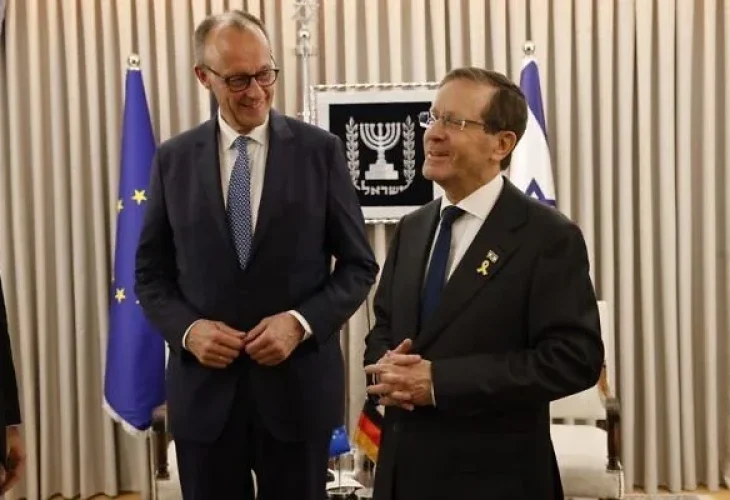 Herzog and Friedrich Merz (Yossi Zamir/GPO)
President Isaac Herzog hosted German Chancellor Friedrich Merz in Jerusalem last night, after the German leader touched down at Ben-Gurion Airport for his first official visit since taking office. The meeting came after heightened regional diplomacy and followed the recent deployment of Israel’s Arrow 3 missile-defense system in Germany.
Upon landing, Merz was welcomed at Ben-Gurion Airport by Foreign Minister Gideon Sa’ar, and noted that “relations between the two countries are on an upward trajectory.” He cited Germany’s recent decision to lift part of its arms embargo, its “clear opposition to all forms of boycotts against Israel.” Sa’ar added that “Germany is a valued friend and partner, and I am convinced that the chancellor’s visit will contribute to strengthening the special relationship between our countries.”
The significance of Merz’s visit was evident even before he reached Jerusalem, as it came immediately after the U.S.-led UN Security Council resolution that outlined international preparations for the “day after” in Gaza, and European debates over Germany’s own arms policy toward Israel. Merz had also met in Jordan a day earlier, where he urged the international community to maintain a political horizon for Palestinians. With fighting in Gaza continuing, both sides viewed his arrival as a chance to steady relations and align expectations for the next phase.
At the President’s Residence, Herzog opened the meeting by highlighting 60 years of diplomatic relations and the deep strategic connection between the countries. “We have become very close friends, and to see the Arrow 3 missiles being installed in Germany to defend Germany and Europe — Israeli-made products — is something very unique, moving, and important,” he told the chancellor. Herzog then pointed to the UN Security Council resolution and said Israel must guarantee that Hamas will not rebuild its military capacity. “In order to move to the next stage, we must ensure that Hamas cannot operate again in Gaza,” he said, adding that this was essential to creating “a new horizon” for Israelis, Palestinians, and regional partners.
Herzog also warned of the broader Iranian threat. “We are facing an empire of evil from Tehran, and that is why the equilibrium in the world is very clear: it’s us defending Europe, and it’s us working very hard to reach the day after in Gaza,” he said.
Merz responded by stressing Germany’s unwavering commitment to Israel, describing the post-Shoah relationship as historic and extraordinary. “We couldn’t meet in more challenging and complicated times,” he said. “We still consider this friendship a miracle.” Addressing Germany’s controversial partial arms embargo, he acknowledged Berlin’s dilemma while assuring Herzog that its support had not changed. “The military actions… confronted us with a dilemma. We had to react, but rest assured that we are still on your side,” he said.
The chancellor reiterated Germany’s positions on Israel’s security and the terms for ending the war. “Israel has the right to defend itself and the right to exist,” he said, adding that “the war will end as soon as Hamas lays down all its arms.” Merz also voiced hope for progress in Judea and Samaria, saying, “We hope the situation in Judea and Samaria will evolve positively,” although repeated Germany’s long-standing support for a two-state solution.
According to Israeli officials, Merz conveyed privately that Germany seeks to play a larger role in Gaza’s post-war arrangements and expressed interest in contributing to efforts connected to the late hostage Ran Gvili. They said he clarified that his comments on a Palestinian state were part of Germany’s routine diplomatic messaging and not intended to provoke public sensitivity in Israel.
Herzog and Merz closed their meeting by agreeing that the relationship between the two nations remains stronger than often portrayed. Merz concluded by saying that “standing with Israel is part of our core DNA and our policies.”

