
Israel News
Isaac Herzog Says His Presidency Has Become Israel’s Most Difficult Due to War, Divisions and Pardon Debate
In a wide-ranging interview, the president discusses the Netanyahu pardon request, U.S.–Israel tensions, rising antisemitism in New York, and the emotional toll of the Gaza war
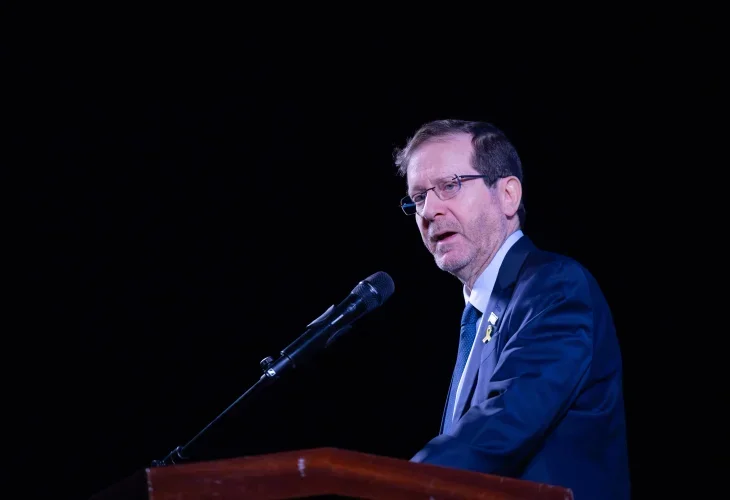 Herzog (Photo: Yonatan Sindel, Flash90)
President of Israel Isaac Herzog says he is carrying “the most difficult” term any Israeli president has faced. “The emotional weight that I carry on my shoulders is huge,” he told POLITICO Magazine ahead of a visit to New York, describing how his presidency has been shaped by Oct. 7 and the war that followed. Herzog said the role was transformed by “the enormous pain we’ve endured” and by meeting “over 1,500” bereaved families whose stories now define his daily work.
That burden now includes decisions no president expects to confront. Herzog confirmed he has received Prime Minister Benjamin Netanyahu’s request for a preemptive pardon, calling it “an extraordinary request” that will be evaluated solely according to “the best interest of the Israeli people.” The move places the presidency at the heart of a legal and political crisis that could shape Israel’s future.
Pressure is also coming from abroad. President Donald Trump has publicly urged Herzog to grant the pardon, an unusually assertive intervention in Israel’s internal affairs. Herzog noted that he “respects President Trump’s friendship and his opinion,” but emphasized that “Israel, naturally, is a sovereign country.” The comment underscored his effort to balance diplomatic gratitude with the independence of Israel’s legal system.
As Herzog weighs this decision, he is also watching American public opinion shift. He expressed deep concern about growing skepticism toward Israel among young Americans, driven in part by social media trends he says distort the conflict. “Is Israel a strategic ally? Yes. Is Israel contributing to American national interests? Absolutely yes. Is Israel a beacon of democracy in the Middle East? Absolutely yes,” he said, arguing that Americans should understand Israel’s role before forming conclusions based on “a very shallow discourse.”
Herzog said this shift has been amplified by “a very aggressive PR machine” supporting Hamas, and by what he called superficial online narratives around Gaza. “We did not seek this war. We did not want this war,” he said, insisting that Israel acted “in self-defense according to international law” and warning that “billions and tens of billions of dollars” have been poured into global efforts to shape public perception. He urged Americans to seek “fair reporting, not fake reporting,” and consider the broader context of Oct. 7.
Those tensions now follow Herzog into his upcoming visit to New York, where he will receive an honorary doctorate from Yeshiva University. The election of Zohran Mamdani as the city’s next mayor has alarmed many Israelis and American Jews. Herzog said he is “extremely bothered” by Mamdani’s statements and suggested that the incoming mayor should “understand better” the perspectives of New Yorkers with “Israel minted in their DNA.”
Back in Israel, Herzog faces internal fractures that have deepened since the war. He highlighted debates over military service, religion and state, and political identity as issues that “go to the core” of Israeli society. He added that the Arab community in Israel has been “an integral part of our society involved in all fields of life,” saying that in the aftermath of Oct. 7, “they clearly have been a very important element in the way we have managed to get through the war.” Herzog said his role is to prevent societal tensions from escalating during an election year and urged restraint in political rhetoric.
During these political pressures, Herzog said he continues to meet Israelis mobilized by the war effort, including elderly volunteers who returned to serve as drivers and suppliers, some as old as 96. “They were truck drivers. They were suppliers of food or ammunition,” he said, presenting them as another example of the national strain and the collective response to the war.
Closing the interview, Herzog returned to the emotional toll of his term and the sense of mission that sustains him. Despite the crises, he said he believes he was placed in this position for a purpose. “I’m very proud that God gave me this role at this moment, to be there for Israel in its most difficult hour.”

