
Israel News
Draft-Exemption Bill Sent to MKs as Israel Moves to Formalize Charedi Yeshiva Student Status
Updated proposal sets strict study requirements, rising annual quotas, and multi-year compliance thresholds as lawmakers prepare for next week’s debate
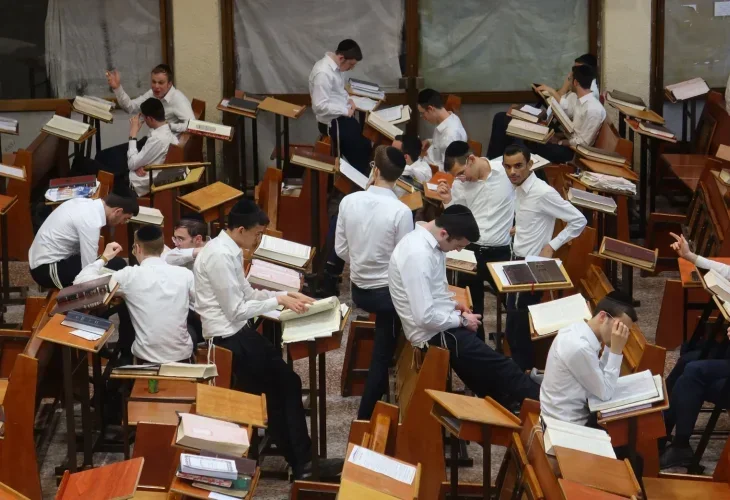 Chareidim in Yeshiva (Shutterstock)
Israel moved forward Thursday with its major draft-exemption plan as the Foreign Affairs and Defense Committee circulated an updated bill that would formally regulate the status of Charedi yeshiva students. Committee head MK Boaz Bismuth said the move begins the final legislative push, following approval from Prime Minister Benjamin Netanyahu and a green light from senior Charedi rabbis. “Here we go — we are moving forward with a balanced and responsible draft law that is good for the people of Israel… a law to stabilize a country,” Bismuth said.
At its core, the proposal creates the first comprehensive legal framework governing how deferments and exemptions apply to Charedi yeshiva students. Today, men who study Torah full-time renew their deferment every year, but the rules were never written into permanent law. There was no clear definition of who counts as a yeshiva student, which yeshivot qualify, or how Israel should enforce the system. This new proposal aims to set everything down in one framework, adding yearly enlistment targets, compliance rules for yeshivot, financial penalties for repeated failures, and service tracks meant to bring more Charedi men into national service.
The updated draft begins by defining who qualifies as a yeshiva student under the exemption framework. To receive a deferment, a student must study at least 45 hours per week in yeshiva, or 40 hours per week for married kollel students. Outside work is not allowed, except in limited cases like married students over 22 who work only after study hours. Both the student and a yeshiva representative must file official declarations confirming the student’s status, and giving false information would result in heavy fines.
The bill gives the Defense Minister authority to maintain the official list of recognized yeshivot and to remove yeshivot if their students do not attend or if administrators explicitly instruct students not to enlist. The IDF would also be required to create designated service tracks for Charedi recruits, including preparatory programs and frameworks designed to protect their religious lifestyle.
A major change in the updated version is that civilian-security national service, meaning in the police, Prison Service, Shin Bet, or Mossad, will now count toward the annual recruitment quotas, expanding the number of eligible service pathways.
The enforcement system relies on rising annual enlistment targets of 5,760 Charedi recruits within the first six months of the law’s passage and 8,160 within roughly eighteen months. After that, the draft sets specific yearly minimum quotas: at least 6,840 recruits in the second year, 7,920 in the third year, and 8,500 in the fourth year. The fifth-year target must be no lower than 50 percent of the annual cohort of Charedi high-school graduates. From the sixth year onward, the Defense Minister will determine the required minimum each year.
The bill also spells out when penalties would start. In the first year, yeshivot must meet at least 75% of their recruitment goal. In the second and third years, they must reach 80%, and from the fourth year onward, 90%. If they repeatedly fall short, their government funding would be cut gradually, dropping all the way to 20% after seven straight years of missing the targets.
Individuals who do not enlist or regularize their status would also face consequences. A student who neither reports for service nor receives an exemption would be barred from obtaining a driver’s license and from leaving the country until age 23. He would also lose access to state scholarships and would be ineligible for civil-service jobs designated for equitable representation.
An official from the Religious Zionism party said, “We are studying the law and trying to locate the pitfalls — we will decide later whether to support it.” Former prime minister Naftali Bennett sharply condemned the proposal, calling it “the most anti-Zionist law ever legislated” and warning that it would dramatically increase reservists’ annual burden. Opposition leader Yair Lapid likewise vowed to block it, calling the bill “an anti-Zionist disgrace.”
Committee hearings begin next week, setting up a decisive national debate over Israel’s long-standing exemption system for Charedi students and the state’s effort to regulate it through binding law.

