
Israel News
Israel Approves National Plan to Complete Aliyah of Bnei Menashe by 2030
Government greenlights multi-year operation to bring remaining 5,800 community members from northeast India, including full conversion tracks, absorption centers, and settlement
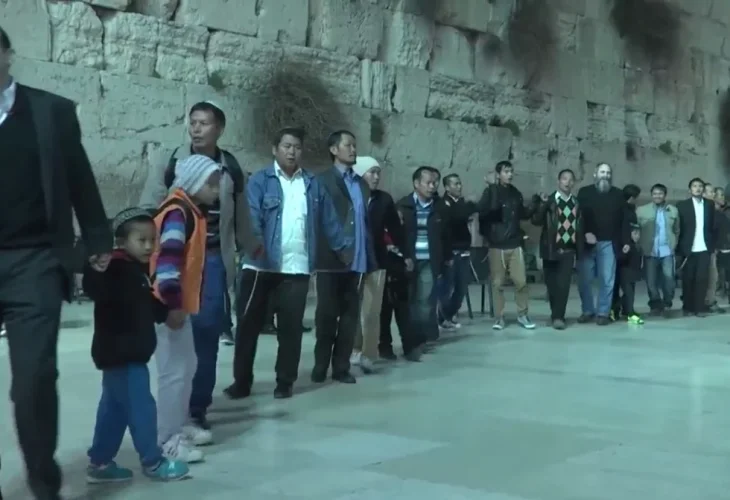 Bnei Menashe dance in the Kotel plaza (Photo: Courtesy of the Shavei Israel organization)
The government on Sunday approved a national initiative to complete the aliyah of the Bnei Menashe community from the Indian states of Mizoram and Manipur, a move officials say will reunite families long divided between Israel and northeast India. The plan is set to run through 2030 and will bring approximately 5,800 additional members of the community who identify as descendants of the Tribe of Menashe.
Under the decision, around 1,200 people will arrive by the end of 2026. Their first months in Israel will include Hebrew study in state-run ulpan programs and preparation for a full state conversion. After completing the conversion track, the new immigrants will transition into schools, workplaces, and long-term housing, primarily in cities across northern Israel. An additional 4,600 community members are expected to arrive by 2030, effectively completing the aliyah of the entire group. The move is both a humanitarian step to reconnect families and part of a broader demographic and economic effort to strengthen Israel’s north. The government plans for most of the new immigrants to settle in Nof HaGalil and nearby cities.
The Bnei Menashe trace their traditions to the lost Ten Tribes, connecting themselves to the Tribe of Menashe, which was exiled from the Land of Israel more than 2,700 years ago by the Assyrian Empire. Over the past twenty years, approximately 4,000 members of the community have already made aliyah under previous government decisions.
Their path to immigration has included a longstanding halachic debate in Israel. Some major rabbis over the decades argued that their Jewish lineage is strong enough to forgo conversion, while others leading rabbinic authorities held that while the community preserves meaningful customs, their status requires a complete conversion out of halachic caution. Building on these assessments in 2005, the Sephardi Chief Rabbi, Rabbi Shlomo Amar, sent a rabbinic delegation to India to study the community’s practices firsthand. He later affirmed that the group possesses Jewish roots but ultimately ruled that the proper route back to the Jewish people is through full conversion.
In accordance with these guidelines, a rabbinical court is set to finalize the community’s conversions as part of the new government plan. A special delegation will depart for India next week to evaluate the eligibility of candidates. Once approved by the chief rabbis, the immigrants will enter Israel on temporary residency status until completing the conversion and citizenship process.
Prime Minister Benjamin Netanyahu praised the decision, saying: “I welcome this important and Zionist decision passed today by the government, which will bring further aliyah of the Bnei Menashe community to the Land of Israel. The immigrants will settle in northern Israel, as part of the government’s policy to strengthen the north and the Galilee and promote its growth. We will continue to act to unite the communities and ensure their successful absorption in Israel.”
Minister of Aliyah and Integration Ofir Sofer said: “Today we are making an important and meaningful decision that will enable the aliyah of the Bnei Menashe community over the next five years. This aliyah joins the blessed wave of aliyah we have seen from many diasporas in the past two years—an aliyah that strengthens the resilience, solidarity, and renewal of the State of Israel.”
Finance Minister Bezalel Smotrich added that: “This is an important Zionist decision that reconnects hearts and families. Completing the aliyah of the Bnei Menashe is the renewed connection of brothers who carried the longing for Zion in their hearts for generations. Their aliyah to the Galilee and their settlement in Nof HaGalil strengthen our presence in the north and the future of the State of Israel.”
The first group of immigrants is expected to arrive early next year, marking what officials describe as the final chapter in a decades-long national effort to bring the entire Bnei Menashe community home to Israel.

