
Israel News
Former Hostage Guy Gilboa-Dalal Describes Abuse and Starvation During Hamas Captivity
In a Channel 12 interview, the 23-year-old recounted two years of assault, humiliation and deliberate starvation in Gaza tunnels
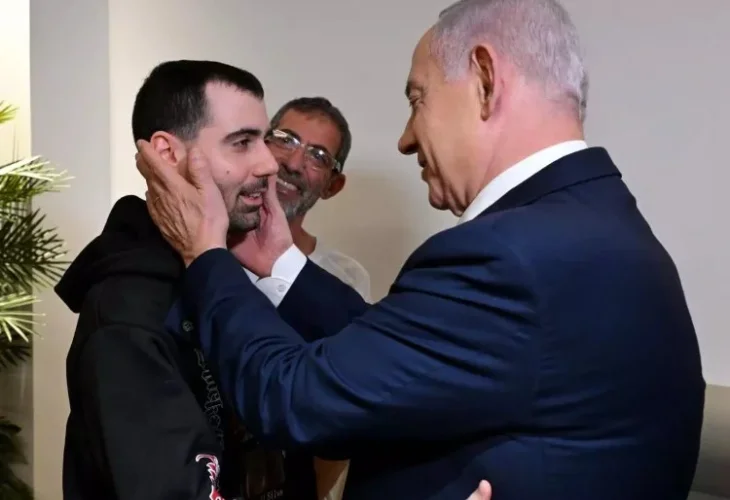 Prime Minister Benjamin Netanyahu with Dalal at Beilinson Hospital (Photo: GPO)
Former hostage Guy Gilboa-Dalal revealed new details Saturday night about the more than two years he spent in Hamas captivity, describing repeated sexual assault, physical abuse and deliberate starvation in a lengthy interview aired on Channel 12. Gilboa-Dalal, 23, who was freed last month under the current ceasefire deal, said the abuse occurred while he was held with fellow captives Evyatar David, Tal Shoham and Omer Wenkert.
The former hostage is the second male captive to publicly disclose sexual assault during Hamas captivity, following Rom Braslavski. Several released female hostages have also described sexual violence and threats. Gilboa-Dalal said he decided to speak out so the public could understand “what really happened there.”
He recalled being abducted from the Nova music festival during Hamas’s October 7 massacre, saying he and other hostages were thrown into a truck and driven through Gaza as civilians beat them. The first stage of captivity, he said, “was horrible,” and he “cried all day long.”
Describing the first assault, Gilboa-Dalal said his captor took him into a room, covered his eyes and taunted him. “He came up behind me. He started touching me all over my body, and I froze in that moment… He started really touching me and kissing the back of my neck,” he continued, adding that his “whole body was burning.” Gilboa-Dalal said the terrorist then pressed a rifle to his head and a knife to his throat and threatened to kill him if he told the others. “Not only did I go through that horrifying experience, but I also couldn’t tell anyone,” he said.
He described a second incident in which the same guard waited for him to finish showering and “grabbed [him] by force.” Gilboa-Dalal said he tried to appeal to the guard’s religious prohibitions: “I said to him: ‘You’re joking, right? This is forbidden in Islam.’” He said the episode ended only when other guards returned, preventing the terrorist from being alone with him again. “But it was always, always in my mind every time I saw him,” he said. Gilboa-Dalal said he feared that if he were separated from the group, “maybe this will become something regular… more invasive,” saying he had “nowhere to run.”
Beyond the assaults, he described constant humiliation and starvation. He said he and the others received food only once every 24 hours, usually a small piece of pita with a tiny amount of food on the side. “We were intentionally starved,” he said. “Every day when we finally ate, we were eating food that was already 24 hours old.”
For much of his captivity, Gilboa-Dalal said he and his fellow hostages were held in a cramped gray tunnel space barely high enough to stand. A camera monitored them constantly, and he coped by imagining it was recording messages to his family. “I imagined I was teaching them how to survive,” he said.
He also described beatings by the same captor who assaulted him. “He put a mask on me… then he grabbed me, threw me on top of Omer, and he started beating us, really beating us,” he said.
Gilboa-Dalal credited his survival to his friendship with fellow hostage Evyatar David. “We were each other’s anchor,” he said. At their weakest point, he added, David helped him with basic tasks. “My muscle mass had dropped so dramatically that I couldn’t move my shoulders.”
When he was released, Gilboa-Dalal took extra time to wash and shave so his family would see him “as a human being.” Returning home, he said, gave new meaning to small things. “The first thing I wanted was to get a Coke… the freedom that came back to me.”
President Isaac Herzog responded to the interview, saying it was “heartbreaking to hear the horrors recounted by Guy Gilboa-Dalal.” He said the former hostage’s willingness “to speak on camera, expose his wounds, and articulate the incomprehensible cruelty to which he was subjected was an act of extraordinary bravery.” Herzog added that “the world must hear his shocking testimony” and told him, “Guy, you are not alone.”

