
Israel News
Thousands Rally in Tel Aviv Demanding a Full State Inquiry into October 7 Failures
At Habima Square, bereaved families, survivors, and reservists accuse the government of creating a political committee to avoid accountability, demanding a fully independent, Supreme Court–appointed inquiry instead
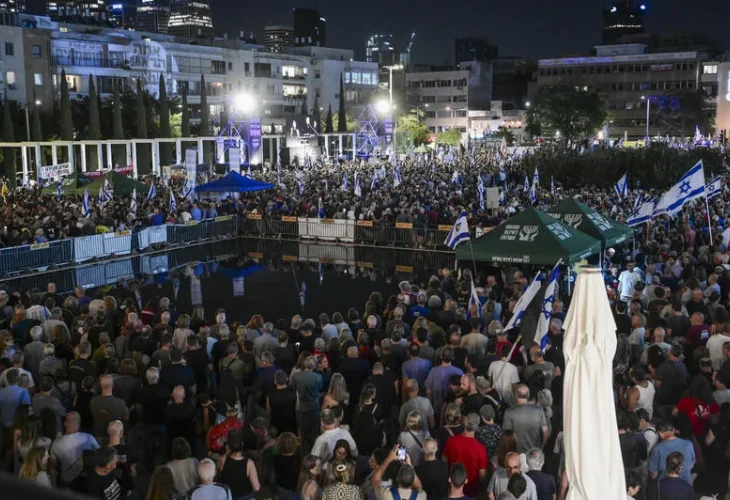 Habima Square in Tel Aviv (Avshalom Sassoni/Flash90)
Thousands filled Tel Aviv’s Habima Square on Saturday night as bereaved families, Nova survivors, and reservists demanded a state commission of inquiry into the failures of October 7. Senior opposition figures including former prime minister Naftali Bennett, Opposition Leader Yair Lapid, Benny Gantz, Gadi Eisenkot, and Yair Golan stood with the families, urging an investigation appointed by the Judicial branch rather than by government ministers.
The demonstration was led by Mao’atzat October, a coalition of bereaved families, hostage families, survivors, and wounded. For more than two years, the group has pressed for a state commission, arguing that only a Supreme Court–appointed inquiry can expose the full chain of failures. Arriving with large crowds, they accused the government of replacing an independent investigation with a political panel crafted to shield those in power.
Rafi Ben Shitrit, a bereaved fatherת told the crowd that “on October 7 the state abandoned its citizens,” warning that a government-appointed committee would “hide the truth.” Yizhar Shai, a former minister who also lost his son, said nine ministers had been tasked with “approving a committee meant to ensure the truth never comes out,” calling on witnesses to refuse to appear before what he described as “a committee of cover-up.” Reservist Yonatan Shilo called on young Israelis to stand together, while Nova survivor Tali Biner said she had lived “two years as a prisoner of lies,” demanding an inquiry that could “look itself in the eyes and say: here we failed.”
At the heart of the confrontation is who appoints the investigators. In Israel, the strongest investigative body is a state commission of inquiry. Unlike a panel chosen by politicians, a state commission is formed by the President of the Supreme Court and usually led by senior judges. These judges hold full legal authority in that they can subpoena witnesses, demand classified material, and require top political and military officials to testify. For many Israelis, this structure is the only guarantee of true independence.
The government, however, has taken a different route. Last week, the cabinet approved what it calls an “independent” commission of inquiry whose authority and scope will be defined not by the courts but by a ministerial panel appointed by Prime Minister Benjamin Netanyahu. The committee has 45 days to decide which events the investigation may review, how far back it can go, and which government or security bodies fall under its scope. Although officials say it will have “full investigative powers,” opponents argue that a committee chosen by the very officials who may be investigated cannot be considered independent.
As part of the reasoning for the government-controlled panel, National Security Minister Itamar Ben Gvir argued that the judicial system itself must be examined, claiming the courts and the Attorney General influenced security policy before October 7.Netanyahu has long maintained that responsibility for the failures lies primarily with Israel’s security agencies, not with political leaders. For the past year, the government has also argued that establishing a state commission “during wartime” was not feasible and would slow military decision-making. With the war now at a lower intensity and public pressure increasing, calls for a full commission have returned to the center of public debate.
Opposition leaders, including Lapid and Bennett, have pledged to establish a state commission on their first day in office if they form the next government as polls show strong public support for such a move.
As the rally ended, Mao’atzat October unveiled a “Wall of Truth,” a large white installation where Israelis were invited to write unanswered questions they want an inquiry to resolve. Families said the wall would stand as “a symbol of the open wound” left by October 7.
With the government advancing its own inquiry and the families rejecting its legitimacy, the battle over how Israel examines the failures of that day is likely to intensify. Protest organizers vowed to keep demonstrating until a full state commission is established.

