
Israel News
Kazakhstan Joins Abraham Accords With Israel
Kazakhstan’s decision marks the first expansion of the U.S.-brokered Abraham Accords in Trump’s second term, highlighting Central Asia’s growing role in Middle East diplomacy
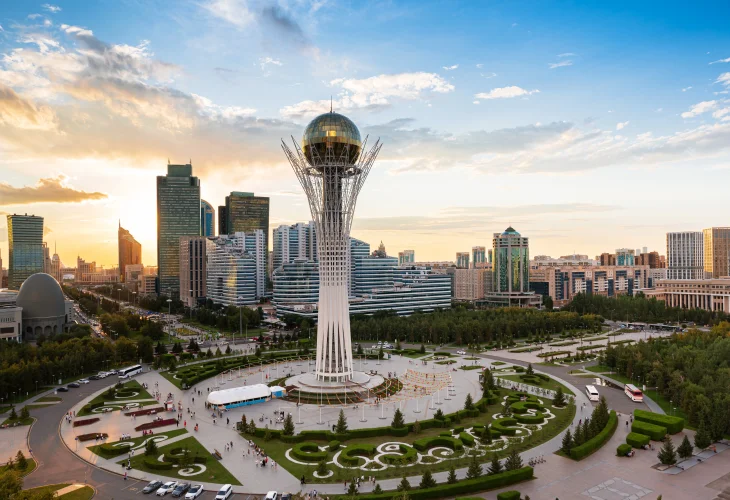 Kazakhstan (Shutterstock)
Kazakhstan will join the Abraham Accords, U.S. President Donald Trump announced Thursday, saying the nation will normalize relations with Israel as part of an expanding framework connecting Israel and Muslim-majority states. The declaration followed a joint phone call between Trump, Prime Minister Benjamin Netanyahu, and Kazakh President Kassym-Jomart Tokayev.
“I just held a great call between Prime Minister Benjamin Netanyahu of Israel and President Kassym-Jomart Tokayev of Kazakhstan,” Trump wrote on Truth Social. “Kazakhstan is the first Country of my Second Term to join the Abraham Accords—the first of many. This is a major step forward in building bridges across the World… BLESSED ARE THE PEACEMAKERS!”
Trump said a signing ceremony would be held “soon” in Washington. The announcement came hours after his White House meeting with Tokayev and the leaders of Kyrgyzstan, Tajikistan, Turkmenistan, and Uzbekistan, part of a U.S. push to strengthen influence in a region long dominated by Russia and courted by China.
Kazakhstan’s government confirmed their joining was in its final stage. “Our anticipated accession to the Abraham Accords represents a natural and logical continuation of Kazakhstan’s foreign policy course—grounded in dialogue, mutual respect, and regional stability,” the statement said.
While Israel and Kazakhstan have maintained full diplomatic and economic relations since 1992, U.S. Secretary of State Marco Rubio said the accords offered “an enhanced relationship beyond just diplomatic relations.” He emphasized that membership connects participating countries in a “unique partnership that brings special economic development on all sorts of issues.”
At the White House event, Trump praised the decision as a major diplomatic breakthrough. “Kazakhstan has officially joined the Abraham Accords—a tremendous country with a tremendous leader,” he said, thanking Tokayev personally. The Kazakh president replied: “You are the great leader, statesman, sent by Heaven to bring commonsense and traditions that we all share and value back into the United States’ policy… Millions of people in so many countries are grateful to you.”
Vice President JD Vance added that “the momentum of the Abraham Accords is alive and well in the second Administration,” hinting that other Muslim-majority countries may join in the coming months.
Since their launch in 2020, the Abraham Accords have served as a cornerstone of Washington’s Middle East diplomacy, normalizing ties between Israel and the UAE, Bahrain, Morocco, and Sudan. Trump has pledged to expand the framework to new regions, and officials say talks with additional states are under way.
Israeli Ambassador to the UN Danny Danon called the step “an important strengthening of the regional alliance for peace.” Israel and Kazakhstan already cooperate in technology, agriculture, and defense. Arabic Post reported that Israeli companies have supplied drones, radar systems, and communications equipment to Kazakhstan since a 2014 defense agreement.
Kazakhstan’s accession carries little immediate impact on day-to-day relations, as there is no history of hostility between Israel and Kazakhstan, but strengthens its image in Washington. On the same day, Kazakhstan also signed a U.S. agreement on strategic minerals, deepening its partnership with the West.
Chief Rabbi Yeshaya Cohen of Kazakhstan said the news was “exciting but not surprising,” describing the country as “a model for peace and tolerance.” Cohen, who has lived in the country since 1994, added: “I see that Kazakhstan is a model for peace and tolerance.”
Though largely symbolic, the decision revives international momentum for the Abraham Accords after expansion paused during the Gaza war. Trump officials hope it will inspire other nations, possibly in Central Asia or the Arab world, to follow.

