
History and Archaeology
The Secret Factory That Saved Lives: A Hidden Chapter in Tel Aviv
Every day, around twenty individuals entered a disguised bunker to manufacture arms and ammunition for Jewish fighters. Each worker was meticulously inspected upon leaving, ensuring nothing could reveal their true occupation. Any mistake could expose the factory to the British—and cost many Jews their lives.
Port of Haifa, the month of Sh’vat, 5696. Three British intelligence officers rubbed their hands together against the winter cold as they watched the approaching lights of a Polish cargo ship. They were confident. A mole within the Jewish underground had provided a detailed report, including photographs of Jews in Warsaw loading crates of ammunition disguised as ordinary goods. The officers knew exactly what to expect—and where to look.
The moment the ship docked, they boarded it, shoved the captain and crew aside, and marched triumphantly toward a specific corner of the hold. Crate after crate was opened amid shouted orders. But as the search continued, the commands turned into curses. There was nothing unusual inside—only mundane merchandise. Nothing incriminating at all.
What the British did not know was that a British intelligence officer named Yehuda Arazi was also aboard the ship. While at sea, he had diverted it to the port of Beirut to unload goods supposedly destined “for the British army.” From there, the cargo was loaded onto British army trucks driven by members of the Jewish underground and sent toward customs in Haifa. Midway through the journey, all crates intended for underground use were quietly unloaded and transferred to private vehicles. By the time the trucks reached Haifa, they were entirely free of prohibited materials.
Those crates contained machinery for ammunition production, secretly purchased in Poland. Now the Jews faced a daunting task: establishing an arms factory directly under British rule—where possession of weapons was punishable by hanging.
A remote, isolated location was selected and deliberately masked with misleading signs. Today, the site of the former Eastern Fair is part of the Tel Aviv Port complex and Reading Park. In the 1930s, it hosted a major international fair and was littered with abandoned pavilions, remnants of exhibitions, fences, and large construction zones. Far from the city center, parts of the area still functioned as an industrial zone—making it the perfect cover.
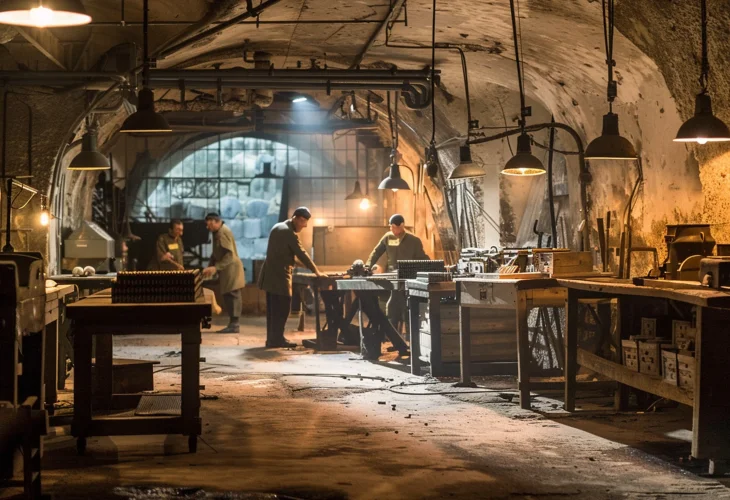
Workers of the underground TAAS organization dug a channel 33 meters long, 8 meters wide, and 7 meters deep. They poured reinforced concrete walls and a ceiling half a meter thick, leaving only two concealed entrances: one through a shaft leading into an oven at the center of a tiny bakery, and the other hidden beneath the floor of a laundry. The channel was then covered with dirt and construction debris, leaving no visible trace of what lay beneath.
Into this disguised bunker—later known as the TAAS Factory—approximately twenty people entered each day to manufacture weapons and ammunition for Jewish fighters. Every worker underwent a meticulous inspection upon leaving to ensure nothing remained that could betray the operation: not a speck of gunpowder in their hair, no trace of copper on their hands, not even a suspicious smell. Any oversight could expose the factory to the British and sentence many Jews to death.
At one point, a worker’s wife noticed an unusual odor on his clothes and strange marks on his hands. Bound by his oath of secrecy, he told her they were residue from spraying the orchard—but she did not believe him, and tension grew at home. Desperate, he turned to his commander for advice. The solution was bold: the wife was brought on a guided tour of the factory. She saw everything, understood the truth, and left filled with pride for her husband’s role in the clandestine effort.
The machines had arrived from Poland—but copper and gunpowder were still needed. Members of the underground seized a British train transporting ammunition to Camp Nahal Sorek. They immobilized the driver and unloaded hundreds of crates of ammunition and tank shells. The copper was melted down and molded into 9mm bullets, while the gunpowder was carefully extracted and reused.
In total, more than one million bullets were produced in the underground TAAS factory beneath the Tel Aviv port. These bullets saved countless Jewish lives—crafted in secrecy, danger, and unwavering devotion by those who risked everything to defend their people.

