
Life After Death
Can the Soul Leave the Body? New Scientific Research Reveals Surprising Evidence
MRI studies, near-death data, and a rare voluntary out-of-body case challenge the belief that consciousness is confined to the brain
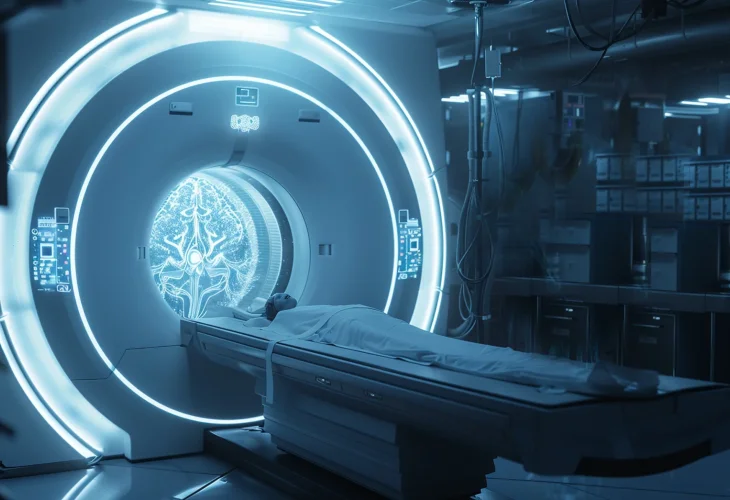
Many people today struggle to accept the existence of a soul. They are not even sure they themselves have a soul, and certainly do not believe that a soul can leave the body. If there is only a body and a brain, then nothing can exist outside the physical form.
Near-Death Research and Consciousness Outside the Body
Professor Claude Messier, a psychologist and brain researcher at the University of Ottawa in Canada, has lectured for years about near-death experiences — in which a person experiences being outside the body. The research and testimonies in this field are well documented.
In his lectures, Messier regularly discusses the work of cardiologist Michael Sabom, who recorded accounts from people who underwent near-death experiences and described scenes seen “from above” — as if by a soul outside the body, that they could not possibly have seen with their physical eyes, which were closed or covered at the time. He also cites studies showing that roughly 7% of the population has experienced this phenomenon in some form.
A Surprising Case: Out-of-Body Experiences on Demand
Messier received a major surprise about a decade ago during one of his lectures. At the end of the talk, a 24-year-old student approached him and said she had experienced out-of-body episodes many times.
"Is that only for people who are close to death? I thought anyone could do it…” she said innocently.
The student explained that as a small child who struggled to fall asleep during afternoon naps, she would practice leaving her body while lying in bed. Today it is harder for her to reach that state, she said, but still entirely possible and still happens from time to time.
Messier was intrigued and wanted to investigate. He does not simply believe stories; he is a scientist. The student came to his lab and while her brain was connected to an MRI machine, she was asked a series of questions, and was asked to intentionally trigger her “out-of-body” experience.
MRI Results: Brain Activity Resembling Clinical Death
According to the MRI results, the same areas of the brain that activate during clinical death lit up during the student's self-induced experience. The temporoparietal junction showed heightened activity — a unique region that, when the central brain is impaired, has an independent functional capacity of its own. This region tends to activate during brain trauma, and is often associated with sensations of separation from the physical self.
This student described that she can perform actions such as moving, lifting up, turning around. These actions give her a real sensation of performing them — all while fully awake, not dreaming. Even when she “turns too fast,” she feels dizzy. Yet her physical body remains completely still.
Published Research: “Extra-Corporal Body Experience”
The research was published in an academic peer-reviewed journal by Messier and his colleagues under the title “Extra-Corporeal Body Experience.” The article documents the experiment, including the following:
Inside the MRI machine, Messier and his partner assigned the student six different tasks. In half of them, she was asked to deliberately initiate an out-of-body experience, allowing them to monitor her brain in real time during the event.
In the other tasks, she was asked to imagine herself performing specific gymnastic movements, or to physically move her fingers and then only imagine moving them.
When she merely imagined doing gymnastics, she reported the feeling was completely different — she did not actually feel the movements — unlike the moments when she experienced the out-of-body state.
Science Still Has Much to Learn About Consciousness
Rakefet Tavor, who reviews phenomena at the boundary of science and consciousness, writes in conclusion: “It appears that when it comes to understanding what truly happens when a person feels their body leave them, science still has a long road ahead before it reaches clear answers. This is even more true when the experience happens voluntarily, without a near-death event triggering it.”
The case demonstrates that the boundary between body and consciousness, or soul, is far from fully understood. And for those who assume the soul cannot leave the body, the evidence continues to raise fascinating and unresolved questions.

