
Torah Personalities
The Story of Shimon HaTzadik: High Priest, Miracle Worker, and Defender of Jerusalem
Discover the teachings, legends, and historical legacy of one of Judaism’s greatest figures
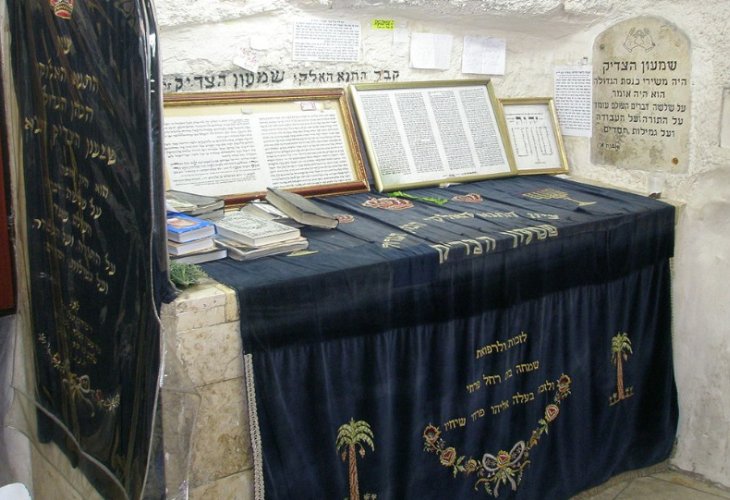 Tomb of Shimon HaTzadik
Shimon HaTzadik was the final member of the Great Assembly, serving as High Priest for forty years and leading the Jewish people in the generation following Ezra.
From Persia to Greece
According to tradition, Shimon HaTzadik served at the end of the Persian Empire and the beginning of Greek rule in the Land of Israel. With the transition of governments, the Great Assembly was dissolved and replaced by the Sanhedrin, headed by the High Priest. Shimon HaTzadik is considered the last of the Men of the Great Assembly.
His Teaching in Pirkei Avot
Pirkei Avot records the famous saying in his name: “Shimon HaTzadik was among the remnants of the Great Assembly. He would say: The world stands on three things — on Torah, on Divine service, and on acts of kindness.”
Miracles During His Forty Years as High Priest
Throughout the forty years he served as High Priest, several miracles occurred consistently (Yoma 39a):
The Yom Kippur goat-lot always appeared on the right side
The scarlet thread always turned white
The western lamp of the Menorah remained lit continuously
The fire on the altar burned more intensely and never died down
His Prediction of His Passing
In Menachot (109b) it is told that in the year of his death, he said to his students: “This year I will die.”
They asked, “How do you know?”
He answered: “Every Yom Kippur, an old man dressed in white would appear to me. He would wrap himself with me, enter with me, and leave with me. This year he entered with me but did not leave with me.”
Indeed, after Sukkot he became ill for seven days and passed away on the 29th of Tishrei.
The Miracle: Shimon HaTzadik Saves the Jewish People
The Talmud recounts a dramatic episode in which Shimon HaTzadik saved the Jewish people from destruction.
The Samaritans slandered the Jews to Alexander the Great, accusing them of rebelling and requesting permission to destroy the Temple. Alexander marched toward Jerusalem to carry out the destruction.
Shimon HaTzadik went out to meet him, dressed in full priestly garments, accompanied by the dignitaries of Israel, each holding torches of fire. They walked throughout the night until dawn.
When dawn rose, Alexander asked, “Who are these people?”
His advisors answered: “Jews who rebelled against you.”
Alexander continued killing Jews — until the turning point: When he saw Shimon HaTzadik, he descended from his chariot and bowed before him.
His officers asked: “Shall a great king like you bow to this Jew?”
Alexander replied: “The image of this man’s face leads me to victory in every battle.”
He explained that in each of his battles, he saw a vision resembling Shimon HaTzadik, and through the merit of that vision, he was victorious.
Alexander then asked Shimon HaTzadik: “Why have you come?”
Shimon answered: “Is it possible that the Temple, in which prayers are offered for you and your kingdom, should be destroyed because of these Gentiles?”
Alexander asked, “Who are these people?”
They answered: “These Samaritans standing before you.”
Alexander said: “They are delivered into your hands.”
The Talmud continues: “Immediately they pierced their heels, tied them to horses’ tails, and dragged them over thorns and briars until they reached Mount Gerizim. When they reached Mount Gerizim, they plowed it and sowed it with beans — just as they intended to do to the House of our God.”
The Origin of the Jewish Name “Alexander”
According to Midrash Rabbi David HaNagid, Alexander the Great asked that his image be placed in the Temple. Shimon HaTzadik explained that the Torah forbids creating statues or images. Instead, he promised that every kohen born that year would be named Alexander.
So it was — and this became the source of the widespread Jewish name Alexander.
The Burial Site
According to tradition, Shimon HaTzadik is buried in Jerusalem near the Sheikh Jarrah neighborhood. The earliest known written testimony about his burial site appears in the year 4535, recorded by Rabbi Yaakov the emissary: “Near Jerusalem is the cave of Shimon HaTzadik and his disciple.”
The grave belonged to a local Arab who charged entrance fees for entry and prayer. In 1876 (5636), the Rishon LeZion Rabbi Avraham Ashkenazi purchased the land from its Arab owners.
The Site’s Importance in Jerusalem’s Jewish Life
Shimon HaTzadik’s burial place held great holiness and significance among Jerusalem’s Jews.
A perpetual lamp burned inside the cave
Weddings were held in the courtyard for those unable to marry within the city
When travel to Meron was difficult or impossible, Lag BaOmer celebrations and chalaka (upsherin- first haircut) ceremonies were held there in honor of Rabbi Shimon bar Yochai
A Special Prayer Recited at His Gravesite
“Master of the Universe, God of Hosts, Who dwells between the cherubim, behold, I have come today to prostrate myself and pray at the grave of Shimon HaTzadik, the High Priest, who served before You in truth and sincerity. Therefore I pour out my supplication before You: just as You heard the prayer of Shimon HaTzadik when he prayed for Your people Israel within the Holy of Holies, so too may You listen and attend in Your abundant mercy to my prayer and my supplication, which I offer here at his grave…”

