
Torah Personalities
Remembering Rabbi Moshe Feinstein: The Humble Giant of Halacha
Stories, legacy, and lessons of the Torah world’s greatest halachic authority
 The grave of Rabbi Moshe Feinstein at Har HaMenuchot
Rabbi Moshe Feinstein was born on the 7th of Adar, 5655 (1895), and passed away on the 13th of Adar II, 5746 (1986). He is buried on Har HaMenuchot, near the grave of Rabbi Aharon Rokeach, the Belzer Rebbe.
He was one of the greatest halachic authorities of the post-Holocaust era, serving as the chairman of the Moetzet Gedolei HaTorah of Agudath Israel of America, and as Rosh Metivta of Tiferet Yerushalayim in New York.
Halachic Authority
Rabbi Feinstein was recognized as the leading and most influential Charedi halachic decisor in the United States. His thousands of halachic responsa were distributed throughout the Jewish world and collected in his monumental series Igrot Moshe. He addressed modern issues such as new technologies, medical ethics, and foundational principles of Jewish belief.
He was also deeply active in public affairs and education in the Jewish community and spoke sharply against the Reform and Conservative movements.
A Great Leader
He was revered as one of the greatest Torah leaders of the generation.
Part of the inscription on his tombstone reads: “A pillar of halachic guidance, the Gadol HaDor, a father to sages, foremost in all matters of holiness… He bore the burden of the generation with wisdom and courage, with limitless patience… He stored treasures of Torah in his sefarim Igrot Moshe and Dibrot Moshe, bringing new light to Torah learning and understanding… He humbled himself for every needy and downtrodden soul… Holy, pure, wise, and humble; beloved above and beloved below.”
He published his halachic work Igrot Moshe (nine volumes), containing halachic responsa that became cornerstones of modern halachic decision-making. He also published Derash Moshe on derush and aggadah, and several volumes of Dibrot Moshe, shiurim on various Talmudic tractates.
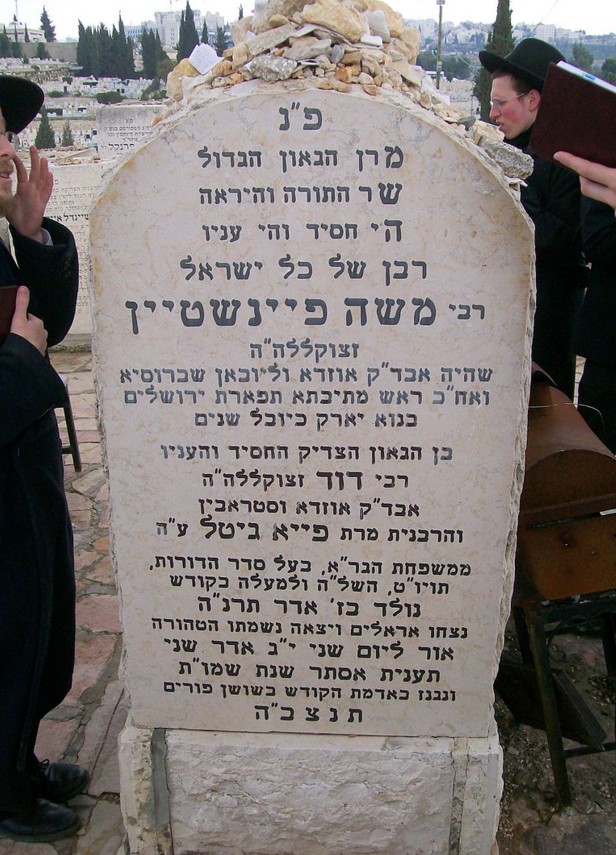 The grave of Rabbi Moshe Feinstein at Har HaMenuchot
Extraordinary Character and Humility
Every Shabbat afternoon, Rabbi Moshe Feinstein would eat seudah shlishit at the yeshiva and recite Tehillim. One Shabbat, a child with a mild cognitive impairment watched him closely. The child came over and tilted Rabbi Feinstein’s Tehillim to the right. Rabbi Moshe continued reciting. The child then tilted the book to the left. Rabbi Moshe continued. The child finally turned the book upside down — and Rabbi Moshe still continued reciting calmly.
Seeing this, someone scolded the child harshly: “Stop! Let the Rosh Yeshiva pray!”
Rabbi Moshe immediately turned to him and said: “He’s just playing with me, and I enjoy it. I love him as if he were my own child.”
Then he embraced the child and kissed him.
A Story of Sensitivity
A pregnant woman who had become seriously ill was told by her doctor that she must terminate her pregnancy or risk her life and the life of the baby. Her husband went to a rabbi, who told him: “This is not a question for me — this is for Rabbi Moshe Feinstein.”
They went to Rabbi Feinstein’s simple home. He asked the woman to repeat every word of the doctor carefully, asked several clarifying questions — and then said: “Do not be afraid. You will give birth to a healthy child. Your own health will also improve. There is no cause for worry.”
Months later, every detail came true — the woman recovered and delivered a healthy baby.
One year later, on the child’s first birthday, the phone rang in their home. Rabbi Moshe Feinstein was on the line.
He asked about the mother and the baby and then said, to their astonishment: “Today is the child’s birthday. May Hashem send health and blessing to your entire family.”
Empathy even during personal grief
On the day of the funeral of his beloved son-in-law, Rabbi Moshe Shisgal, another funeral was taking place in the neighborhood. In the middle of his own family’s tragedy, Rabbi Feinstein turned to accompany the other deceased as well.
He explained: “Everyone is coming to my son-in-law’s funeral — this causes neglect of the other deceased. If I go, others will follow, and the deceased will receive proper respect.”

