
Personal Stories
The Rebbe's Personal Guidance Charted My Life's Course: A Captivating Interview with Nechama Shaki
At 16, she embraced Judaism and later married the late Professor Avner Hai Shaki. Throughout her life, she dedicated herself to learning, supporting her husband, and investing in her family. What did the Lubavitcher Rebbe request from her? A captivating interview with Nechama Shaki.
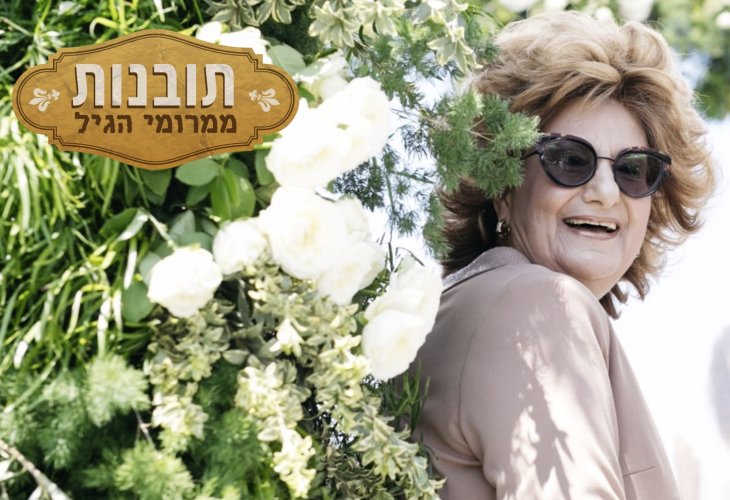 Nechama Shaki (Photo: Private Album)
Nechama Shaki was born in Egypt, where her father David worked as a bank director. Her grandfather, Chaim Sevilia, was born in Safed, but because of famine in Israel he moved down to Egypt, where he married her grandmother, also named Nechama. With the establishment of the State of Israel, the whole family merited to return, and her parents settled in Tel Aviv.
Because of her father’s academic education and his fluency in four languages, he became the manager of the Bank Leumi branch at the airport, and the family enjoyed an excellent financial situation. At age 16, Nechama met the teacher who would become the most influential figure in her life, and thanks to this teacher she returned to a life of Torah and mitzvot. Later she went to France to study for her first degree, and when she returned to Israel to study law, she met one of her lecturers, Dr. Avner Shaki, and married him.
Avner, who had been widowed earlier, was already the father of four children, and after their marriage the couple had three more children together. After decades of teaching and research at the Faculty of Law, Avner joined the National Religious Party (Mafdal) and was elected Deputy Minister of Education, a minister in several governments, and a Knesset member in various roles. Together, they also ran the Institute for Family Research, and today Nechama serves as chairwoman of the institute.
In the early years she focused mainly on raising the family, a role she considers the most important and central in her life. In addition, her great love for learning drew her to be constantly involved in study. For over 20 years she has been giving Torah and faith classes in different places, and this, she says, is a direct result of a rare encounter she and her husband merited to have with the Lubavitcher Rebbe.
An event that left a deep mark on me
“Every person has circles in their life that leave a significant imprint and guide their path. The first and most significant ‘ring’ in my life – in every sense of the word, was my marriage to Avner, of blessed memory. I was 23, a law student, after my studies in France.
I met Avner, who had been my law lecturer the previous year, at the bar mitzvah of mutual friends. Our conversation captivated me – almost hypnotized me. His knowledge, his broad horizons and his charm fulfilled my deepest need for curiosity and a desire to learn.
Avner was then a widower with four children. On the face of it, there was no chance that my parents would agree to such a match. But Hashem had already arranged that a certain time before, my parents had moved to Canada because of my father’s job. Despite their very natural resistance as parents, we received their blessing to marry, and baruch Hashem we merited to live together many long years, with partnership and love.
Because of Avner’s many public roles, I wondered what kind of shared path we should choose, among all the famous examples of public figures and their spouses. I saw women who constantly accompanied their husbands, others who completely ignored that world, and still others who, alongside their husbands’ top positions, built their own separate, high-profile careers, often without any real consideration for the children or the family.
For me it was quite clear: I would invest in our home – our fortress – and join Avner only at public events where I was specifically asked to attend. For that reason, when I was asked to serve on the presidium of the Emunah movement, I agreed.
In addition, one day I received an unusual, unplanned visit from Avner’s secretary, who was curious to meet the wife whose opinion he took so much into account, even though I had never once set foot in his office. Our life was a life of sharing in everything, and Avner was always the first one I told everything to, the one I consulted, and whose view I sought on every matter.”
The meeting with the Lubavitcher Rebbe
“The next major formative experience was our meeting with the Lubavitcher Rebbe.
At that time there was a fierce public debate in Israel over the question of ‘Who is a Jew’. Avner crisscrossed the country from Metula to Eilat, warning about the terrible danger inherent in changing the halachic definition of this question. Again and again he explained the destructive consequences such a change could bring: splitting the Jewish people and renewing lists of genealogical rolls for every Jew and Jewess.
The Rebbe, who knew and followed what was happening in Israel day by day and hour by hour, heard about Avner’s activities and invited us to a private audience with him. Many people asked to come and receive his blessing, but presumably only a few merited such a personal invitation.
We were told to come to 770 at midnight, and the meeting took place from 12 at night until 3 in the morning. By the way, this was a record length for a private audience with the Rebbe, which usually lasted only a few minutes. The Rebbe, who had also studied at the Sorbonne, spoke with us in French, and I was deeply moved when he asked me, ‘Help Avner spread Judaism in the Holy Land.’
From the moment he asked me that, I decided to take it upon myself. Since then, I’ve been giving lectures and classes for decades, in Israel and abroad. Over the years we merited two more three-hour private audiences with the Rebbe, and each time we left amazed and strengthened, with a desire to take on more missions and more challenges.
In his great nobility, the Rebbe also shared with me the words of the Arizal: ‘In the merit of righteous women Israel was redeemed from Egypt, and so it will be in the final generation.’”
The thing I am happiest I did in my life
“My greatest joy is that I merited to return to a life of Torah and mitzvot, and that from then on my life has been guided by both awe and love of Hashem.
At about age 16, when I was studying in a secular high school, I had a Haredi teacher for Bible. For me, that meant my existing knowledge and worldview were shaken. It forced me to ask myself: How will the years of my life really look? The inner struggle raised the question: Who is more right?
Am I right, and God forbid the Torah learning is just a collection of legends? Or am I the one who is mistaken, and the Torah is true, eternal and holy?
Little by little I came to understand that the Torah is pure truth, and I was ready to live a fully observant life, keeping Torah and mitzvot according to halacha. At first, my steps were hidden. I would wake up earlier than usual to pray, and I secretly observed certain things without anyone noticing. But when my family did find out, they received it with great love.
My parents were traditional, and my father would sometimes lead prayers as a chazzan in various places, without taking payment. My father made sure to instill in us that giving to others is the greatest ‘wage’ a person can dream of. In general, my parents were truly exceptional people all their lives. Our home was almost like a community center for every new immigrant or anyone in need, and the results of that education can be seen in the unity between us siblings and in the love that has remained between us even after their passing.
Today I am happy and moved to see that over the years more members of my extended family have also come back to Torah – and that I had the privilege of being the first of them.”
Something I regret
“That Avner is not here with us today to experience the growth and development of the children, grandchildren and great-grandchildren, and to rejoice in the simchas of our family, our people and our land. In my heart I feel he is always here, very present in our lives – in the way we speak and in the way we raise the children and grandchildren, who are growing up in his light.
After his passing, I went through a very difficult time of coping. One example: the house we bought on Mount Zion, at the request of the government after the Six Day War. In those days, they literally begged Jews to purchase properties there, legally and properly, to strengthen Jewish presence, and we responded out of a sense of redeeming the land.
Suddenly, I was hit with a petition to the High Court of Justice – a thousand pages long – from a Christian Crusader association in Israel, claiming that Mount Zion belongs to the Christians. At that point I was just beginning to advance a patent I had invented. It had won first place in national competitions and was already on supermarket shelves. Together with Avner’s death, all of this created such an overload that I felt a bit like ‘David facing Goliath’.
I decided to give up on fully developing the patent and turned to our friend, the late Dr. Yaakov Weinroth, for help. Dr. Weinroth took full responsibility for that complex case and, as one of Avner’s doctoral students, handled it free of charge.
After three years, all three Supreme Court justices ruled in our favor and rejected the Christian association’s petition – something far from obvious in our times. Since then, the patent has been abandoned, but the house on Mount Zion is ours, sealed with the stamp of a High Court decision.”
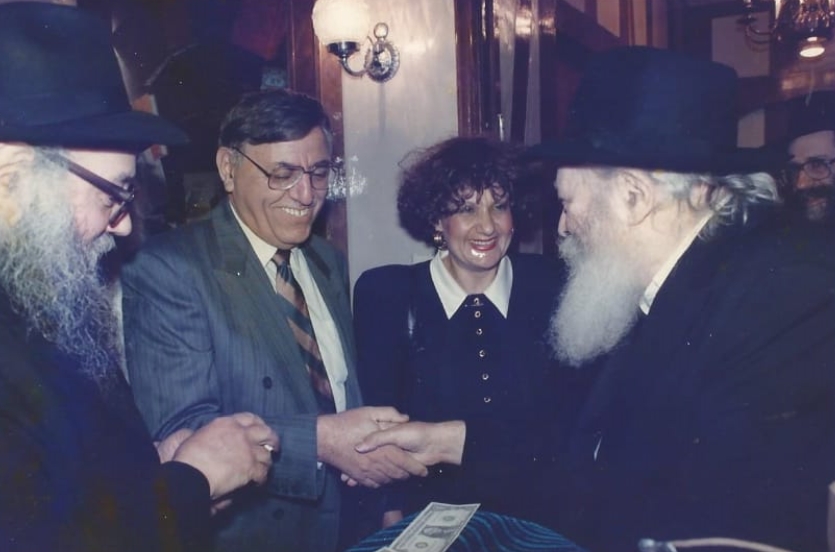 Meeting the Rebbe (Photo: Private Album)
A major insight I gained in life
“That any public activity you do gives you far more than it gives the recipient. The ability to touch people and extend a helping hand, to live connected to your surroundings, to learn and to teach – that is a multi-layered, endless learning program for the giver.
We saw this in our own lives when we moved to Ramat Aviv, next door to Yitzhak Rabin and Shimon Peres. At that time there wasn’t even a single regular minyan in the area. You literally had to stop people on their way to the beach so there would be at least one person to answer ‘Amen’ to Kaddish.
Today, our community ‘Heichal Chaim’ has three minyanim every morning, children’s classes, and I established a regular women’s shiur and monthly gatherings. This community was built by Avner – starting from people who came by chance for a bar mitzvah, a family occasion, or a memorial service, and were captivated by Avner’s unique and inspiring derashot on Shabbat and festivals. Over time they became regular members of the community.
Avner himself was careful to give a daily shiur every morning after the early minyan, despite his many obligations. After his passing, our children, may they live long and well, continued that tradition.
All of this followed the winning formula of the Lubavitcher Rebbe: when you send people on shlichut (outreach), you send a couple and children to uplift the place. In this way, the shluchim connect with the people there and serve as a living example of Jewish life.
The root of the word shaliach (שלח – ‘send’) can be reversed to spell chalash (חלש – ‘weak’), because every mission you take on actually gives you strength, power and renewal. With that feeling, I’ve built the foundation of my life and continue to walk that path.”
A person who left a powerful impression on me
“The Haredi teacher who was sent to teach in the secular high school where I studied, whose name I unfortunately no longer remember. She was the ‘maestro’ who redirected the entire course of my life, and to her I owe the happiness of my faith. To her – my thanks and my blessing.”
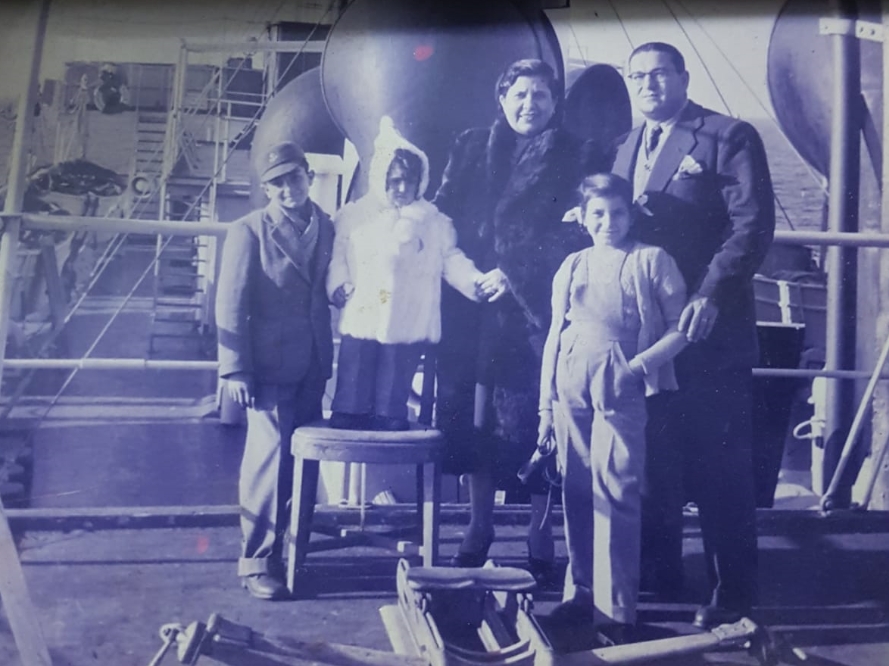 (Photo: Private Album)
What changed after age 70?
“The numbers of a person’s age belong, in my eyes, to the ID card. I look at it with a smile. In practice, baruch Hashem, I get to continue doing everything I love and have been doing until now. I keep learning in two different midrashot, I continue giving lessons, I write and publish ‘Pearls of Torah’ that are also translated into English around the world. I keep helping and advising people in general and in the community in particular, I invest in my family, and I only pray that all this good should continue forever.”
“I chose to keep my base of activity in Ramat Aviv, even though my fledglings have flown the nest, and at the same time to hold on tightly to the wonderful bond I have with our descendants and their children – who are, without any competition, number one in my life.
When they ask, ‘Do you have time for…?’ the answer is always, ‘Yes – I’ll make time.’
For my 70th birthday, my loved ones organized an unforgettable Shabbat, filled with divrei Torah, compliments and deeply moving blessings. My eldest daughter wrote to me, among other things, that ‘the world could not exist without you’. A grandson from the USA wrote, ‘Meeting my grandmother leaves a mark on everyone who meets her.’ It was incredibly emotional.”
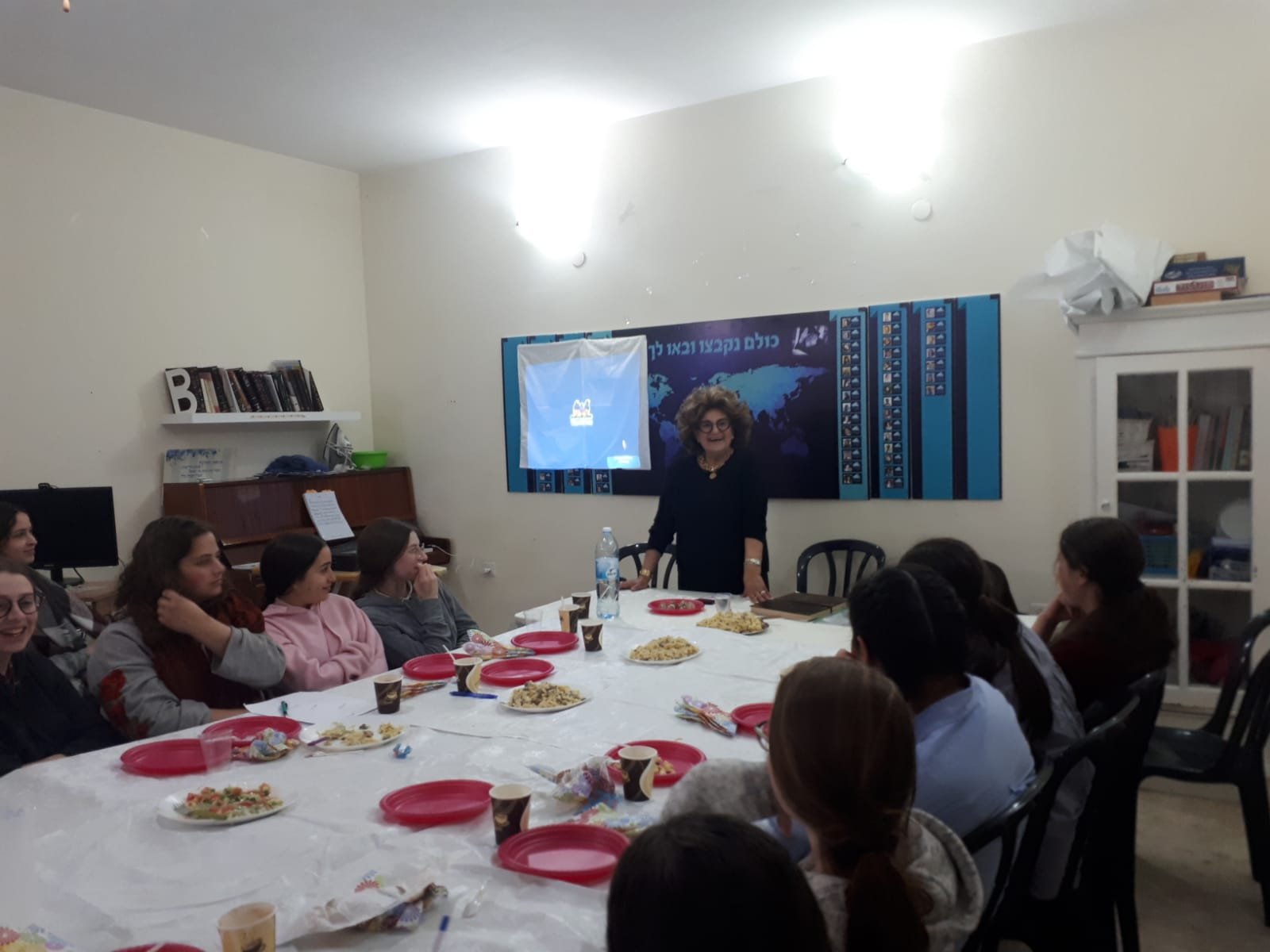 (Photo: Private Album)
I would like to ask forgiveness from…
“Anyone who would tell me they were hurt by me. I certainly never intended to hurt anyone, not to judge and not to label – not in thought, not in speech and not in action. One of the key points in my life’s path is to succeed in bringing joy to others.
‘Same’ach’ (שמח – ‘to make happy’) has the same numerical value as Mashiach (משיח – ‘Messiah’). Bringing joy to one another surely brings the redemption closer for Am Yisrael.
From the height of my years, what matters most to me is…
“My family members. I love them very much and I’m always available for them. Each and every one of them is amazing and precious in my eyes.”
What I would like to leave in this world
“I would like to leave behind this ‘segulah’: the knowledge and faith that in Hashem there is only eternal good. He is our strength, our stability, our joy, our love, our compassion, and the source of everything a person truly wants, needs and dreams of.
In my humble opinion, corresponding to the 13 Principles of Faith that the Rambam wrote and published, I can speak of 13 direct outcomes of faith in the One God – outcomes that I believe in, live by, and am privileged to teach, at least in their foundations.”

