
Personal Stories
Born Survivors: The Remarkable Story of Three Babies Who Escaped Mengele and Survived Auschwitz
How three pregnant mothers hid their condition, endured death marches, and brought new life into the world as WWII came to an end
- Hidabroot
- |Updated
 Three babies born at the end of World War II to mothers who survived Auschwitz
When the infamous Dr. Mengele asked Priska Löwenbeinová, a Jewish teacher from Slovakia, whether she was pregnant, Priska quickly answered no. In truth, she was two months pregnant — but although she did not yet know about the brutal experiments Mengele performed on pregnant women, her survival instinct told her to hide her condition.
So she joined the forced laborers in Auschwitz while carrying a baby — and she was not alone. Two other women also underwent Mengele’s medical inspection and denied being pregnant. Like Priska, they chose to lie.
These two were Rachel Friedman, who had come from the Łódź Ghetto, and Anka Nathanová from Prague. All three were deemed fit for labor and assigned to work producing airplane parts for the German Air Force, the Luftwaffe.
The three women never met in the chaos of Auschwitz, and each concealed her pregnancy as best she could. In the starvation conditions of the camp, this was not difficult. They worked grueling seven-day weeks and prayed for a miracle.
The book Born Survivors, documents the extraordinary miracles that happened to these three women.
They were taken on a death march deep into Germany — but survived. Near the end of their pregnancies, the German guards already knew about their condition — but with Allied forces bombing Dresden to rubble and Germany’s surrender imminent, the guards no longer dared to harm them.
When Priska went into labor, the SS women agreed among themselves that if she gave birth to a boy, it meant the war would continue, but if she gave birth to a girl — the end of the war was near.
Priska gave birth to a daughter, and in a grotesque scene, the German guards celebrated: “It’s a girl! Peace is coming!”
On April 14, however — just two days after the birth — came the order to evacuate the relatively healthy women by train to Mauthausen. Priska and her tiny newborn daughter, Hana, were put on the train — along with Rachel and Anka, both of whom would give birth in the coming days.
 Three babies born at the end of World War II to mothers who survived Auschwitz
Three Babies Born at the End of WWII
Three mothers — who had survived Auschwitz — gave birth to infants weighing barely a kilo and a half.
The new mothers and their fragile newborns suffered hunger, disease, and infections until May 5, 1945, when the U.S. Army’s 11th Armored Division liberated Mauthausen.
Priska, who had been a language teacher and spoke English, immediately called for help. Medical personnel rushed to assist the dehydrated, starving mother and child.
They treated the babies’ infected wounds and administered a new, revolutionary drug — penicillin. Rachel and her son Mark, and Anka and her daughter Eva, were also treated with great care and slowly began to recover.
None of the three women’s husbands survived the war.
Priska returned to Bratislava, became a professor of languages, and never remarried. She died in 2006 at the age of 90. Her daughter later made aliyah after the Prague Spring in 1968 and eventually moved to California.
Rachel remarried, made aliyah, and later moved with her son and new husband to America. She died in 2003 at age 84.
Anka returned to Prague, remarried, and later moved to Britain. She died in 2013 at age 96. None of the three women ever had additional children.
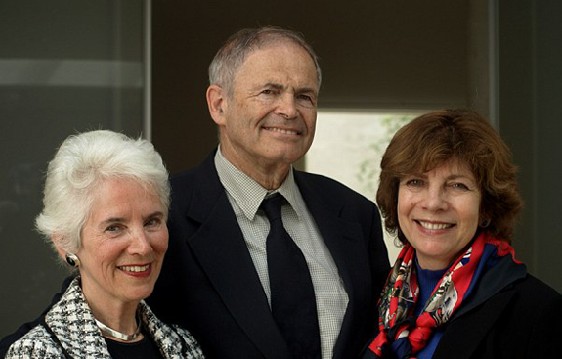
The three “miracle babies” met for the first time five years ago at a survivors’ reunion. Only Anka was still alive then — long enough to learn that she had not been the only pregnant woman to survive Auschwitz with her baby, and to meet the other two “infants.”
Today, all three of the once-tiny babies have grandchildren of their own.
They have remained connected ever since discovering the parallel journeys of their mothers, and reunited in Auschwitz — at an event marking 70 years since the liberation of the camp, and 70 years since their personal miracle.

