
History and Archaeology
A Jewish Woman’s Diary from 350 Years Ago: A Rare Window into Jewish Life in Europe
An extraordinary autobiographical journal revealing daily life, community, and history of Western European Jews in the 17th century
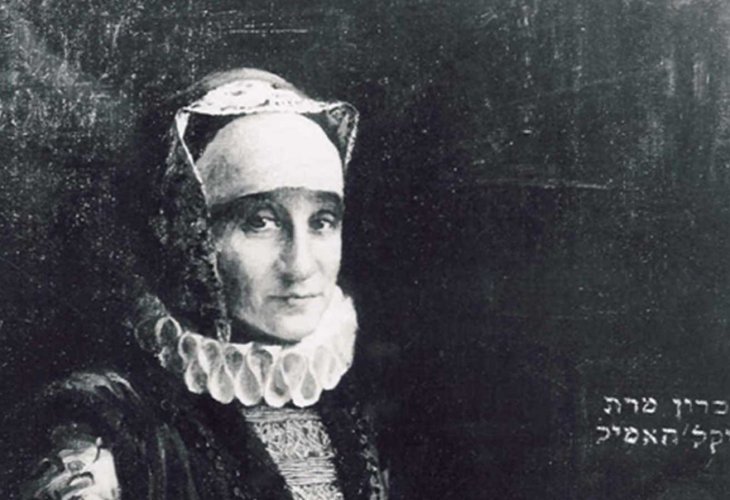 Glikl of Hameln
About three hundred and fifty years ago, a young Jewish girl kept an autobiographical historical diary describing her life from childhood within the Jewish communities where she lived. That girl later grew into a respected and well-known businesswoman, yet she continued writing her diary throughout all stages of her life. The diary gained wide recognition and became one of the most fascinating historical works for understanding Jewish life during that era.
Marriage at a Young Age and Life in Hameln
Glückel married at the age of fourteen, something that was sometimes customary due to various governmental decrees, and moved to the town of Hameln, her husband’s hometown. She describes the move as follows: “I was a child… and had to remain without my father and mother in a foreign land among strangers… I was young and raised from my earliest years in comfort… to come from a city like Hamburg… Hameln itself is a miserable and uninteresting place. But none of this mattered to me because of the pleasure and kindness I received from my father-in-law.”
Hameln was indeed a small and impoverished town, known today primarily from the famous German folktale “The Pied Piper of Hamelin.”
Leaving Hameln and Moving to Hamburg
Glückel did not follow the Pied Piper. She soon left Hameln, finding little interest there, and moved with her husband to the large city of Hamburg. There, her first daughter was born, whom she named Zipporah (Tsippor). At the same time, Glückel’s own mother also gave birth to a daughter, and the two women recovered together: “We had no rest because of the many people who hurried to see the marvel: mother and daughter, both having given birth, lying together in one room.”
Glückel writes warmly about her home life: “I believe there was no happier or more loving couple in the world than we were.”
Fear of Plague and a Mother’s Pain
One day, a purulent wound was discovered on her daughter Zipporah. Panic spread through the Jewish community, fearing the city’s duke might hear of a possible outbreak of disease. It was decided to secretly send the child with a maid to a village outside the city to stay temporarily in a non-Jewish home. Glückel writes: “We were forced to send away our beloved child… I leave it to any decent father and mother to judge what our state of mind was… I do not believe that Avraham our father suffered more at the Binding of Yitzchak than we suffered at that moment.”
After she recovered, Zipporah was allowed to return home.
A Prestigious Wedding in Amsterdam
Zipporah married at the age of twelve in Amsterdam. By then, Glückel was already a prominent businesswoman. Among the distinguished guests at the wedding were Prince Karl Emil and Prince Friedrich, sons of Frederick William, the Great Elector of Brandenburg.
A Successful Jewish Businesswoman
Glückel owned a stockings factory that sold luxury stockings in major markets across Europe, including Amsterdam, Leipzig, Berlin, Vienna, Metz, and Paris.
War, Flight, and Acts of Kindness
She describes the outbreak of one of the wars against the Swedes: “It was a terribly cold winter… Suddenly, on Shabbat morning, the cry arose: ‘The Swede is coming!’ It was early morning; we were still in bed. We all jumped up — alas — naked and exposed from our beds and ran into the city, where some of us found shelter with Spanish Jews and others with townspeople.”
Later, they returned home, and ten refugees were hidden in their attic.
The Rise of Shabbatai Tzvi
Glückel also records the early spread of belief in Shabbatai Tzvi’s messianic claims: “The young Portuguese men would dress in their finest clothes and gird themselves with a wide green silk sash — the garment of Shabbatai Tzvi. Thus they went with drums and dancing to their synagogue… Some of them, poor souls, sold everything they owned—house and property—hoping day after day to be redeemed.”
A Lasting Historical Treasure
Glückel was married for thirty years and gave birth to fourteen children. Her writings vividly portray Jewish communal life in Western Europe about 350 years ago and serve as an extraordinary historical source for understanding the events of that era. Her diary is infused with deep knowledge of the Bible, Midrash, and ethical teachings, giving her words enduring spiritual and historical significance.

